The spacecraft
| Spacecraft facts | |
| Spacecraft bus dimensions | 1.5 x 1.8 x 1.4 m |
| Spacecraft mass | 1270 kg (including 93 kg of payload and 570 kg fuel) |
| Thrust of main engine | 400 N |
| Attitude thrusters | |
| Solar arrays |
|
| Power storage | Three lithium-ion batteries |
| Antennas |
Two high-gain dishes, HGA1 = 1.3 m diameter, HGA2 = 0.3 m in diameter, 2 low-gain antennas |
Structure
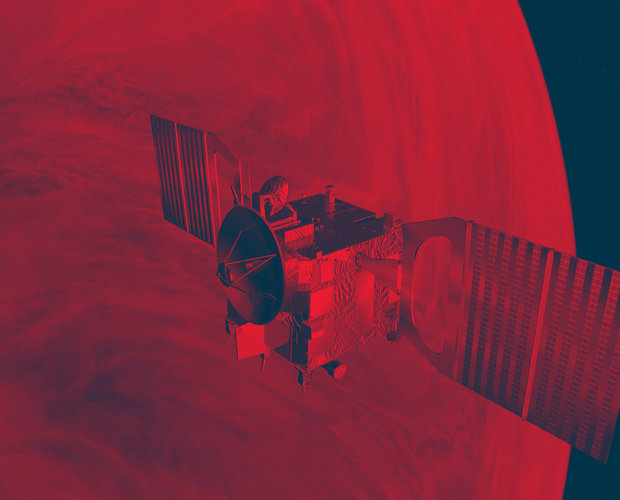
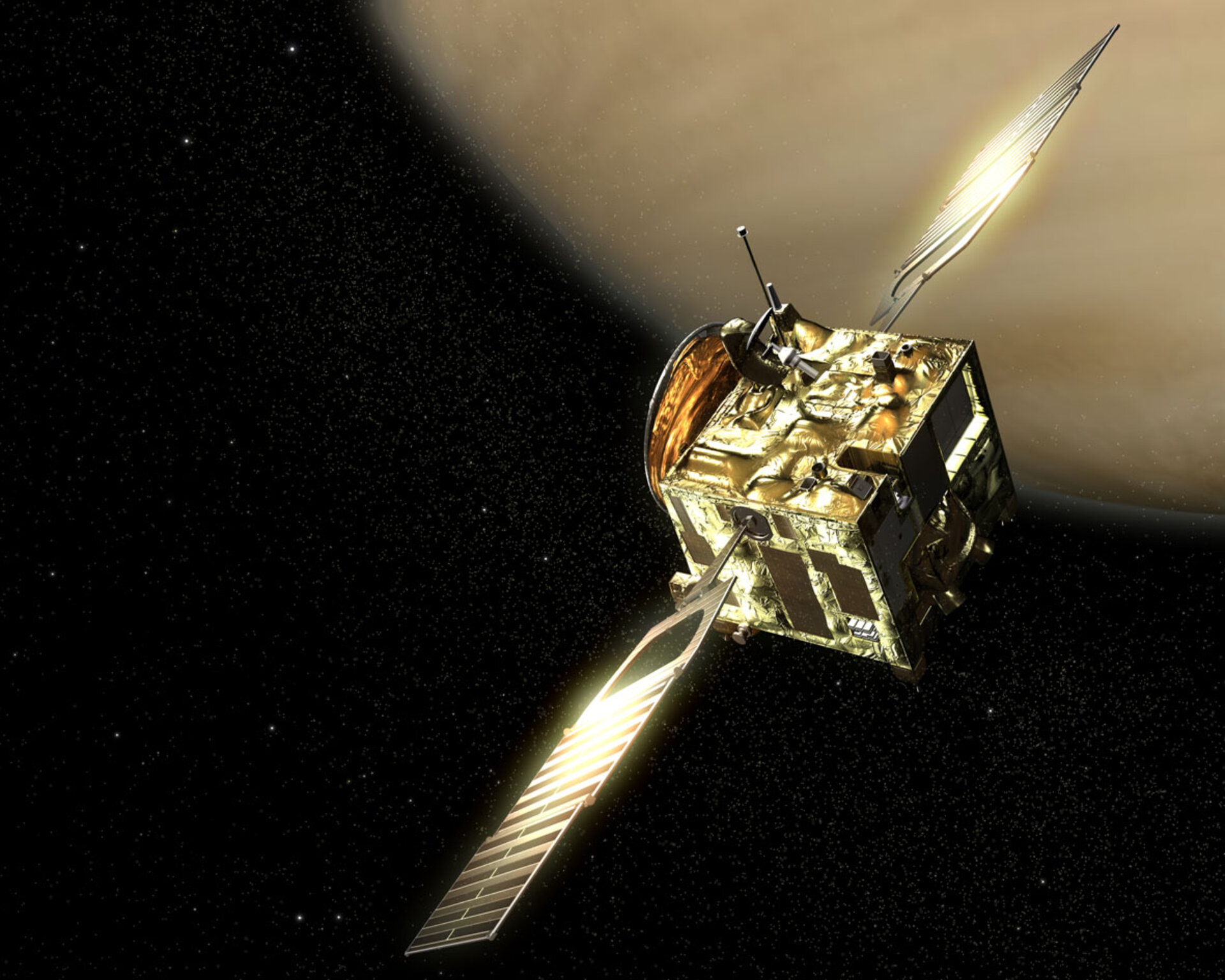
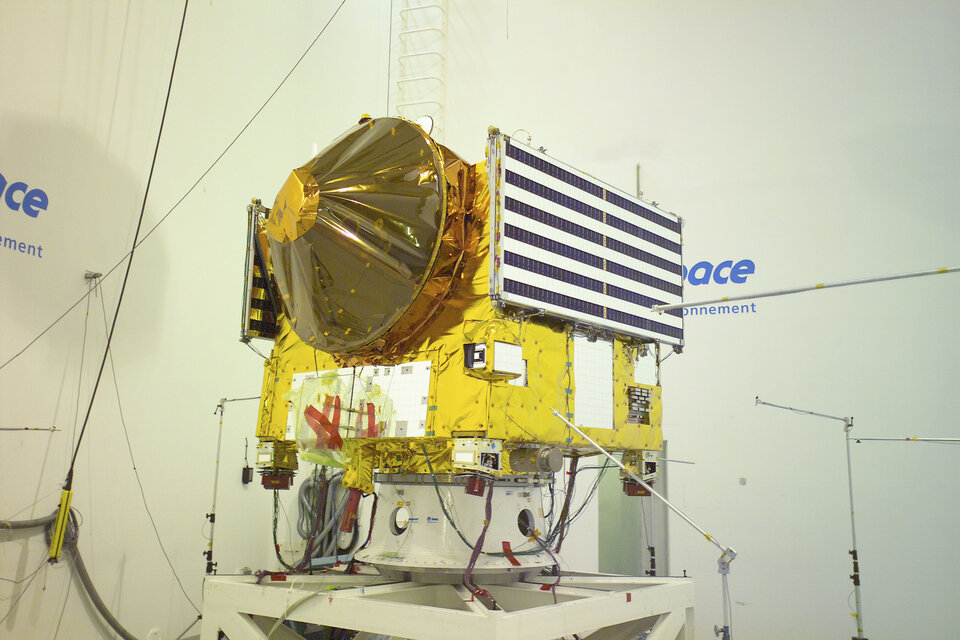
The Venus Express spacecraft was a virtual twin of Mars Express. The spacecraft body itself, termed a ‘bus’, was a honeycomb aluminium box about one and a half metres wide. With its solar arrays extended, it measured about eight metres across.
As with Mars Express, the scientific instruments were mounted in the bus. Only minor changes from Mars Express were required to accommodate the revised instruments payload, which was concentrated on three sides of the spacecraft.
However, the environment of Venus is very different from that of Mars. This required some design changes that made Venus Express more suited to operating around Venus.
Thermal control
Flying to an inner Solar System planet like Venus, at half the distance to the Sun as compared to Mars, meant that the effect of solar illumination and ionising radiation on the spacecraft was much higher. In fact, the heating of the spacecraft was four times greater at Venus than at Mars.
To keep Venus Express within temperatures that were safe for the spacecraft, the radiators on the spacecraft surface were increased in area and efficiency. The spacecraft coating, called ‘multi-layer insulation’ or MLI, was composed of 23 layers, packaged differently from Mars Express.
Moreover, for Venus Express, the MLI was gold instead of black, which provided greater capability to reflect radiation away. In general, Mars Express was designed to keep warm while Venus Express was modified to stay cool.
Power
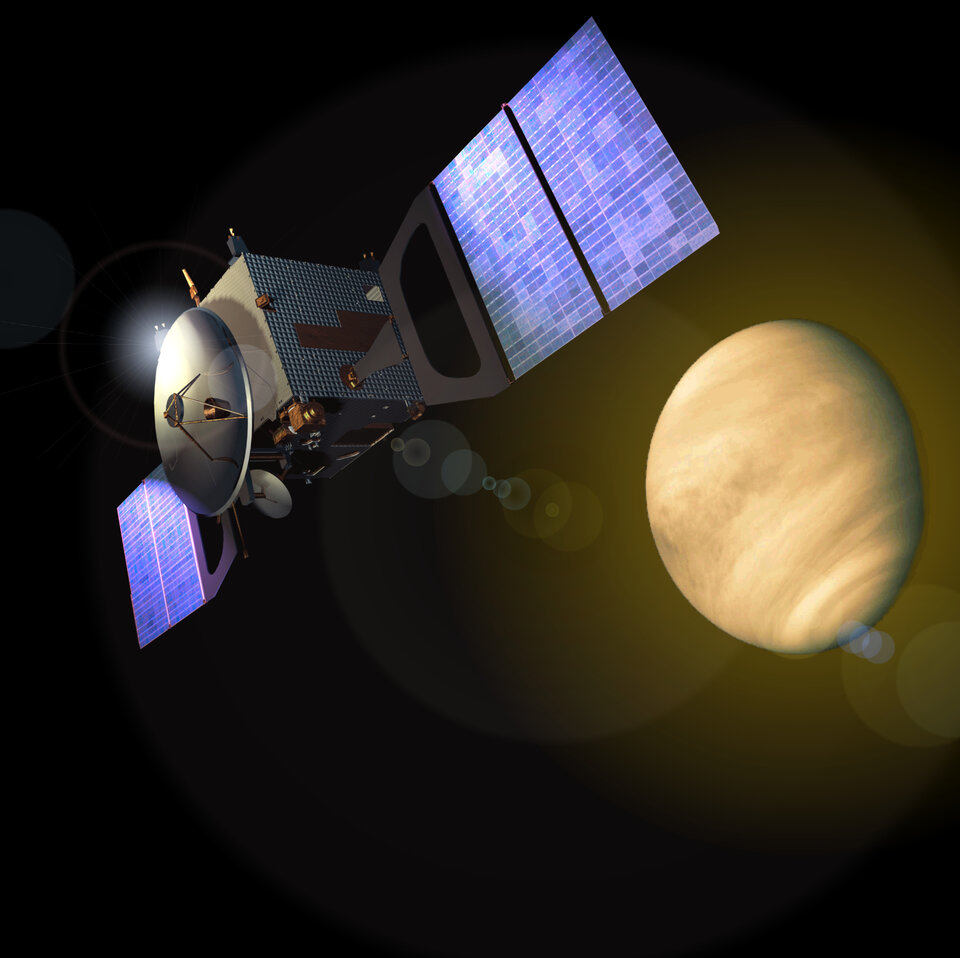
At Venus, the Sun appears twice as powerful as on Earth, so solar radiation to power the spacecraft was plentiful. Venus Express’s solar arrays could be made smaller (almost half size) than those of Mars Express.
The two symmetric solar arrays, measuring around six square metres, were based on a ‘triple junction’ gallium arsenide (GaAs) technology, different from the silicon-based technology used for Mars Express.
The solar cells, each composed of four layers of gallium arsenide, were more tolerant to high temperatures (up to around 120 °C), so they were more suitable for hot environments. Moreover, they were able to exploit a wider range of solar radiation. The solar cells were separated by aluminium strips that helped to reject heat. All together, these aluminium strips covered half of the overall solar array surface.
When the spacecraft was in shadow (eclipse) or when its power demand exceeded the capacity of the solar arrays, electrical power was supplied by three lithium-ion batteries that were charged by the solar-generated power.
Propulsion
The gravity of Venus, almost the same as Earth’s, is about eight times higher than that of Mars. This, plus the fact that the gravitational pull of the Sun is stronger at Venus, meant that Venus Express needed more energy to brake and be captured into orbit around Venus.
This energy was provided by part of the 570 kilograms of propellant on board (about 20% more than for Mars Express). The propellant mass was almost half of the overall spacecraft weight!
Major spacecraft manoeuvres, like the injection into orbit around Venus, were performed by firing the main engine located at the bottom floor of the spacecraft, while minor manoeuvres were made using four pairs of thrusters located at the four bottom corners of the spacecraft.
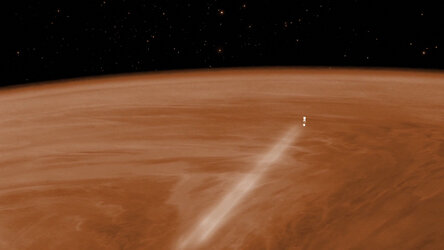
The thrusters were used for small trajectory corrections, spacecraft attitude changes, and to correct the altitude of the Venus Express orbit’s pericentre about every 50 days. In fact, due to the gravitational pull of the Sun while the spacecraft is farther away from the planet, the pericentre naturally drifted upwards at a rate of about 1.5 kilometres per day.
Communications
For a spacecraft in orbit around Venus, it is not always possible to point a single antenna dish at Earth while always keeping the cold face of the spacecraft, hosting delicate instruments, away from the Sun.
To overcome this pointing constraint, Venus Express had two high-gain antennas, mounted on different spacecraft faces. The main high-gain antenna, used for most of the communication with Earth, was a dish measuring 1.3 metres diameter.
The second and smaller high-gain antenna (30 centimetres diameter) was used to communicate with Earth when the spacecraft was in the part of the orbit closest to our planet (less than 0.78 Astronomical Units* away).
Two low-gain antennas were also mounted on board, to communicate with Earth during launch, in the first days of the cruise and, if necessary, during severe ‘safe modes’.
*One Astronomical Unit, defined as the mean distance between the Sun and Earth, is about 150 million kilometres.
Navigation and attitude control
Venus Express was a three-axis stabilised spacecraft. Through three different systems on board, the spacecraft could acquire data about its position in space, attitude (orientation) and change of velocity.
These on-board systems consisted of two star trackers, two Sun sensors and a set composed by three laser gyroscopes and three accelerometers. They provided data to re-orient the spacecraft and the solar arrays when necessary.
The actual spacecraft re-orientation manoeuvre or trajectory correction was performed by means of so-called ‘reaction wheels’ or by firing the thrusters.
Data storage
The Venus Express on-board computer was responsible for supervising and managing the overall spacecraft functioning, for handling all data acquired by instruments and sensors and for sending commands through the whole spacecraft.
Part of the computer was the Solid State Mass Memory, which had a capacity of 12 gigabits. All scientific data collected by the instruments were stored here until they could be downloaded to Earth during the appropriate orbital phase.