• → European Space Agency

      • Space for Europe
      • Space News
      • Space in Images
      • Space in Videos
    • About Us

      • Welcome to ESA
      • DG's News and Views
      • For Member State Delegations
      • Business with ESA
      • ESA Exhibitions
      • ESA Publications
      • Careers at ESA
    • Our Activities

      • Space News
      • Observing the Earth
      • Human Spaceflight
      • Launchers
      • Navigation
      • Space Science
      • Space Engineering
      • Operations
      • Technology
      • Telecommunications & Integrated Applications
    • For Public

    • For Media

    • For Educators

    • For Kids

    • ESA

    • Venus Express

    • ESA Science

    • Europe goes to Venus

      • Tribute to the cryptic planet
      • Penetrating an impenetrable world
      • Past missions to Venus
    • About Venus Express

      • Venus Express mission facts
      • Venus Express objectives
      • The spacecraft
      • Orbiter instruments
      • The launcher
      • Operating Venus Express
    • About Venus

      • Venusian geography
      • The surface
      • Acid clouds and lightning
      • Greenhouse effect, clouds and winds
      • Venus compared to Earth
    • Meet the team

      • International collaboration
      • Project Manager: An interview with Don McCoy
      • Project Scientist: An interview with Håkan Svedhem
      • Launch Campaign Manager: An interview with Michael Witting
      • Spacecraft Operations Manager: An interview with Andrea Accomazzo
      • Venus Express Flight Control Team
      • Principal Investigators
    • Multimedia
    • Venus Express images
    • Venus Express videos
    • VideoTalk
    • 3D Flash 'model'
    • Build a model (pdf)
    • Wallpapers
    • Screensavers
    • Services
    • Comments

    ESA > Our Activities > Space Science > Venus Express

    Venus Express propellant loading completed

    Propellant loading on Venus Express
    4 October 2005

    ESA's Venus Express spacecraft is now fuelled and ready for transport to the next facility at the Baikonur Cosmodrome, Kazakhstan, dedicated to installing it onto the launcher upper-stage.

    To be efficiently trapped by Venus’s gravity, the spacecraft has been equipped with a ‘bipropellant’ propulsion system similar to the ones used on board of modern telecommunication satellites. It mainly differs by the size and number of propellant tanks. Venus Express has two tanks of more than 260 litres capacity.

    The gravity of Venus, almost the same as Earth’s, is about eight times higher than that of Mars. This, plus the fact that the gravitational pull of the Sun is stronger at Venus, means that Venus Express needs more energy to brake and be captured into orbit around Venus.

    Venus Orbit Insertion

    For Venus Express, a total of 570 kilograms of propellant has to be loaded in the tanks (about 20% more than Mars Express). The propellant mass is almost half that of the overall spacecraft mass! In April 2006, the spacecraft’s main engine will use more than 70% of this propellant during the very long Venus Orbit Insertion burn (where the engine will fire for 53 minutes).

    The propellants to be loaded, nitrogen tetroxide oxidiser (NTO) and monomethylhydrazine fuel (MMH), are very toxic, corrosive and flammable chemicals. Working with them requires specific health protection precautions and detailed safety procedures in close co-operation with launcher facility operators.

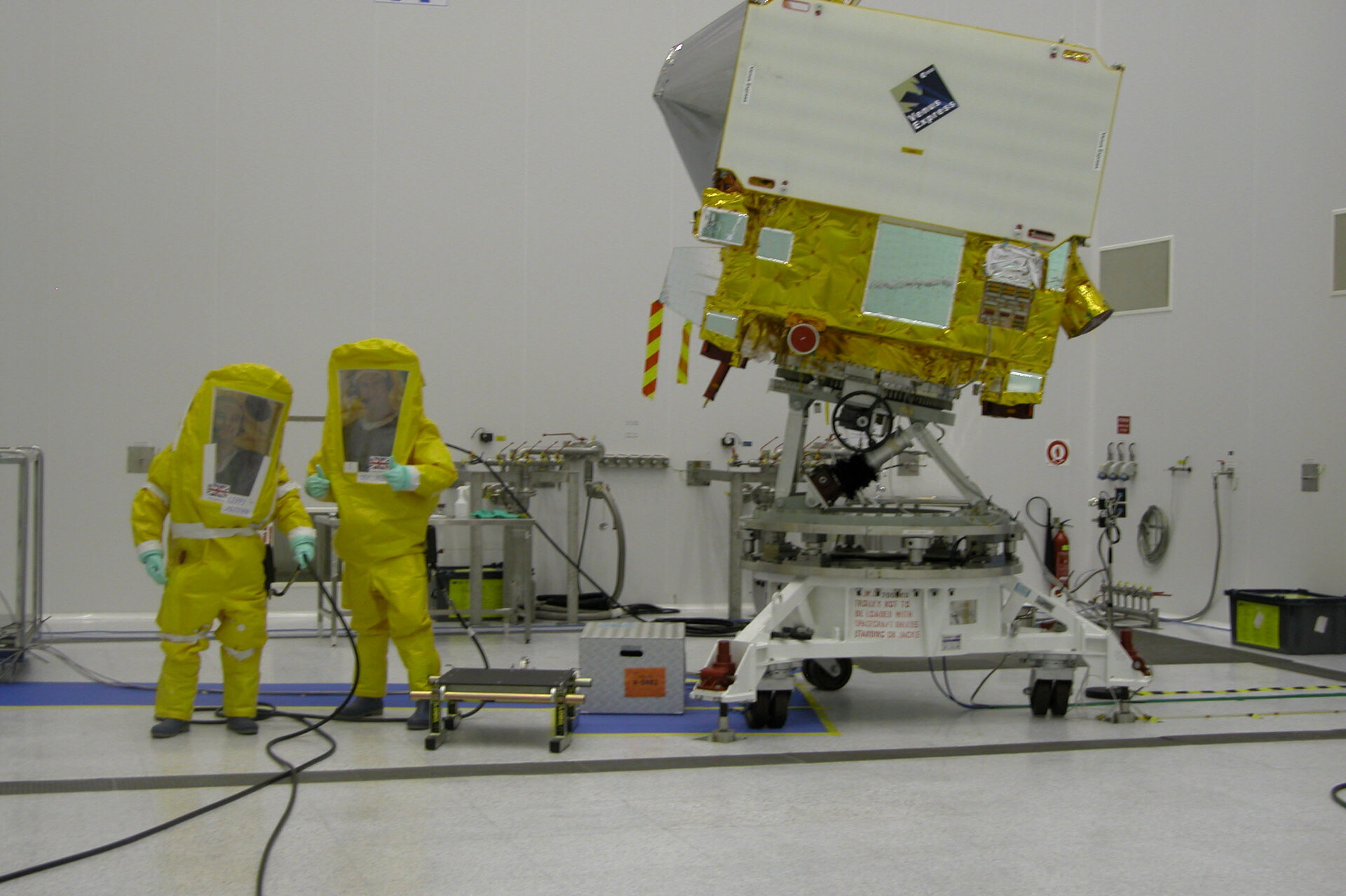
    Loading of the propellant tanks with fuel began early in the morning of 27 September. All activities taking place in the Hazardous Processing Facility (HPF) were managed and monitored via camera and special intercoms from a remote control room located in another building.


    SCAPE suit preparation at Baikonur

    Because of the dangers of handling these propellants, access to the area was closed and doctors, ambulance and firemen were on stand-by.

    The propellant loading operators from Astrium Stevenage wore special protective suits (called SCAPE suits). SCAPE stands for Self-Contained Apparatus Protective Ensemble, like a space suit but used for hazardous operations during ground processing.

    The NTO oxidiser loading went perfectly and was completed within six hours. Before switching to the MMH fuel loading, one day was spent for cleaning the facility’s common ducts and pipes so that the process could start again on 29 September. After another six hours, the spacecraft was fully loaded with propellant and the facility could be cleared of all hazardous vapour.

    The Venus Express spacecraft is now ready for transfer to the Upper Composite Integration Facility at Baikonur for stacking onto its adapter and then onto the Soyuz launcher’s Fregat upper-stage.
    Rate this

    Views

    Share

    • Currently 0 out of 5 Stars.
    • 1
    • 2
    • 3
    • 4
    • 5
    Rating: 0/5 (0 votes cast)

    Thank you for rating!

    You have already rated this page, you can only rate it once!

    Your rating has been changed, thanks for rating!

    31
    Tweet
    • Looking at Venus
    • Launch replay
    • Venus Express launch
    • Related articles
      • Venus Express performs flawlessly, LEOP complete
        • Venus Express mission operations update
          • "Venus Express, give me a GO/NO GO for launch..."
            • Venus Express: ready for lift-off
              • Green light for Venus Express launcher fuelling
                • Venus Express countdown activities started
                  • Venus Express moved back to launch pad
                    • Venus Express set for transport to launcher assembly building
                      • Venus Express mated with upper-stage
                      • More about...
                      • Status reports
                      • Launch in detail
                        • Venus Express factsheet
                        • Related links
                        • Starsem - the Soyuz
                        • Venus Express operations
                        • Cebreros station webcam

    Connect with us

    • RSS
    • Youtube
    • Twitter
    • Flickr
    • G+
    • Facebook
    • Livestream
    • Subscribe
    • App Store
    • LATEST ARTICLES
    • · Rare merger reveals secrets of gal…
    • · Watching for hazards: ESA opens as…
    • · ESA astronaut Timothy Peake set fo…
    • · Space drives e-mobility
    • · Proba-V opens its eyes
    • FAQ

    • Jobs at ESA

    • Site Map

    • Contacts

    • Terms and conditions