• → European Space Agency

      • Space for Europe
      • Space News
      • Space in Images
      • Space in Videos
    • About Us

      • Welcome to ESA
      • DG's News and Views
      • For Member State Delegations
      • Business with ESA
      • ESA Exhibitions
      • ESA Publications
      • Careers at ESA
    • Our Activities

      • Space News
      • Observing the Earth
      • Human Spaceflight
      • Launchers
      • Navigation
      • Space Science
      • Space Engineering
      • Operations
      • Technology
      • Telecommunications & Integrated Applications
    • For Public

    • For Media

      • Media
      • ESA TV
      • Videos for professionals
      • Photos
    • For Educators

    • For Kids

    • ESA

    • Technology

    • Technology Transfer

    • About technology
    • Foundation of innovation
    • A solid investment
    • Going up
    • Competitive edge
    • Supporting science
    • Giant leaps
    • Cross-Cutting Initiatives
    • Strategy and harmonisation
    • About strategy and harmonisation
    • Generic technology programmes
    • Basic Technology Research Programme (TRP)
    • General Support Technology Programme (GSTP)
    • Technology Transfer Programme (TTP)
    • European Components Initiative (ECI)
    • Technology in domain programmes
    • Technology in Domain programmes
    • Services
    • ESA Conferences
    • RSS feeds
    • Subscribe

    ESA > Our Activities > Technology

    A unique technical achievement

    GOCE will open a new chapter in our understanding of gravity

    There have been other gravity-detecting missions flown in space – the German satellite CHAMP (2000) and the US-German GRACE (2002) – but these worked by measuring gravity-driven variations between the orbits of differing spacecraft. CHAMP tracked changes in distance between a satellite orbiting 400 km up and GPS satellites above it at an altitude of 20,000 km. GRACE detects shifts in the orbits of twin spacecraft in 400 km about 200 km apart, as well as using the GPS constellation as a reference.

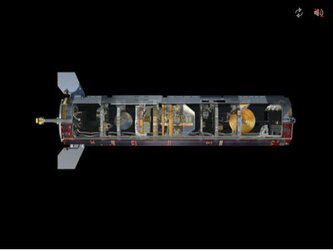
    While GOCE also employs GPS tracking to assess its orientation in space, its main instrument measures differences in gravity between accelerometers pivoted just 50 cm apart from each other, rather than between satellites hundreds or thousands of kilometres away. The result is that GOCE can detect gravity gradients down to a resolution of 100km apart, compared the a few thousand kilometres resolution yielded by CHAMP and 600 – 1000 km delivered by GRACE.

    GOCE is also the first satellite to operate throughout its planned 20 month lifetime while maintaining an orbit such a low altitude. In the absence of GOCE's never-before-flown drag-free system the spacecraft would plunge steadily downward.

    GOCE's results: a boon for next-generation space hardware

    GOCE will serve up the most detailed map of gravity field variations ever – a product of high interest for scientific community, who can use the results to peer deep within the Earth's interior - but also with great technological potential.

    Launchers such as ESA's Ariane 5 rely on inertial navigation to steer spaceward. But subtracting the effect of accelerations caused by gravity variations will reduce inertial positioning errors to a high degree, delivering higher-performance flights to orbit. And a more accurate reference model of Earth's gravity will produce a significant improvement in orbital calculations for satellites, in turn enabling more precise observations and the possibility of re-analysing older Earth observation data for enhanced accuracy.
    Last update: 9 March 2009

    Rate this

    Views

    Share

    • Currently 0 out of 5 Stars.
    • 1
    • 2
    • 3
    • 4
    • 5
    Rating: 0/5 (0 votes cast)

    Thank you for rating!

    You have already rated this page, you can only rate it once!

    Your rating has been changed, thanks for rating!

    12
    Tweet
    • More Information
      • Building ESA's gravity mapping mission posed hi-tech challenge
        • Flying a suite of technologies
          • A unique technical achievement
            • Technology potential for the future
            • GOCE launch
            • GOCE technical site
            • Related links
            • The Living Planet

    Connect with us

    • RSS
    • Youtube
    • Twitter
    • Flickr
    • G+
    • Facebook
    • Livestream
    • Subscribe
    • App Store
    • LATEST ARTICLES
    • · Rare merger reveals secrets of gal…
    • · Watching for hazards: ESA opens as…
    • · ESA astronaut Timothy Peake set fo…
    • · Space drives e-mobility
    • · Proba-V opens its eyes
    • FAQ

    • Jobs at ESA

    • Site Map

    • Contacts

    • Terms and conditions