• → European Space Agency

      • Space for Europe
      • Space News
      • Space in Images
      • Space in Videos
    • About Us

      • Welcome to ESA
      • DG's News and Views
      • For Member State Delegations
      • Business with ESA
      • ESA Exhibitions
      • ESA Publications
      • Careers at ESA
    • Our Activities

      • Space News
      • Observing the Earth
      • Human Spaceflight
      • Launchers
      • Navigation
      • Space Science
      • Space Engineering
      • Operations
      • Technology
      • Telecommunications & Integrated Applications
    • For Public

    • For Media

      • Media
      • ESA TV
      • Videos for professionals
      • Photos
    • For Educators

    • For Kids

    • ESA

    • Technology

    • Technology Transfer

    • About technology
    • Foundation of innovation
    • A solid investment
    • Going up
    • Competitive edge
    • Supporting science
    • Giant leaps
    • Cross-Cutting Initiatives
    • Strategy and harmonisation
    • About strategy and harmonisation
    • Generic technology programmes
    • Basic Technology Research Programme (TRP)
    • General Support Technology Programme (GSTP)
    • Technology Transfer Programme (TTP)
    • European Components Initiative (ECI)
    • Technology in domain programmes
    • Technology in Domain programmes
    • Services
    • ESA Conferences
    • RSS feeds
    • Subscribe

    ESA > Our Activities > Technology

    Advanced laser technology on the way to space

    Das LCT-Terminal von Tesat Spacecom
    24 May 2012

    It’s not only superheroes from long ago in a galaxy far, far away who can harness the power of lasers. Thanks to human ingenuity and European industry, advanced laser technology providing ultra-fast and highly secure data relay will start operation in space next year.

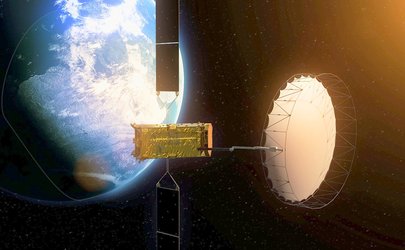
    A laser communications payload has now been integrated on the Alphasat satellite. It combines a laser terminal and a high-speed downlink to route torrents of data from low-orbiting satellites to ground stations via Alphasat.

    It is unprecedented that such a high-speed laser link between low orbit and geostationary orbit will be validated under operational conditions in space.

    The data relay operational scenario offers time data access and significantly increased link durations from low-orbit satellite to ground. Together with the high data rate, this boosts the data transfer capability into a new dimension.

    The laser communication terminal is able to acquire and track laser signals from its counterpart up to 50 000 km away and with relative velocities to each other of up to 40 000 km/h. Once locked on, the full-duplex data link between the two laser terminals continues until the low-orbit satellite disappears behind Earth.


    ESA Alphasat

    The major advantage of laser terminals over conventional radio payloads is their very high data rate – 1.8 Gbit/s in this case – and the unique point-to-point contact that makes interference with other users almost impossible.

    The laser terminal arrived on 3 May in Toulouse, France, from Backnang, Germany, and has now been bolted to the Earth-facing part of Alphasat.

    It is a precursor of the laser system that will be used operationally in the European Data Relay System, planned for launch in 2014–15.
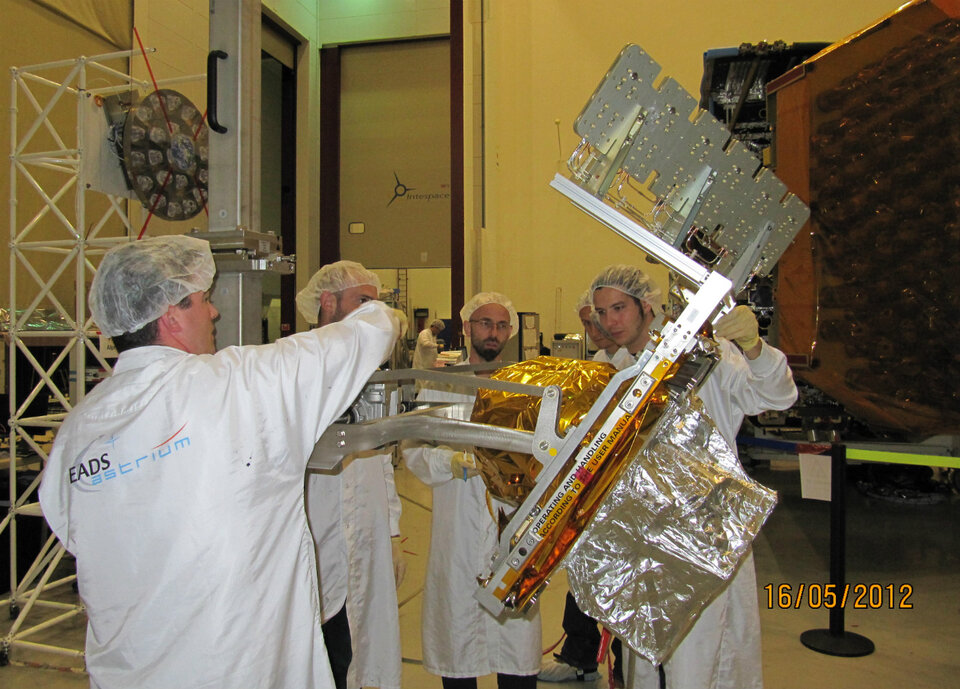
    Alphasat also carries three other ‘hosted’ technology demonstrators, developed through ESA’s Advanced Research in Telecommunications Systems (ARTES) programme: an experiment looking at the suitability of high frequencies for future communications, an advanced startracker and a package monitoring radiation effects on electronic components and sensors in geostationary orbit.

    Developed by Tesat Spacecom in Germany under DLR German space agency contract in coordination with ESA, the laser terminal includes key technologies from Ruag of Switzerland developed under ESA contract with support from the Swiss Space Office.

    Alphasat is being built in partnership between ESA and European operator Inmarsat by Astrium. It is the first satellite to use Alphabus, the new European high-power telecommunications platform jointly developed by Astrium and Thales Alenia Space under a joint contract from ESA and the French space agency, CNES.

    Alphasat is scheduled to be launched in early 2013.

    Rate this

    Views

    Share

    • Currently 5 out of 5 Stars.
    • 1
    • 2
    • 3
    • 4
    • 5
    Rating: 5/5 (1 votes cast)

    Thank you for rating!

    You have already rated this page, you can only rate it once!

    Your rating has been changed, thanks for rating!

    277
    Tweet
    • TIA ARTES website
    • Documentation
    • Alphabus fact sheet (PDF)
    • Alphabus fact sheet (French): [PDF file: ~168 kB]
    • Alphabus Bulletin Article
    • Alphasat fact sheet (PDF)
    • Alphasat fact sheet (French): [PDF file: ~139 kB]
    • Related links
    • ARTES 8 Alphabus/Alphasat
    • Alphabus highlights
    • Alphasat highlights
    • DLR
    • TESAT
      • Sharing the satellite

    Connect with us

    • RSS
    • Youtube
    • Twitter
    • Flickr
    • G+
    • Facebook
    • Livestream
    • Subscribe
    • App Store
    • LATEST ARTICLES
    • · Rare merger reveals secrets of gal…
    • · Watching for hazards: ESA opens as…
    • · ESA astronaut Timothy Peake set fo…
    • · Space drives e-mobility
    • · Proba-V opens its eyes
    • FAQ

    • Jobs at ESA

    • Site Map

    • Contacts

    • Terms and conditions