

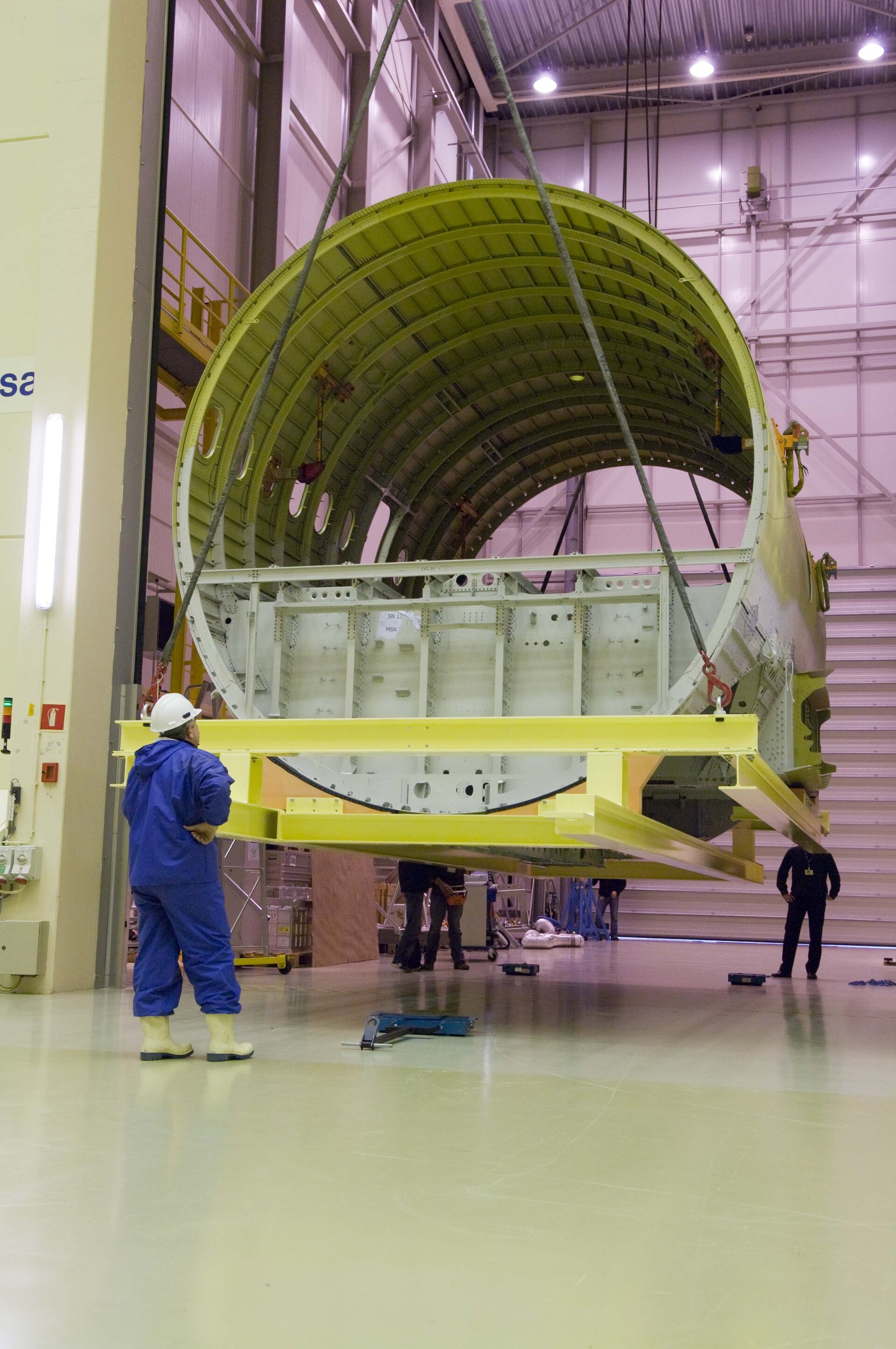
Airbus at ESTEC for ground-based shakedown test
Seeking to investigate how aircraft respond to a range of flight conditions, engineers from Airbus are preparing to vibrate a full-scale fuselage section on a giant ESA shaker table normally used to simulate the extreme conditions of a rocket launch.
As part of its Dynamic Barrel Simulation and Testing for an Optimised Approach research project, Airbus’s Hamburg-based Loads and Aeroelasticity group, Dynamic Loads department will employ specialised facilities at the ESA Test Centre at the European Space Research and Technology Centre (ESTEC), Noordwijk, the Netherlands. Their aim is to investigate structural responses to high-frequency excitations, with the objective of reducing aircraft structure and system loads through more accurate design methods.
A section of Airbus fuselage 6 m long by 4 m wide was delivered to the ESA Test Centre at the end of February. The flap track fairing is expected in March. The Test Centre staff are accustomed to receiving flight-ready satellites; however, the 4-tonne piece of fuselage was treated in the same manner. It was attached to an overhead crane, moved into the cleanroom and mounted on the multi-axis vibration test facility HYDRA.
From the test room point of view, HYDRA appears rather modest. Its visible part is just a 5.5 x 5.5 metre aluminium plate lying flush with the floor. But this plate is the top surface of an 18-tonne table that is moved by eight hydraulic actuators and performs in a similar way to a flight simulator platform.
These HYDRA actuators enable the reproduction of complex combined table movements. The control of the table is performed by a network of 28 parallel computers, using a large hydraulic infrastructure of more than one megawatt capacity that provides the required oil flow to the actuators. The facility can shake specimen of up to 22 tonnes with an acceleration between 0.05 g and 5 g.

The Airbus team will use HYDRA's high controllability to subject their hardware to the kind of brief but significant stresses known as ‘transients’ that an aircraft sustains during manoeuvres, high winds and touchdowns. They will also check for potentially troublesome internal resonance effects.
"Flight testing is an expensive and potentially risky proposition," explains Alexander Kübler of European Test Services, the company that operates the Test Centre facilities for ESA."This is the next best thing to real flight. HYDRA is big enough that a large section of a plane can be tested at once. The risk of damaging the fuselage with too many cycles at very high loads is minimised since single pulses are used to check the vibration behaviour against the modelling predictions."
The tests will begin with the flap track fairing in late March for two weeks, with work on the fuselage set for November. Some tests on the fuselage may include humans to see the interaction between passenger and vibration behaviour of the fuselage – the first time that people would have participated in this way in vibration testing at ESA. This activity is a follow-up of previous Airbus tests performed at ESTEC, which involved assessing a cargo system for vibration loads during landing.
"We have observed in recent years that the performance of the facilities and quality of service that the Test Centre can provide is becoming attractive beyond the space business," says Gaetan Piret, head of ESTEC's Testing Division. "We are happy that our expertise is helping industries that traditionally have not been doing business with ESA" - supporting European industry in terms of technical knowhow and competitiveness being among ESA’s primary objectives.
"Airbus has already performed several test campaigns on HYDRA," says expert Ludger Merz of Airbus. "All specified requirements regarding the shaker table excitation and measurement quality were fulfilled, and the Test Centre team supported our work with experience and commitment."
About HYDRA
The extreme vibration of a launch is potentially a major cause of equipment failure, so satellites and mission hardware require exhaustive testing. The largest satellite shaker in Europe, HYDRA has subjected the largest ESA spacecraft to vibration testing over the course of the last decade, from the Envisat Structural Model in 1997 to the Herschel Spacecraft Structural Model in 2007. The largest spacecraft tested so far is the Automated Transfer Vehicle Jules Verne, in 2002. It weighed 22 tonnes with its propellant tanks full.
Contact
Alexander.Kuebler @ esa.int
Gaetan.Piret @ esa.int

