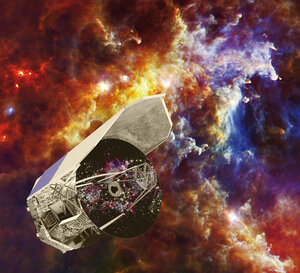
Artificial diamond for mirror making
ESA’s 2009-launched Herschel observatory surveyed the infrared cosmos with the largest mirror flown in space, at 3.5 m across. Made of super-hard silicon carbide, it has twice the observing area of the Hubble Space Telescope’s main mirror at just one third the mass. But it took more than a decade of preliminary ESA-led research to prepare to apply silicon carbide – originally developed as an artificial diamond, more typically used today for industrial pump bearings and seals – to the delicate art of space mirror making. Today, silicon carbide is being applied to numerous space missions, including providing a stable optical bench for ESA’s Gaia mission as it makes a 3D map of a billion stars.