


ESA’s long-term technology plans for space exploration
Make it to low-Earth orbit and you’re halfway to anywhere, observed science fiction writer Robert Heinlein. A workshop at ESA’s technical heart has been assessing the technologies needed to make the other half of the trip.
ESA’s technical experts have prepared long-term roadmaps of technologies required for advanced robotic and human exploration.
On 13 April the people who will actually be developing these technologies for current and future space missions had their say.
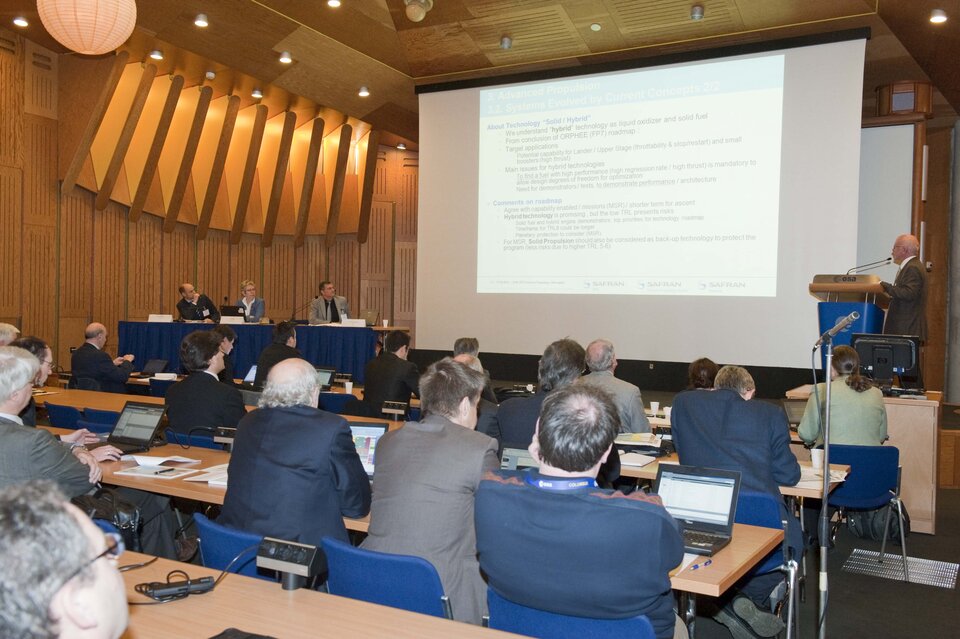
A one-day Space Exploration Technologies Workshop at ESTEC, the Netherlands, co-organised with industry body Eurospace, gathered representatives from leading European aerospace companies and ESA delegations to give their own reactions to the draft technology plans.

More than 70 participants representing a variety of European industrial expertise and experience ranging from primes and large integrators to more specialised smaller companies spanning many ESA Member States were present.
“We are here to listen to your comments and ideas,” said ESA’s Giorgio Saccoccia, head of the Agency’s Propulsion and Aerothermodynamics division plans and coordinator for Exploration in the Directorate of Technical and Quality Management.
Nicolas Peter, Secretary of the Human Spaceflight, Microgravity and Exploration Programme Board, added that, “this workshop is part of a process aiming to initiate a dialogue with industry to prepare the future steps in exploration technology development and procurement.”
Technology roadmaps covering ten major technology areas were presented and discussed. It was highlighted by ESA specialists and industrialists that:
Advanced propulsion technologies will be required to meet the new requirements for space exploration cargo and human long-distance travel and planetary landing and return.
Robotic missions will need advanced autonomy, because signals from Earth will take long periods to reach them.
The Automation and Robotics plan includes a new generation of surface rovers. The workshop discussed whether development should extend beyond wheeled rovers to other modes of locomotion, such as walkers or aerostats.
Missions will venture farther from the Sun, and beneath planetary atmospheres. Solar energy may no longer be available at useable levels. So the Novel Energy Production and Storage plan includes the development of European nuclear power sources, as well as fuel cells.
Human crews will have to be kept alive and comfortable for years at a time. A self-sufficient closed-loop life-support system will be required – the long-term aim of ESA’s Micro-Ecological Life Support System Alternative (MELiSSA) programme – and effective radiation protection will be essential.
Inflatable habitats will be key to roomy space living, both for orbital missions and planetary exploration, ideally with portholes.
Planetary explorers will face a new class of threat that has so far only been encountered very briefly: surface dust.
The single most difficult class of missions, short of human expeditions, is sample return. An international Mars sample return mission remains a long-term plan, with other missions being considered.
Landing safely and precisely and then taking off will be extremely difficult, along with docking to a waiting ‘mothership’ for return to Earth.
- The long distances that sample-return missions will travel means they will return to Earth very rapidly, requiring sophisticated thermal control.
The technology plans have been prepared by the Directorate of Technical and Quality Management, in coordination with mission designers in the Directorates of Science and Robotic Exploration and Human Spaceflight and Operations.
Based on the comments provided by industry, the plans will be consolidated for ESA’s upcoming Ministerial Council and will form the basis for the preparation of an ESA coordinated procurement plan.


