• → European Space Agency

      • Space for Europe
      • Space News
      • Space in Images
      • Space in Videos
    • About Us

      • Welcome to ESA
      • DG's News and Views
      • For Member State Delegations
      • Business with ESA
      • ESA Exhibitions
      • ESA Publications
      • Careers at ESA
    • Our Activities

      • Space News
      • Observing the Earth
      • Human Spaceflight
      • Launchers
      • Navigation
      • Space Science
      • Space Engineering
      • Operations
      • Technology
      • Telecommunications & Integrated Applications
    • For Public

    • For Media

    • For Educators

    • For Kids

    • ESA

    • Technology

    • Technology Transfer

    • About technology
    • Foundation of innovation
    • A solid investment
    • Going up
    • Competitive edge
    • Supporting science
    • Giant leaps
    • Cross-Cutting Initiatives
    • Strategy and harmonisation
    • About strategy and harmonisation
    • Generic technology programmes
    • Basic Technology Research Programme (TRP)
    • General Support Technology Programme (GSTP)
    • Technology Transfer Programme (TTP)
    • European Components Initiative (ECI)
    • Technology in domain programmes
    • Technology in Domain programmes
    • Services
    • ESA Conferences
    • RSS feeds
    • Subscribe

    ESA > Our Activities > Technology

    Planck needs onboard fridge to map Big Bang's chilly aftermath

    Planck in space

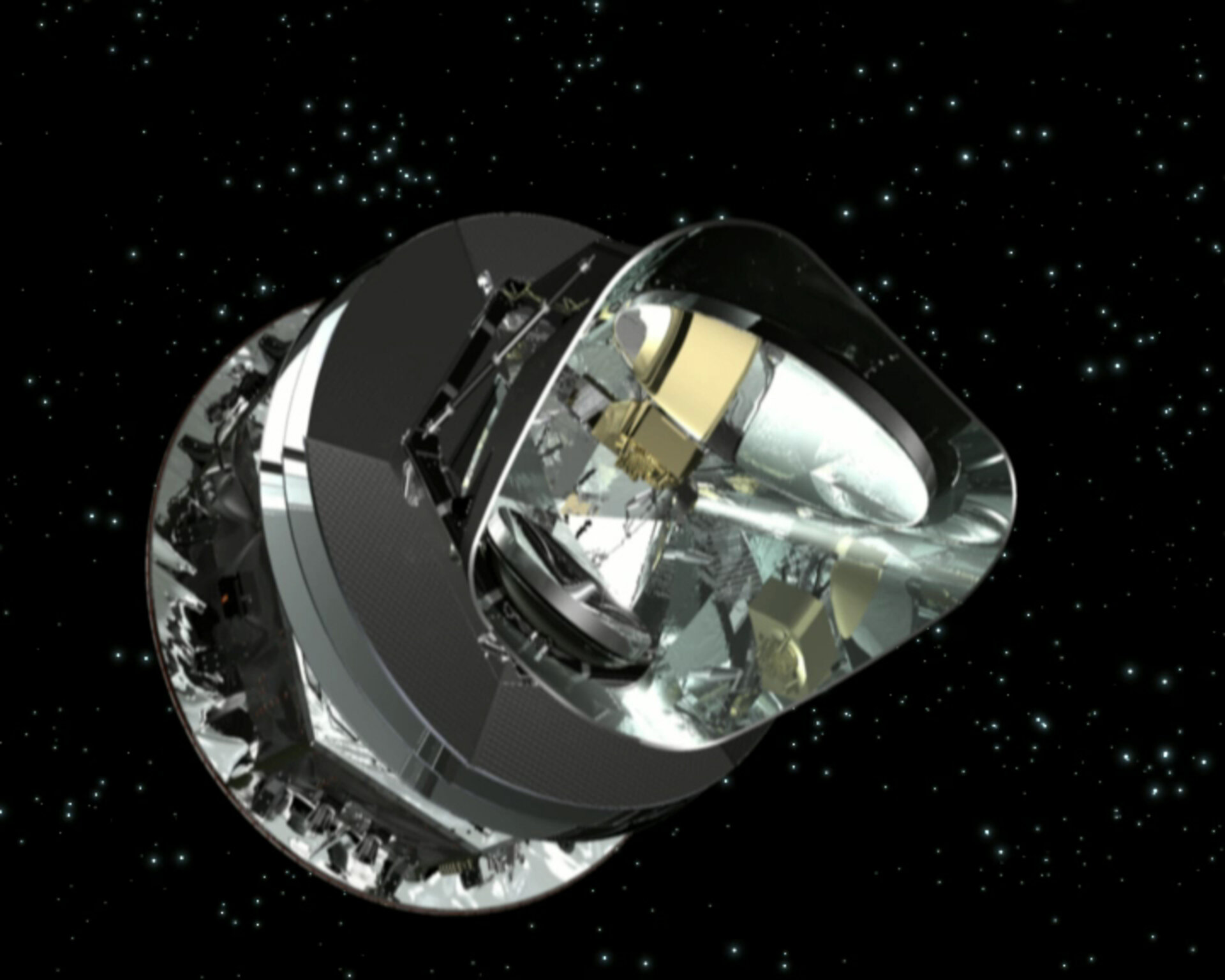
    Launched on the same rocket, headed to the same distant region of space and with operating temperatures lower than any spacecraft before them, ESA's Planck and Herschel are true sister missions. Planck is the smaller of the two, but nevertheless its new cryogenic technology will bring it just a tenth of a degree away from absolute zero.

    To observe the very coldest features of the Universe the spacecraft instruments must operate at even lower temperatures, otherwise they lose all sensitivity as the surrounding spacecraft emitting in the infrared will be much brighter than the sky.

    Planck's onboard detectors seek to measure variations in the background radiation of space leftover from the Big Bang. Mapping this 'Cosmic Microwave Background' to the required accuracy of a million times less than one degree is comparable to measuring from Earth the heat produced by a rabbit on the Moon.

    To achieve its own mission of observing extremely cold celestial objects, Herschel houses its instruments within a cryostat with a tank filled with superfluid helium-4. The tank is insulated from the environment by a vacuum vessel – following the same principle as a bottle of champagne in an ice bucket though in practice more than 270 degrees colder.

    To last through its projected three and a half year lifetime Herschel's cryostat has more than 2000 litres of helium aboard.
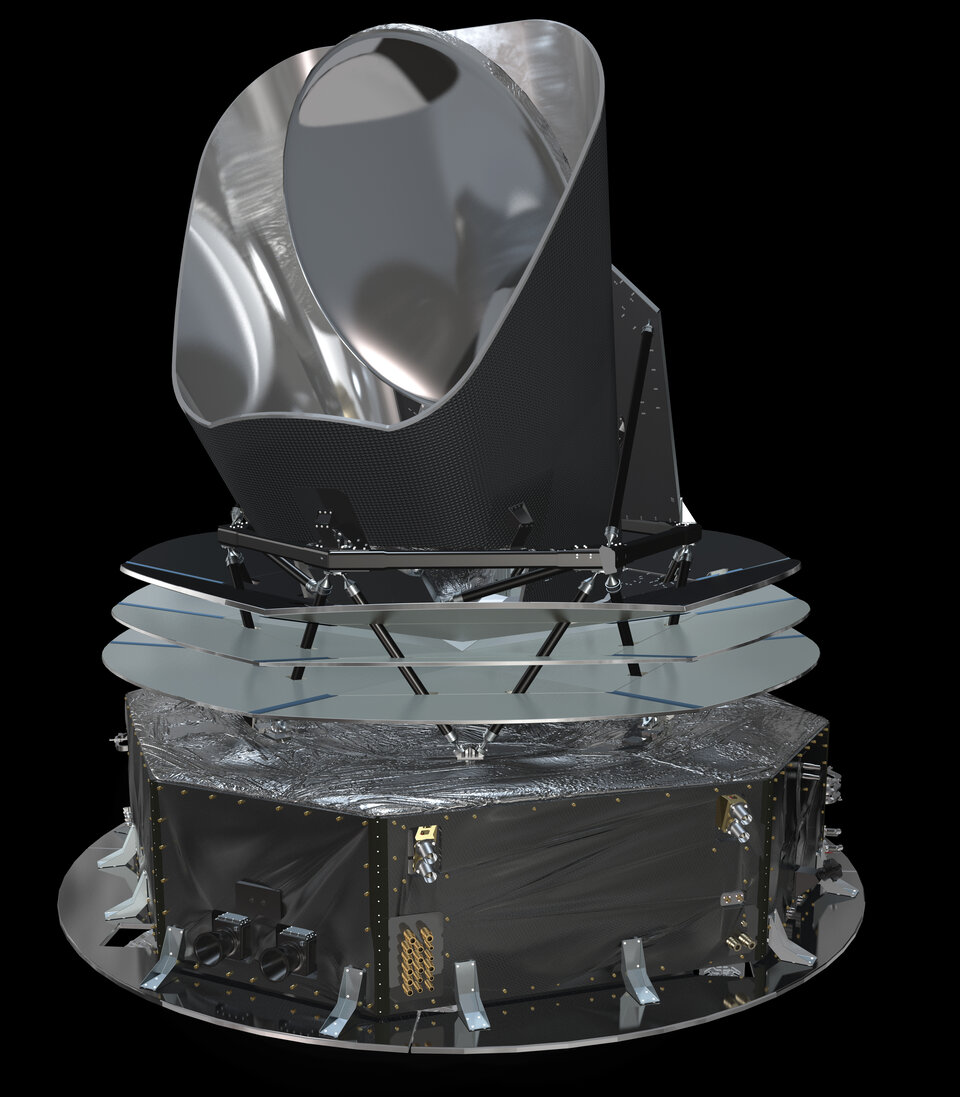
    Planck’s cooling system - full view
    Planck’s cooling system - full view

    Planck will be launched 'warm' but then its temperature will be gradually brought down in space over a period of months by radiative and mechanical cooling systems, that operate on a similar basis as an electric refrigerator. But no single system is capable of reaching in one step Planck's target 0.1K temperature. Instead the spacecraft employs a chain of four different cooling technologies, each nestled within the other like Russian dolls. Each has to bring the spacecraft temperature down in sequence before the next one can begin to work.

    "The difference between Herschel and Planck cryogenically is the difference between a passive device and an active device," says Chris Jewell ESA's cryogenic expert for Herschel and Planck, who has worked on the cryogenic systems of both missions. "Planck is clearly in a class of its own. We have flown individual mechanical coolers many times in Earth observation missions but never such a cooling chain before."


    More information

    Chris.Jewell @ esa.int
    Last update: 7 May 2009

    Rate this

    Views

    Share

    • Currently 0 out of 5 Stars.
    • 1
    • 2
    • 3
    • 4
    • 5
    Rating: 0/5 (0 votes cast)

    Thank you for rating!

    You have already rated this page, you can only rate it once!

    Your rating has been changed, thanks for rating!

    9
    Tweet
    • This article continues...
      • Planck's cooling chain
      • Related links
      • Planck minisite
      • Planck in depth
      • Thermal and Environmental Control
      • Herschel's cooling system
        • Superfluid cryogenics gives Herschel a cool view of the cosmos

    Connect with us

    • RSS
    • Youtube
    • Twitter
    • Flickr
    • G+
    • Facebook
    • Livestream
    • Subscribe
    • App Store
    • LATEST ARTICLES
    • · Proba-V opens its eyes
    • · First new Galileo satellite arrive…
    • · Next destination: space
    • · Leak repaired on International Spa…
    • · After Chelyabinsk: European expert…
    • FAQ

    • Jobs at ESA

    • Site Map

    • Contacts

    • Terms and conditions
