Proba-3 Mission
Editor's note: This page is no longer being updated, but will be preserved as a record. Click here for the latest information on Proba-3.
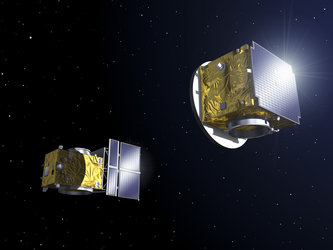
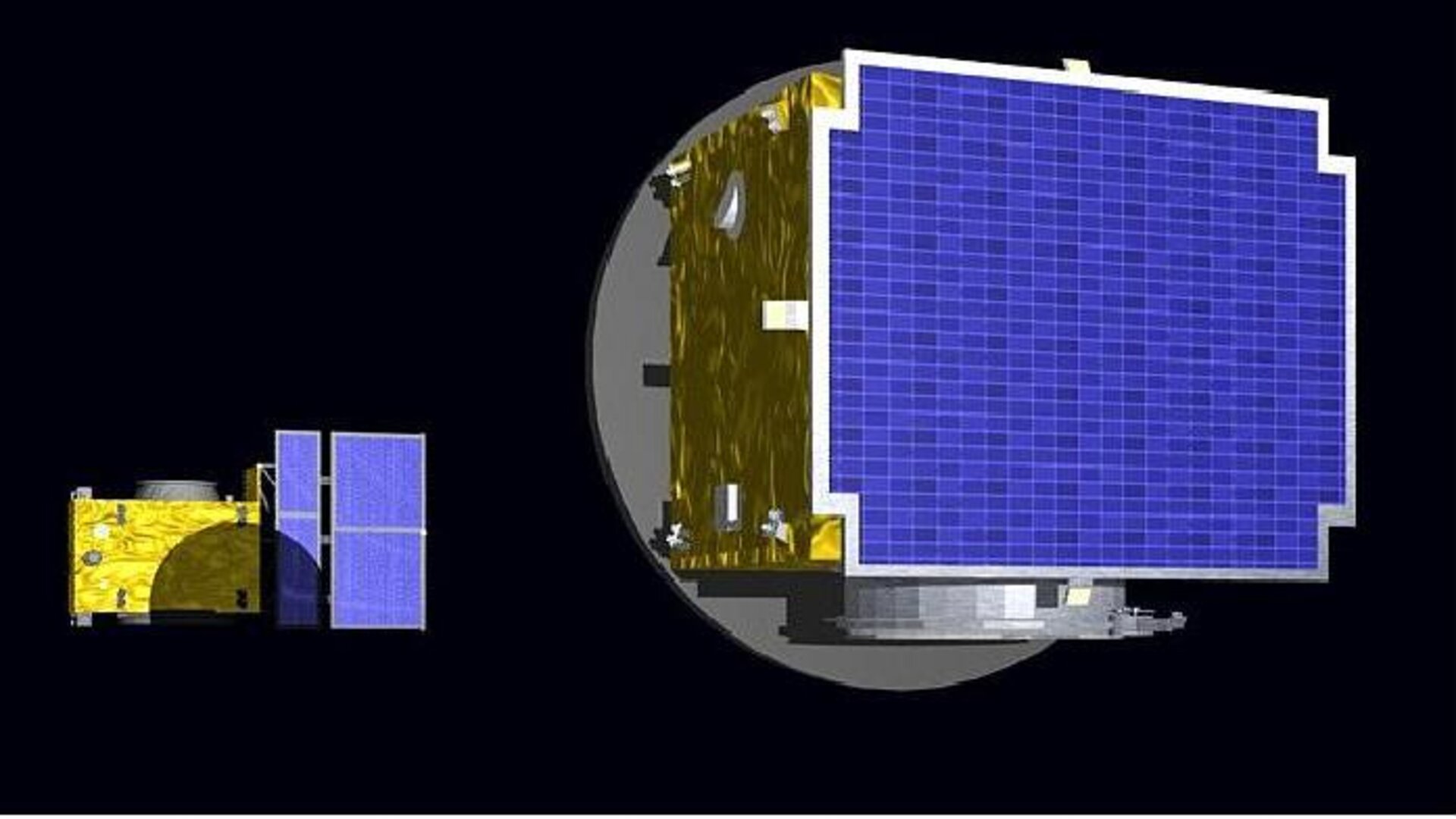
Proba-3 is devoted to the demonstration of technologies and techniques for highly-precise satellite formation flying. It consists of two small satellites launched together that will separate apart to fly in tandem, to prepare for future multi-satellite missions flying as one virtual structure.
Current scientific and applications challenges call for the detection of ever fainter signals and smaller features. Larger apertures, longer focal lengths and baselines that are beyond what can be achieved with a single spacecraft will be required to meet these goals. The solution is satellite formation flying.
Achieving precise formation flying opens up a whole new era for science and applications. Future missions could be assembled on a much larger scale. Applications of interest include Earth observation as well as in-orbit satellite servicing.
In preceding years Europe has made significant progress in the field of multi-satellite missions. ESA’s Automated Transfer Vehicle has demonstrated precision down to a few centimetres when docking with the ISS while Sweden’s Prisma mission has demonstrated formation flying for brief periods, maintaining cm-level accuracy across tens of metres.
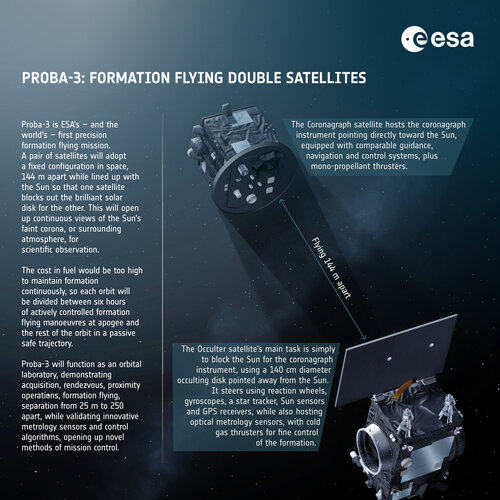
Proba-3 marks the next step in formation flying. As a world first, its two satellites –the Coronagraph spacecraft and the Occulter spacecraft – will maintain formation to a few millimetres and arc second precision at distances of around 150 metres for six hours at a time. In effect the pair will be forming a virtual giant satellite. And this will be achieved autonomously, without relying on guidance from the ground.
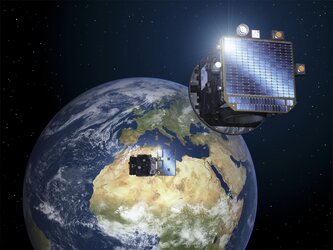
The two small satellites will be launched together in 2024 into a highly elliptical orbit (600 x 60530 km at around 59 degree inclination) in a stack configuration.
After a short preparatory period the two satellites will be separated and injected into a safe relative tandem orbit. Included in the commissioning period will be a demonstration of the mission’s Collision Avoidance Manoeuvre, ensuring they can be left safely in an orbit with no risk of collision or running away from each other.
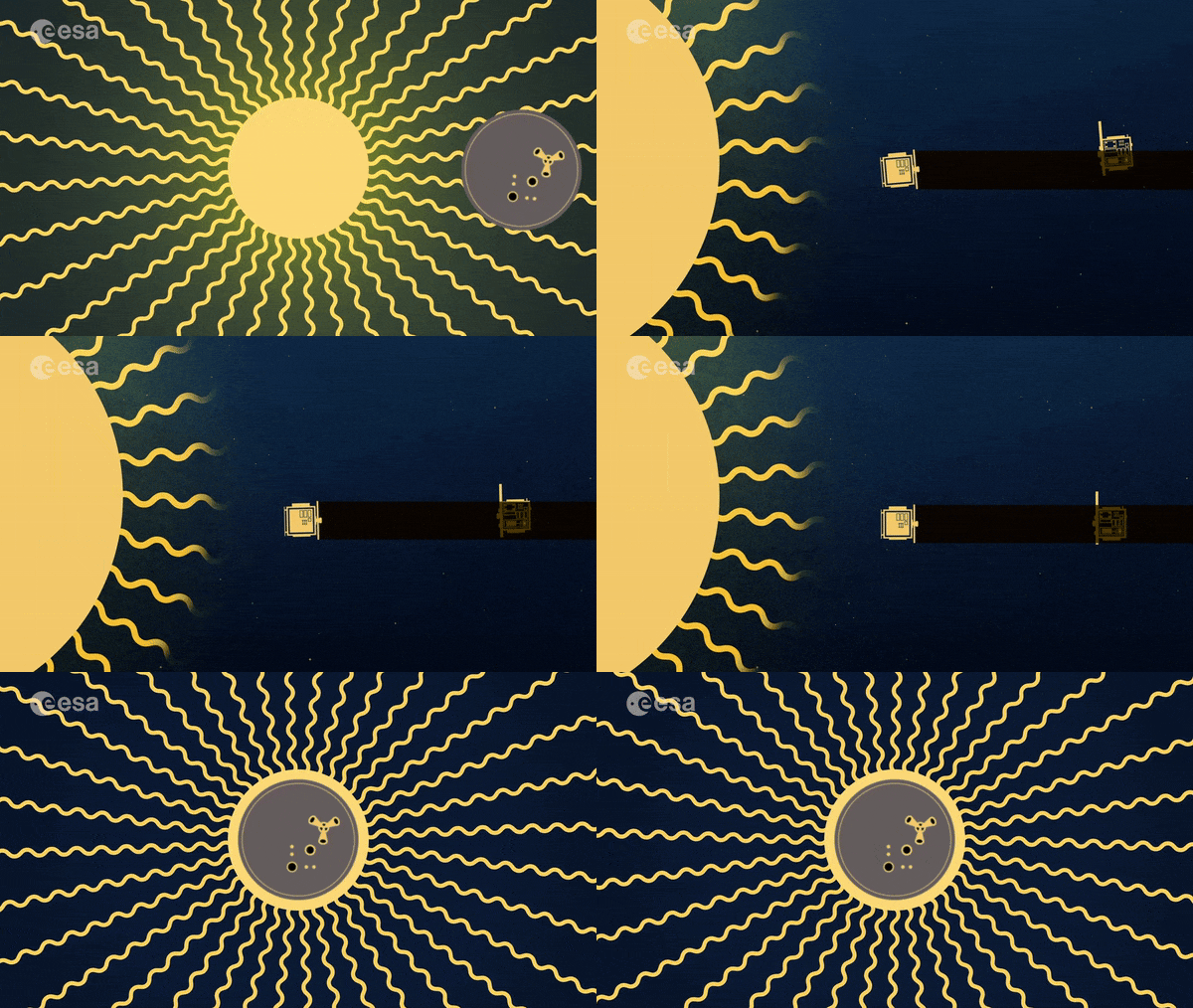
Normal operations will then include both formation flying manoeuvres and scientific observations using a giant solar coronagraph that will block out the blinding light from the solar disk in order to acquire continuous views of the Sun’s ghostly corona, or surrounding atmosphere.
The cost in fuel would be too high to maintain formation throughout the orbit, so each orbit will be divided between six hours of formation flying manoeuvres at apogee and the rest of the orbit in passive safe drifting. The Proba-3 satellites will repetitively demonstrate acquisition, rendezvous, proximity operations, formation flying, coronagraph observations, separation and convoy flying every orbit.
Proba-3 will be a laboratory in space to validate strategies, guidance, navigation and control and other algorithms, such as relative GPS navigation, previously tried in ground simulators. These techniques and simulators developed in the frame of Proba-3 will then be available more widely, becoming instrumental in the preparation of future missions. The mission will also validate the key technologies such as metrology instruments to perform formation flying.
The mission includes also a rendezvous experiment to test sensors and algorithms for Rendezvous (cooperative and uncooperative) in elliptical orbit. This technology could be used for a future Mars Sample return mission and for de-orbiting satellites from low-Earth orbit.
The mission's implementation phase (Phase C/D/E1) began in July 2014.