• → European Space Agency

      • Space for Europe
      • Space News
      • Space in Images
      • Space in Videos
    • About Us

      • Welcome to ESA
      • DG's News and Views
      • For Member State Delegations
      • Business with ESA
      • ESA Exhibitions
      • ESA Publications
      • Careers at ESA
    • Our Activities

      • Space News
      • Observing the Earth
      • Human Spaceflight
      • Launchers
      • Navigation
      • Space Science
      • Space Engineering
      • Operations
      • Technology
      • Telecommunications & Integrated Applications
    • For Public

    • For Media

      • Media
      • ESA TV
      • Videos for professionals
      • Photos
    • For Educators

    • For Kids

    • ESA

    • Proba Missions

    • Proba-V at a glance
    • Overview
    • Objectives
    • About the instrument
    • V for Vegetation
    • Serving science
    • Fitting the world in a box
    • About the platform
    • Joining ESA’s Proba family
    • Boxing clever
    • About the mission
    • Made in Belgium
    • On the ground
    • Starting operations
    • New technology
    • Hitching a ride
    • Tracking aircraft from orbit
    • New space semiconductor
    • Detecting radiation
    • Fly by fibre
    • About the launch
    • Launcher
    • Launch site
    • Proba-V launch diary part 1
    • Proba-V launch diary part 2
    • Proba-V launch diary part 3
    • Proba-V launch diary part 4
    • What's next
    • Proba-3
    • Already flying
    • Proba-1
    • Proba-2
    • Multimedia
    • Proba-V images
    • Proba images
    • Proba Earth images
    • Videos
    • Animations
    • Contact
    • Contact us

    ESA > Our Activities > Technology > Proba Missions

    Pinpoint accuracy with the Proba camera

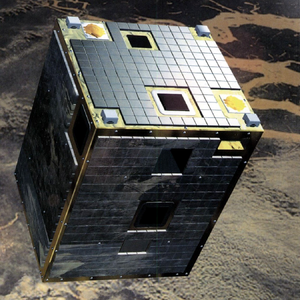
    Proba-1 in orbit
    4 June 2002

    A new star tracker allowing a satellite to determine its orientation in space with an accuracy never seen before has proved its worth aboard ESA's Proba mission.

    Proba (Project for On-Board Autonomy) built by Verhaert (Belgium) for ESA was launched in Autumn 2001 and is now fully operational, carrying out a series of Earth observations with extreme accuracy. Such accuracy is only possible because the satellite knows its own orientation in space so precisely.

    One of the aims of Proba is to test a number of new principles for satellite control. Compared with traditional satellites Proba is virtually autonomous. The majority of problems arising during daily operations can be handled by the satellite with no need for intervention from the ground.

    An important part of the secret behind the autonomy of the satellite is a star tracker developed at the Technical University of Denmark. The camera is similar to that onboard the Danish Ørsted satellite launched three years ago but it has been improved in a number of ways.

    "The new camera is the only one in the world able to online and fully automatically adjust for the relativistic aberration", says head of project John Leif Jorgensen, of the Technical University of Denmark.

    Aberration is the displacement of a star's position due to the Earth's movement around the Sun combined with the finite speed of light. Aberration is thus a relativistic effect - expressing the difference in the position of the star when viewed by an observer standing still compared with one that is moving (we on Earth are moving, as of course is a satellite in orbit).

    Proba in the PSLV fairing
    Proba in the PSLV fairing

    The relativistic aberration can be as much as 25 graduated arc seconds (one degree is divided into 60 graduated arc minutes, which are again each divided into 60 graduated arc seconds). As the displacement of the star varies with the relative speed of the satellite the aberration will keep changing as the satellite orbits the Earth.

    "In other words it will be impossible to obtain arc second accuracy, as is the ambition with Proba, if one cannot fully compensate for the aberration", John Leif Jorgensen states.

    Other advantages of the new camera are that it is very compact and extremely tolerant to fast movements. This makes it possible to steer the spacecraft during one pass to make multiple images of an area while the satellite moves along its orbit. The tracker therefore makes an essential contribution to Proba's high manoeuvrability.
    Rate this

    Views

    Share

    • Currently 5 out of 5 Stars.
    • 1
    • 2
    • 3
    • 4
    • 5
    Rating: 5/5 (1 votes cast)

    Thank you for rating!

    You have already rated this page, you can only rate it once!

    Your rating has been changed, thanks for rating!

    45
    Tweet
    • Related articles
      • First Proba pictures promise wealth of environmental data
        • Indian launch success for European micro-satellite
          • Micro-satellite will hook into Internet
          • Related links
            • Proba-1

    Connect with us

    • RSS
    • Youtube
    • Twitter
    • Flickr
    • G+
    • Facebook
    • Livestream
    • Subscribe
    • App Store
    • LATEST ARTICLES
    • · Rare merger reveals secrets of gal…
    • · Watching for hazards: ESA opens as…
    • · ESA astronaut Timothy Peake set fo…
    • · Space drives e-mobility
    • · Proba-V opens its eyes
    • FAQ

    • Jobs at ESA

    • Site Map

    • Contacts

    • Terms and conditions