Proba-2: Extending ESA’s commitment to technological innovation
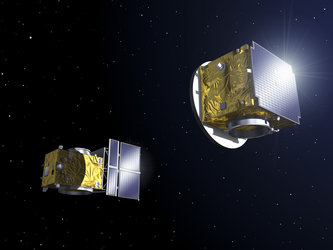
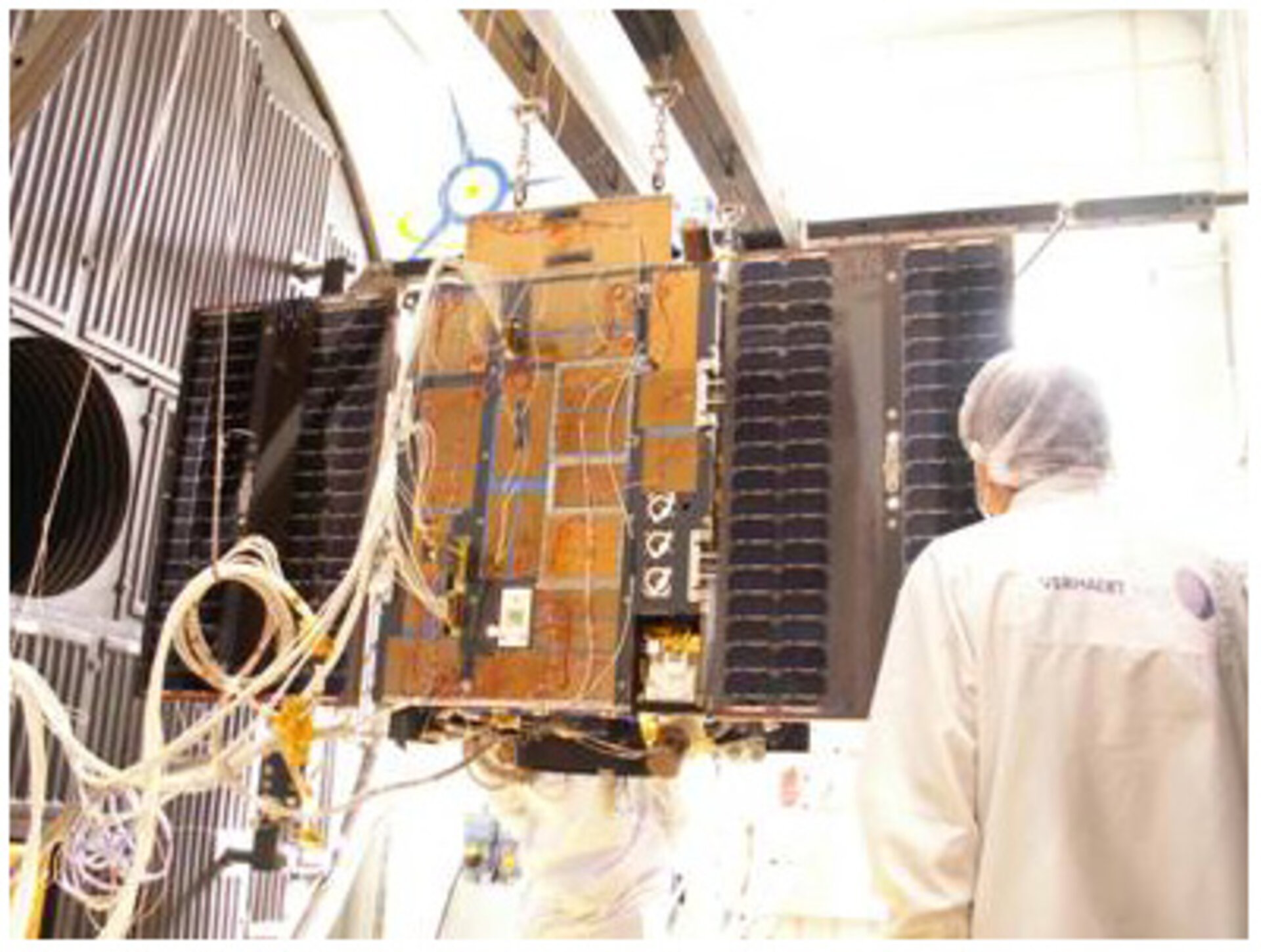
Proba-2, currently under development and due for launch in the second quarter of 2009, is the second in ESA’s series of small, low-cost satellites that are being used to validate new spacecraft technologies while also carrying scientific instruments.
The Proba satellites are part of ESA’s In-Orbit Technology Demonstration Programme, funded through the General Support Technology Programme (GSTP).
The first satellite in the series, Proba-1, was launched in October 2001. Its primary payload is an imaging spectrometer that exploits the spacecraft’s high-performance attitude control and pointing capabilities. Originally designed for a two-year mission, Proba-1 is now in its seventh year of operations.
Proba-2 is being developed by a European consortium lead by the Prime Contractor, Verhaert Design and Development NV of Belgium, a subsidiary of QinetiQ (UK).
Technology demonstrations
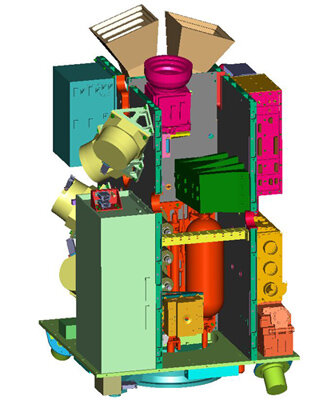
The spacecraft infrastructure technologies are:
- a new type of lithium-ion battery
- an advanced data and power management system, containing many new component technologies
- combined carbon-fibre and aluminium structural panels
- new models of reaction wheels, star trackers and GPS receivers
- an upgraded telecommand system with a decoder largely implemented in software
The passenger technologies are:
- a digital Sun-sensor
- a dual-frequency GPS receiver
- a fibre-sensor system for monitoring temperatures and pressures around the spacecraft
- a new star-tracker development being test-flown before use on the BepiColombo mission
- a very high precision flux-gate magnetometer
- an experimental solar panel with a solar flux concentrator
- a xenon gas propulsion system using resistojet thrusters and a solid-state nitrogen gas generator to pressurise the propellant tanks
- an exploration micro-camera (X-CAM)
Science payload
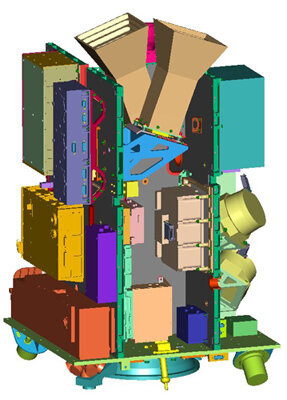
Four experiments are being flown: two for solar observations and two for space weather measurements.
The solar observations will be performed by a Lyman-Alpha radiometer (LYRA) and an extreme-ultraviolet telescope using new active pixel sensor (APS) technology - the Sun Watcher using AP-sensors and image Processing (SWAP) experiment.
LYRA will monitor four bands in a very wide ultraviolet spectrum while SWAP will make measurements of the solar corona in a very narrow band. Both experiments are collaborations between the Royal Observatory of Belgium, the Centre Spatiale de Liege, Belgium, and the World Radiation Centre in Davos, Switzerland.
The space weather experiments are Dual Segmented Langmuir Probes (DSLP) and a thermal plasma measurement unit (TPMU). DSLP will measure electron density and temperature in the background plasma of the Earth’s magnetosphere. TPMU will measure ion densities and composition. Both experiments are provided by the Institute of Atmospheric Physics at the Czech Academy of Sciences.
For more information contact:
frederic.teston @ esa.int