Proba-2: Spacecraft
Spacecraft configuration
Proba-2 is a 0.6 × 0.6 × 0.8 metre, box-shaped structure with two deployable solar panels and a nominal weight of 130 kilograms. The primary mechanical structure consists of three aluminium honeycomb panels arranged in an H configuration and a bottom panel that acts as the interface to the launch vehicle. Almost all the satellite system units are mounted on these inner panels.
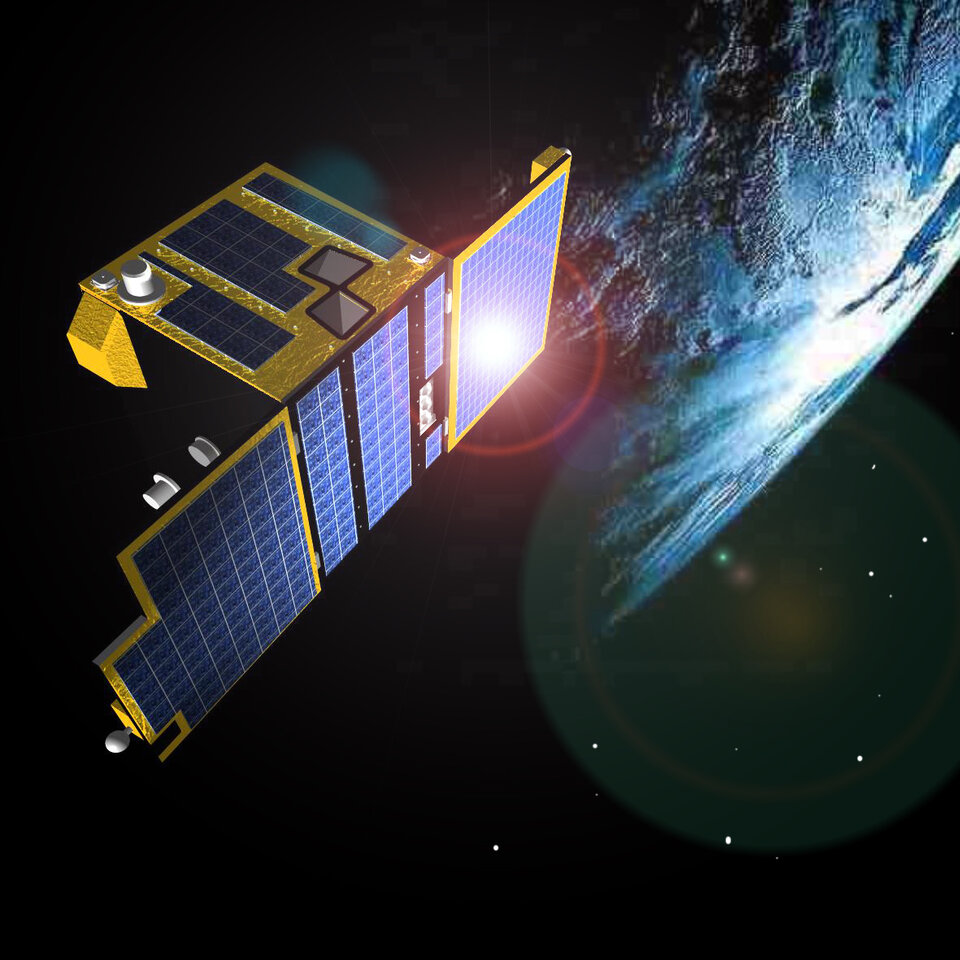
The outer panels that do not carry solar cells are also fabricated from aluminium honeycomb and are variously painted black to radiate to cold space or white to minimise absorption of solar radiation, as appropriate. The two deployable solar panels and the one outer panel with solar cells are fabricated from an aluminium honeycomb core with carbon fibre reinforced plastic (CFRP) skins.
Attitude control and navigation
Proba-2 is fully three-axis stabilised. Turning moments are supplied by four 30 mN-m Dynacon reaction wheels, which can be unloaded via magnetorquers. Attitude determination is performed using an autonomous high-accuracy (5 arcsec over 10 seconds) two-head startracker, GPS sensors and a three-axis magnetometer. Sun pointing to 100 arcsec accuracy is expected.
Autonomous navigation is enabled with GPS position determination and orbit propagation. All the required navigation and manoeuvring computations are performed onboard.
A single resistojet thruster, capable of producing a thrust of 20 mN, is being used for orbit adjustment. The thruster uses xenon as the propellant gas and, as the xenon supply is depleted, the tank is repressurised with nitrogen from a solid-state gas generator.
Electrical power
The Proba satellites are among the smallest satellites ever flown by ESA
Power is generated by triple-junction gallium-arsenide solar cells mounted on two deployable panels and one fixed panel. The solar generators provide a maximum of 110 watts of electrical power at the end of the nominal two-year mission. A 16.5 Ah lithium-ion battery supplies power during eclipses and when specific payload experiments require a peak power greater than the solar generators can supply.
The spacecraft’s power consumption varies between 70 watts and 110 watts, depending on its mode of operation.
Thermal control
As far as possible, thermal control uses passive means. However, the permanent Sun-pointing attitude required by the science instrument payload results in a large thermal gradient across the satellite, making purely passive thermal control extremely difficult to achieve. Heaters are used to control the temperature of the satellite’s battery, and are also required for decontaminating optical components of the LYRA and SWAP instruments. SWAP uses a passive radiator for cooling its detector.
Launch and orbit
| Orbit characteristics | |
|---|---|
| semi-major axis, kilometres | 7135 ± 15 |
| eccentricity | 0.00116 - 0.0025 |
| inclination, degrees | 98.445 ± 0.1 |
| mean local solar time at ascending node | 06:00 ± 1 min |
Proba-2 will be carried into orbit from Plesetsk, Russia, aboard a Rockot launch vehicle. It will be a secondary passenger during the launch of ESA’s Soil Moisture and Ocean Salinity (SMOS) mission.
Proba-2 will be directly injected into an almost circular, Sun-synchronous orbit. The chosen orbit is eclipse-free for more than nine months of each year, and is thus well matched with the requirements of the solar observation instruments. In the periods when eclipsing occurs, the eclipse duration rises from near-zero to a maximum of about 20 minutes and then returns to zero.
Communications
During normal operations, Proba-2 communicates via an S-band link with ESA’s Redu, Belgium, control centre, which is equipped with a 2.4 metre dish antenna. The S-band channel provides a 64 Kbit/sec packet telecommand uplink and a two-million symbols/sec packet telemetry down link. The Norwegian ground station on Svalbard is being used during the launch and early orbit phase (LEOP) and to provide extended science data download during the operational mission.
Mission operations
The Proba-2 mission is being controlled from a dedicated ground station at ESA Redu, in Belgium. Scientific data is distributed from Redu via a web server.
Industrial team
The Prime Contractor for the Proba-2 project is QinetiQ Space nv (formerly Verhaert Space nv, BE), a subsidiary of QinetiQ (GB), which is leading a pan-European team responsible for the development and manufacture of the satellite.