Proba-2 tracks Sun surging into space
Proba-2 is a small but innovative member of ESA’s spacecraft fleet, crammed with experimental technologies. In its first eight months of life it has already returned more than 90 000 images of the Sun.
Less than a cubic metre in volume, Proba-2 carries a new generation of miniaturised science instruments, focused on the Sun and space weather, as well as 17 state-of-the-art technology payloads.
Launched on 2 November 2009, Proba-2 began routine operations in February. A workshop at ESA’s ESTEC research and technology centre in the Netherlands on 22 June highlighted the microsatellite’s initial achievements.
“We’re getting very good results,” remarked John Jorgensen of Technical University of Denmark, which contributed the mission’s Micro Advanced Stellar Compass, a miniaturised startracker.
“This kind of platform works very well to provide in-flight demonstration of new technologies.”
Technological stepping stone
Proba-2 is a technological stepping stone to future missions. Its other payloads include an additional startracker planned for the BepiColombo mission to Mercury, a credit-card-sized magnetometer for the Aeolus wind-mapping satellite and a full-sized magnetometer for the Swarm constellation charting Earth’s magnetic field.
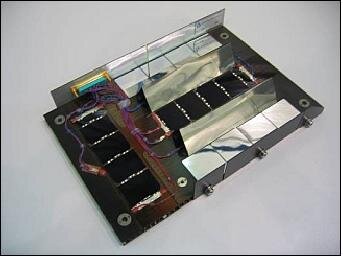
Other technologies might benefit future satellites in general. The Experimental Solar Panel, produced by Belgium’s Centre Spatial de Liège (CSL), surrounds a strip of four solar panels with mirrors to concentrate sunlight.
“Incoming light is concentrated by a factor of 1.55,” said Jean-Marc Defise of CSL. “The question is whether this will degrade over time. Workable solar concentrators mean less expensive solar cells could be used for telecom satellites.”
Another new technology could extend satellite lives. Most space missions end as their fuel runs low. But Proba-2’s gaseous xenon tank includes solid propellant cool gas generators that can be ignited to release gaseous nitrogen, replenishing tank pressure to squeeze out more performance.

The work of the Netherlands’ Bradford Engineering and TNO, the first firing of this Cold Gas Demonstration Experiment is scheduled later this year.
“The gas is chemically bonded in solid material for storage in a low volume with no pressurisation for long time periods,” said Johan Kuiper of Bradford Engineering. “Terrestrial uses include, amongst others, fire extinguishers, flotation devices and medical equipment.”
Following solar storms into space
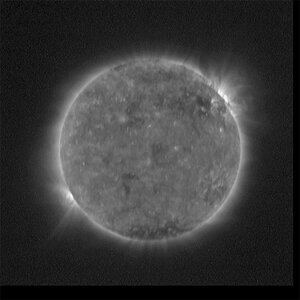
Proba-2’s scientific payloads are equally novel. Its SWAP Sun camera is the first solar physics instrument with Active Pixel Sensor (APS) detectors. This ESA-sponsored development offers improved dynamic range and radiation tolerance compared to standard CCDs. The BepiColombo startracker also uses APS.
SWAP is the size of a large shoebox, but acquires images 15 times more rapidly than its predecessor aboard the SOHO satellite.
“A modest telescope on a small satellite can indeed do great science,” said David Berghmans of the Royal Observatory of Belgium (ROB).
“NASA’s full-sized Solar Dynamics Observatory spacecraft has superior resolution, but SWAP has a wider field of view, so we can follow Coronal Mass Ejections as they leave the solar surface. We can even change the satellite’s pointing direction to track them through space.”
SWAP images are being used alongside data from LYRA, which records solar radiation at key ultraviolet wavelengths. Also designed by ROB, LYRA includes diamond detectors that are transparent to normal light but sensitive to extreme ultraviolet.
Two further science instruments study the plasma environment around the satellite: the Czech-built Dual Segmented Langmuir Probes and Thermal Plasma Measurement Unit.
Their results are proving useful scientifically but also operationally, casting light on how space weather may put satellites at risk.