• → European Space Agency

      • Space for Europe
      • Space News
      • Space in Images
      • Space in Videos
    • About Us

      • Welcome to ESA
      • DG's News and Views
      • For Member State Delegations
      • Business with ESA
      • ESA Exhibitions
      • ESA Publications
      • Careers at ESA
    • Our Activities

      • Space News
      • Observing the Earth
      • Human Spaceflight
      • Launchers
      • Navigation
      • Space Science
      • Space Engineering
      • Operations
      • Technology
      • Telecommunications & Integrated Applications
    • For Public

    • For Media

      • Media
      • ESA TV
      • Videos for professionals
      • Photos
    • For Educators

    • For Kids

    • ESA

    • Proba Missions

    • Proba-V at a glance
    • Overview
    • Objectives
    • About the instrument
    • V for Vegetation
    • Serving science
    • Fitting the world in a box
    • About the platform
    • Joining ESA’s Proba family
    • Boxing clever
    • About the mission
    • Made in Belgium
    • On the ground
    • Starting operations
    • New technology
    • Hitching a ride
    • Tracking aircraft from orbit
    • New space semiconductor
    • Detecting radiation
    • Fly by fibre
    • About the launch
    • Launcher
    • Launch site
    • Proba-V launch diary part 1
    • Proba-V launch diary part 2
    • Proba-V launch diary part 3
    • Proba-V launch diary part 4
    • What's next
    • Proba-3
    • Already flying
    • Proba-1
    • Proba-2
    • Multimedia
    • Proba-V images
    • Proba images
    • Proba Earth images
    • Videos
    • Animations
    • Contact
    • Contact us

    ESA > Our Activities > Technology > Proba Missions

    Proba-3 double satellite mission
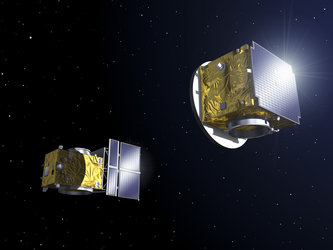
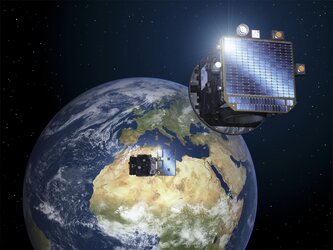
    Proba-3 for close formation flying

    Technologies

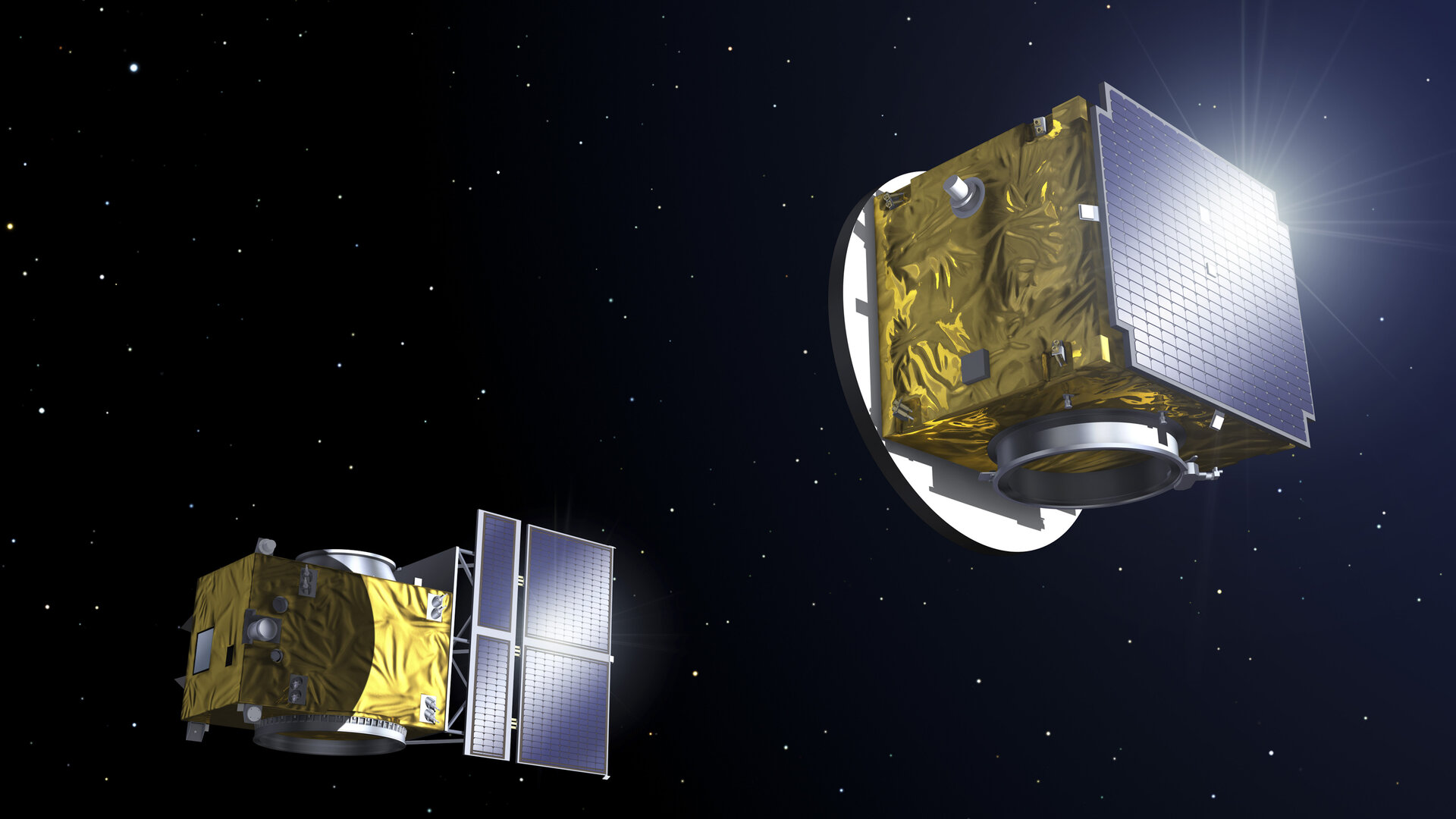
    A broad range of novel technologies will be essential to make Proba-3 a success. The mission’s formation flying system includes components in both satellites, with a Formation Flying Management system being in charge of scheduling and planning formation flying activities.

    The mission includes also a RdV experiment to test sensors and algorithms for Rendezvous (cooperative and uncooperative) in elliptical orbit. This technology could be used for a future Mars Sample return mission and for de-orbiting satellites from low-Earth orbit.

    The satellites will employ various methods to determine their relative positions. First of all, inter-satellite RF links will be established via an S-band system between the two spacecraft. Around perigee, GPS receivers will provide relative position of the satellites and the data will be propagated for the phase of the orbit where GPS signals are not available.

    High Performance Green Propellant thruster

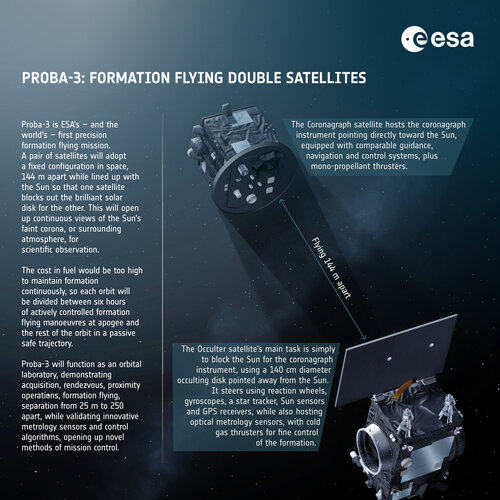
    For fine measurements during closer separations of less than 250 metres, this relative GPS system will be supplemented by a coarse optical metrology and then by a fine optical metrology on the coronagraph spacecraft, with corner cubes placed on the face of the Occulter spacecraft for tracking of relative position and attitude by the coronagraph satellite.

    Star trackers will be used for absolute attitude determination. The high precision requirements demand the co-location of all fine sensors and instrument on an optical-quality bench.

    Millinewton-scale cold gas thrusters will be placed aboard the Occulter spacecraft to precisely maintain the relative positions of the two satellites.


    The Coronagraph satellite will incorporate a monopropellant propulsion system for perigee passage manoeuvres and collision avoidance manoeuvres. This propulsion system is based on High Performance Green Propellant , a much less corrosive and toxic alternative to standard hydrazine monopropellant which also offers improved performance.

    Proba stands for the ‘PRoject for OnBoard Autonomy’ and the decision has been taken to make an expanded use of autonomous on-board control procedures for this mission. With operations staff on duty only during working hours, the majority of formation flying experiments will take place on an automated and autonomous basis.

    To serve widely-distributed project partners a new web-based data distribution system will be implemented. The aim is to make all operational information, including telemetry, available to all project partners on a reliable and secure basis within a very short timescale.

    Proba-3’s Systems Preliminary Design Review has been successfully passed in November 2012. marking the end of Phase B. The key technologies are reaching TRL 5 and the demanding formation flying software has been prototyped and run closed loop with a simulator. Proba-3 is ready to start full implementation (Phase C/D/E) in 2013.

    Last update: 11 April 2013

    Rate this

    Views

    Share

    • Currently 0 out of 5 Stars.
    • 1
    • 2
    • 3
    • 4
    • 5
    Rating: 0/5 (0 votes cast)

    Thank you for rating!

    You have already rated this page, you can only rate it once!

    Your rating has been changed, thanks for rating!

    277
    Tweet
    • More information
      • About Proba-3
        • Mission
          • Platforms
            • Technologies
              • Science payload
              • Proba-3 fact sheet (English)
              • Related article
                • ESA’s Tigers on prowl for solar corona’s secrets

    Connect with us

    • RSS
    • Youtube
    • Twitter
    • Flickr
    • G+
    • Facebook
    • Livestream
    • Subscribe
    • App Store
    • LATEST ARTICLES
    • · Earth Explorers take centre stage …
    • · The fast winds of Venus are gettin…
    • · ExoMars 2016 set to complete const…
    • · Herschel ends operations as orbiti…
    • · Europe’s largest spaceship reache…
    • FAQ

    • Jobs at ESA

    • Site Map

    • Contacts

    • Terms and conditions