• → European Space Agency

      • Space for Europe
      • Space News
      • Space in Images
      • Space in Videos
    • About Us

      • Welcome to ESA
      • DG's News and Views
      • For Member State Delegations
      • Business with ESA
      • ESA Exhibitions
      • ESA Publications
      • Careers at ESA
    • Our Activities

      • Space News
      • Observing the Earth
      • Human Spaceflight
      • Launchers
      • Navigation
      • Space Science
      • Space Engineering
      • Operations
      • Technology
      • Telecommunications & Integrated Applications
    • For Public

    • For Media

      • Media
      • ESA TV
      • Videos for professionals
      • Photos
    • For Educators

    • For Kids

    • ESA

    • Space for health

    • What space can do

      • Space for Health
      • Wellness

        • Wellness
        • Exercise
        • Food
      • Medicine

        • Medicine
        • Medical Research

          • Medical research
          • Physiology
          • Psycho-sociological issues, Cognition and performance
          • Clinical research
        • Diagnosis and treatment

          • Diagnosis and treatment
          • Tele-consultation
          • Homecare and mobile care
        • Emergency and disaster medicine
        • Medical education
        • Biomedical engineering
      • Environmental Health

        • Environmental Health
        • Air quality and pollution
        • Water
        • UV radiation
      • Public health

        • Public Health
        • Disease Surveillance
        • Disaster Relief and Emergency Management
        • Patient data management
        • Strategy and policy
    • What space offers

      • Space assets for health - overview
      • Earth observation
      • Satellite communications
      • Satellite positioning/navigation
      • Human spaceflight
      • Operations and infrastructure
    • Users/partners and ESA's role

      • ESA's role and offer
    • Services
    • Questions, ideas, comments... Contact us
    • Site credits

    ESA > Our Activities > Technology > Space for health

    Pulmonary Function

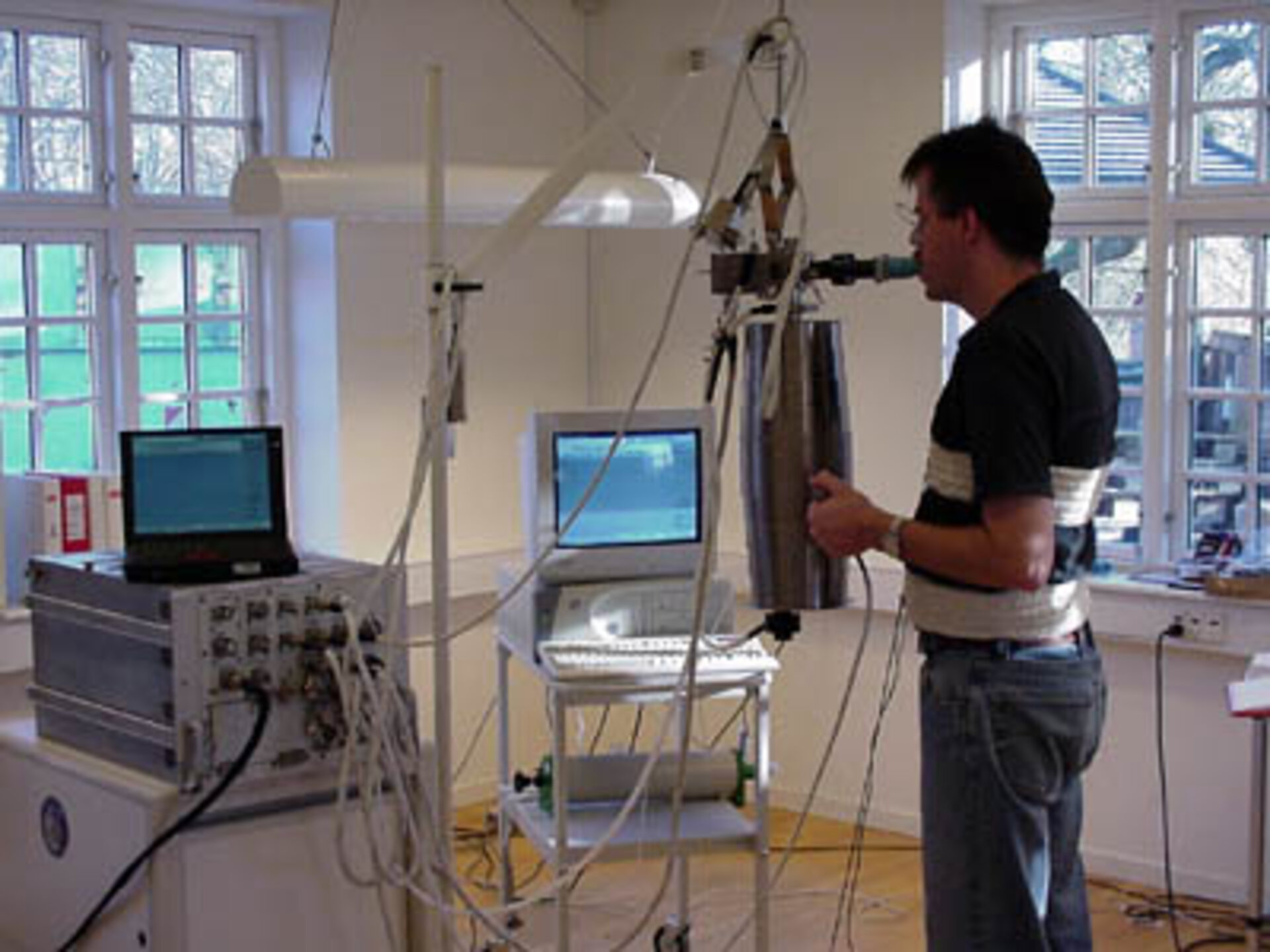
    PFM/PAM in operational mode
    PFM/PAM for Pulmonary Function System in operational mode

    Floating particles in microgravity
    Under the weightless and confined environment of spaceflight, astronauts are at risk of breathing dust and small particles free floating in the atmosphere. These particles can enter deep into the lungs, from the airways ducts to the alveolae. Depending on their composition they can cause irritation, bacterial contamination, or even lead to cancer. Therefore the development of efficient air filtering and cleaning systems is a priority, as also is the development of appropriate diagnostic devices.

    Gravity and pulmonary function
    Pulmonary function is also investigated in space because the distribution of blood into the lungs depends on gravity. On earth, due to the presence of hydrostatic pressure gradients, pulmonary blood flow is larger at the base than at the apex of the lungs. In microgravity blood is uniformly distributed in the lungs. Thus in-homogeneity of ventilation/perfusion, a confounding factor, is removed. Therefore the in-homogeneity of ventilation into the lungs has been studied during the past two decades. This fundamental research has contributed to improving the physical models of the lungs and gas exchange that are used in diagnostic devices and techniques for the assessment of pulmonary function.

    Breathing and extra-vehicular activities (EVA)
    Moreover, the headward fluid shift, which causes an afflux of blood into the thoracic cavity, leads to pressure changes in pulmonary circulation. This, combined with the lower atmospheric pressure that is maintained in the space suits of the astronauts while performing an EVA, generates environmental conditions similar to that faced by divers who can be exposed to venous gas emboli and decompression sicness. Such activities can potentially lead to pulmonary oedema, a fluid accumulation in the lungs causing impaired gas exchange, and possibly also lead to respiratory failure.

    Research & Development
    For all these reasons the pulmonary function has been extensively studied in space and remains an important subject of research. Specific diagnostic and research devices have thus been, and are still being developed (from the oldest to the newest esa developed systems for the evaluation of pulmonary function: ANTHRORACK, ARMS, PFS, PPFS, PLATON, MAP-RSS), and diagnostics methods are being improved.

    Health related topics: pollution, dust particles, smoking, asbestos, asthma, and other pulmonary diseases, chronic obstructive pulmonary disease, monitoring at home, decompression syndrome…

    Last update: 16 January 2008

    Rate this

    Views

    Share

    • Currently 0 out of 5 Stars.
    • 1
    • 2
    • 3
    • 4
    • 5
    Rating: 0/5 (0 votes cast)

    Thank you for rating!

    You have already rated this page, you can only rate it once!

    Your rating has been changed, thanks for rating!

    21
    Tweet

    Connect with us

    • RSS
    • Youtube
    • Twitter
    • Flickr
    • G+
    • Facebook
    • Livestream
    • Subscribe
    • App Store
    • LATEST ARTICLES
    • · Rare merger reveals secrets of gal…
    • · Watching for hazards: ESA opens as…
    • · ESA astronaut Timothy Peake set fo…
    • · Space drives e-mobility
    • · Proba-V opens its eyes
    • FAQ

    • Jobs at ESA

    • Site Map

    • Contacts

    • Terms and conditions