Filming the 'green car' speed record
It was an uninspiring grey early morning on 4 November on the southern outskirts of Paris. EuroNews cameras were at the Brétigny flight test centre. But the engine revving up was not a jet fighter but a prototype racing car preparing to break a world record.
From the outside, the sleek car resembled any other racing vehicle. Its mechanics and engineers were attending to it in the same way as for a 24-hour Le Mans race.
But beneath the white bodywork, this was no ordinary vehicle. Its engine was running not on petrol, but with liquefied propane gas (LPG). The objective was to establish a new speed record using such an alternative 'green' energy.
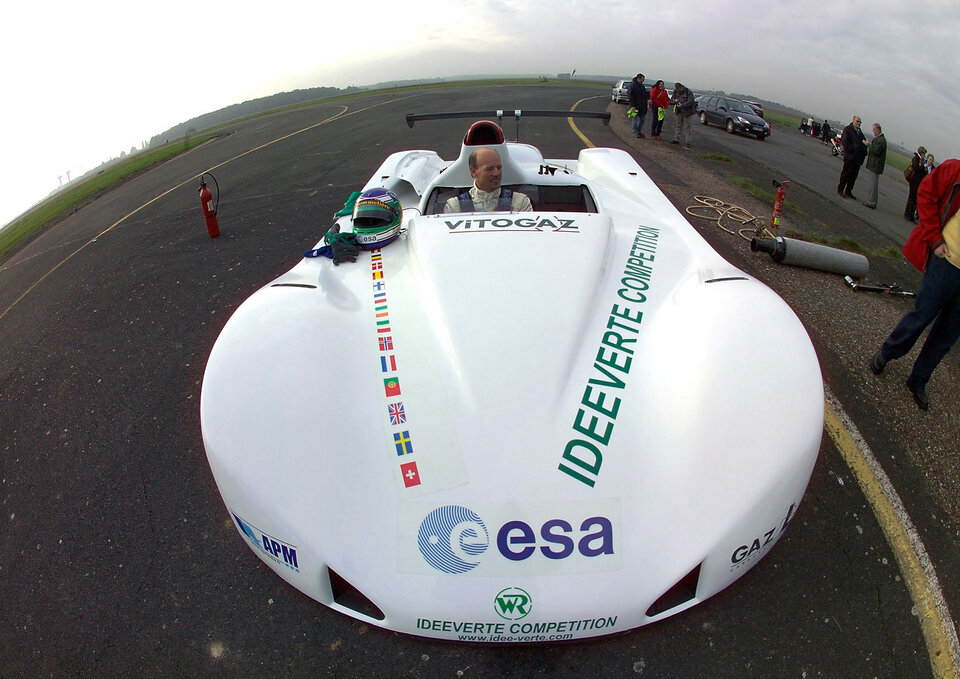
As the car lined up for the 2.3 km sprint down the runway, Sylvain Boulay recapped on the driving advantages of such a fuel. "At the wheel, a gas powered engine responds better than a conventional petrol one. It reacts immediately and the increase in speed is smoother as we gear-up."
There was little wind, the conditions were favourable as the 365 horsepower of the V6 engine clamoured to leap forward. Members of IdéeVerte Compétition, created 12 years ago as an independent and non-profit association, were confident.
The team has long believed in the value of alternative fuels as an answer to the environmental and pollution issues generated by today's cars. "We have always considered that petroleum or natural gas and other bio fuels have great potential, and in the long term will be more interesting than conventional petrol," explained Alain Lebrun, the Association's founder and president. "We believed that competition racing would be the best way to raise public awareness about fuels that are more efficient and pollute less."

A team member took the cameras to the rear of the vehicle and wiped the inside of its exhaust pipe with a white cloth. "Just see for yourselves, there are no particle deposits, no oily smears, no soot."
Such a prototype has however required the most innovative technologies – including ones originally developed for space applications. The European Space Agency has, for instance, helped improve safety in particular to reduce fire risks.
The LPG fuel tank and the exhaust system are insulated with thermal heat wrapping materials developed for the Ariane launcher. They also reduce the risks of gas leaks igniting. The tank itself is made of lightweight titanium developed by space engineers. The driver also has automatic fire extinguishers stemming from Russian rockets.

EuroNews cameras lined up for the record attempt. The car was ready for its first run. Even its speed, acceleration and position were logged using EGNOS satellite navigation and tracking devices.
The white beast revved up and thundered down the runway. Only a few seconds later and everyone watching the digital control clocks was beaming with satisfaction: 315 km/hour, a new record!
"We were not hoping for as much," said a joyous Pierre Brisson, head of ESA's Technology Transfer and Promotion Office. "We were aiming to reach 300 km/h and that first run at 315 km/h has qualified as a world record. We are absolutely delighted."
As the champagne bottles were opened to celebrate, the IdéeVerte association and its backers were even more convinced that alternative, 'green' fuels will sooner or later be more readily accepted in a world of motoring that is more environmentally conscious.