• → European Space Agency

      • Space for Europe
      • Space News
      • Space in Images
      • Space in Videos
    • About Us

      • Welcome to ESA
      • DG's News and Views
      • For Member State Delegations
      • Business with ESA
      • ESA Exhibitions
      • ESA Publications
      • Careers at ESA
    • Our Activities

      • Space News
      • Observing the Earth
      • Human Spaceflight
      • Launchers
      • Navigation
      • Space Science
      • Space Engineering
      • Operations
      • Technology
      • Telecommunications & Integrated Applications
    • For Public

    • For Media

    • For Educators

    • For Kids

    • ESA

    • Telecommunications & Integrated Applications

    • TIA - About Telecommunications
    • About ESA's TIA Directorate
    • Telecommunications satellites
    • Orbits
    • The Satcom market
    • Historical overview
    • Artemis
    • Hylas-1
    • ESA's Telecommunication Programmes
    • ARTES programme overview
    • Alphabus/Alphasat
    • SmallGEO
    • EDRS
    • Iris
    • Integrated Applications Promotion (IAP)
    • Partner Programme: Electra
    • Multimedia
    • Image gallery
    • Video gallery
    • Services
    • Subscribe
    • RSS feeds

    ESA > Our Activities > Telecommunications & Integrated Applications

    Artemis launch

    Artemis was originally scheduled for launch on a Japanese H-IIA rocket under a cooperative agreement with the Japanese space agency, NASDA. However, development delays with the launcher caused ESA to review its launch options during the second half of 2000.

    Artemis will now be launched on an Ariane rocket in summer 2001 from the European launch base in Kourou, French Guiana, South America.

    The change of launcher does not require any design modifications to the satellite.

    A launcher for the future
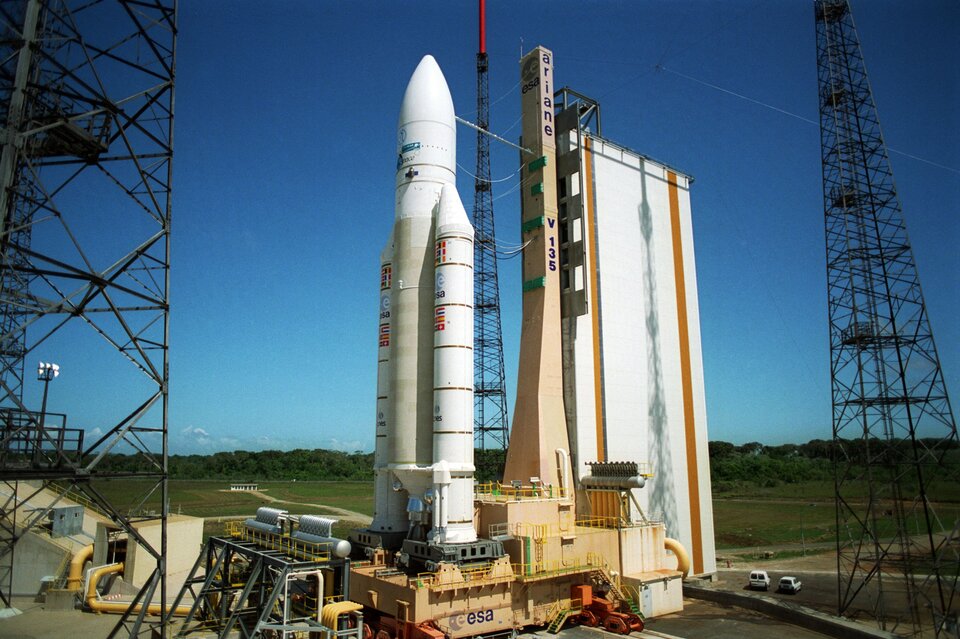
    Ariane 507, V135 on the launch pad
    Ariane 507, V135 on the launch pad

    Ariane 5 is the first in a new generation of heavy-lift launchers and is perfectly tailored to meet the diversifying demands of the rapidly changing commercial launcher market, including larger satellites, a wider range of orbits and combined missions.

    The launcher was conceived by ESA to ensure that Europe maintained its competitive edge in the worldwide market. Flying between eight and 10 missions every year, it will eventually replace the highly successful Ariane 4 series.


    Trajectory

    trajectory diagram from Arianespace
    trajectory diagram from Arianespace

    The launcher’s attitude and trajectory are controlled by two onboard computers which optimise the trajectory to minimise propellant consumption.

    Some seven seconds after the cryogenic main engine fires, the two solid propellant boosters are ignited, enabling lift-off from the launch pad in French Guiana. At first the launcher climbs vertically but after about five seconds it rotates and heads towards the east. After some 600 seconds the first stage is subsequently jettisoned and, left to follow its own ballistic trajectory, falls back off the coast of the Galapagos Islands into the Pacific Ocean.

    In order to propel the Artemis spacecraft into orbit, the final stage of the Ariane 5 will have to reach a velocity of approximately 9,000 metres/second and an altitude close to 1,600 km. This will place the satellite in what is known as an ‘elliptical geostationary transfer orbit’, which has a low point (perigee) of 600 km and a high point (apogee) of 36,000 km.

    At this point the Ariane 5 launcher will have completed its main tasks and the 3,100 kg Artemis satellite will continue alone on its journey to geostationary orbit some 36,000 km above the Earth.

    Once in position, Artemis will undergo a three-month commissioning phase to ensure that all payload instruments are operating as specified.

    Last update: 11 June 2001

    Rate this

    Views

    Share

    • Currently 0 out of 5 Stars.
    • 1
    • 2
    • 3
    • 4
    • 5
    Rating: 0/5 (0 votes cast)

    Thank you for rating!

    You have already rated this page, you can only rate it once!

    Your rating has been changed, thanks for rating!

    6
    Tweet
    • Related news
      • Artemis: Europe's advanced telecommunication satellite to be launched soon on Ariane-5
      • Artemis - introduction
      • Artemis - the satellite
      • Artemis - vital statistics
      • Related links
      • Telecommunications Homepage
      • Artemis homepage

    Connect with us

    • RSS
    • Youtube
    • Twitter
    • Flickr
    • G+
    • Facebook
    • Livestream
    • Subscribe
    • App Store
    • LATEST ARTICLES
    • · ESA astronaut Timothy Peake set fo…
    • · Space drives e-mobility
    • · Proba-V opens its eyes
    • · First new Galileo satellite arrive…
    • · Next destination: space
    • FAQ

    • Jobs at ESA

    • Site Map

    • Contacts

    • Terms and conditions
