


Artemis makes first moves
European scientists and engineers breathed a collective sigh of relief when Artemis – ESA’s newest and most advanced communications spacecraft – wrapped up the first leg of its journey towards orbit.
The 3,100 kg satellite completed an 8,000 km sea voyage from Europe to the jungle launch base at Kourou in French Guiana in South America this spring.
Artemis started its journey by road in a convoy of lorries which left ESA's space technology centre (ESTEC) in Noordwijk, the Netherlands destined for the French port of Le Havre.
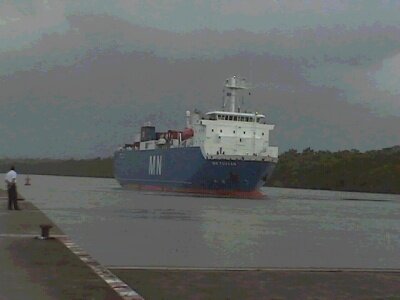
Here the hi-tech cargo was transferred into the specially equipped transport ship, Toucan, for the sea voyage to the European space port at Kourou operated by Arianespace on the opposite side of the Atlantic.
The satellite was accompanied by an ever-vigilant team of Aleniaspazio engineers, who braved stormy seas and worked around the clock to monitor environmental conditions and ensure the precious cargo remained in pristine condition.
The tropical heat of Kourou marked the end of the first leg of a journey that will eventually take Artemis a further 36,000 km into geostationary orbit high above the Earth, where it will act like a modern and very sophisticated communications relay exchange.
Since its arrival in warmer climates, Artemis has been undergoing a series of pre-launch tests and final checks in preparation for the announcement of a specific launch date, which will be on an Ariane 5 rocket later this summer
As the most advanced telecommunications satellite of its kind built by ESA, Artemis will make valuable contributions to advancing mobile telecommunications services and navigation systems over its planned ten years in orbit.
Low-Earth orbiting satellites – such as those that monitor our land and seas – will be able to use Artemis as a quicker and more efficient way of sending and receiving information to and from Earth.
In addition to its sophisticated data relay payload, Artemis is equipped with some revolutionary technologies. In particular, Ion propulsion, which extends in-orbit life at astonishingly low fuel consumption, and for the first time a laser communications link, called SILEX, which will provide unprecedented capacity for satellite to satellite communications in space.
Initially, the SILEX laser instrument will provide a high capacity data relay transmission facility for the French Spot 4 Earth observation satellite, allowing Earth images to be transmitted via Artemis direct to scientists on the ground.
Artemis will also work in harmony with ESA's giant new Earth observing satellite, Envisat, immediately after its launch later in 2001 and high data rate experiments will continue in subsequent years with the Japanese satellite, OICETS.

