• → European Space Agency

      • Space for Europe
      • Space News
      • Space in Images
      • Space in Videos
    • About Us

      • Welcome to ESA
      • DG's News and Views
      • For Member State Delegations
      • Business with ESA
      • ESA Exhibitions
      • ESA Publications
      • Careers at ESA
    • Our Activities

      • Space News
      • Observing the Earth
      • Human Spaceflight
      • Launchers
      • Navigation
      • Space Science
      • Space Engineering
      • Operations
      • Technology
      • Telecommunications & Integrated Applications
    • For Public

    • For Media

      • Media
      • ESA TV
      • Videos for professionals
      • Photos
    • For Educators

    • For Kids

    • ESA

    • Telecommunications & Integrated Applications

    • ARTES

    • TIA - About Telecommunications
    • About ESA's TIA Directorate
    • Telecommunications satellites
    • Orbits
    • The Satcom market
    • Historical overview
    • Artemis
    • Hylas-1
    • ESA's Telecommunication Programmes
    • ARTES programme overview
    • Alphabus/Alphasat
    • SmallGEO
    • EDRS
    • Iris
    • Integrated Applications Promotion (IAP)
    • Partner Programme: Electra
    • Multimedia
    • Image gallery
    • Video gallery
    • Services
    • Subscribe
    • RSS feeds

    ESA > Our Activities > Telecommunications & Integrated Applications

    Artemis vital statistics

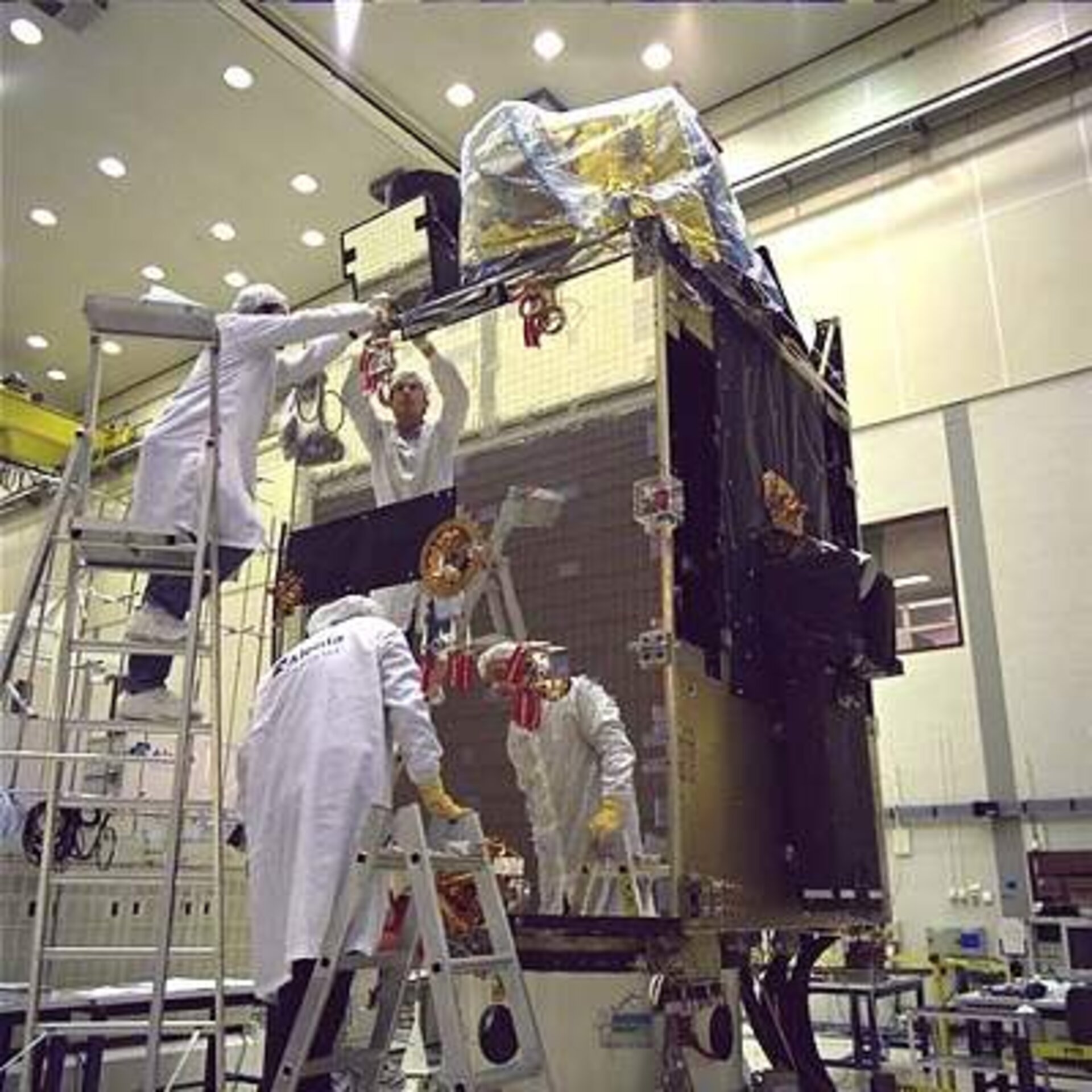
    Artemis in testing at ESTEC
    Artemis in testing at ESTEC

    Satellite characteristics

    Mass
    at launch
    3,100 kg
    Power consumption 2.5 kW
    Height 4.8 metres
    Length 25 metres
    (solar array tip to tip)
    Width 8.0 metres
    (with antennas deployed)
    Launch 2001
    Lifetime 10 years
    Orbital position 21.5°E
    Mobile payload
    Coverage Europe (to Urals), North Africa & Middle East
    Frequency bands 1.5 GHz (L-band) to/from mobiles
    12/14 GHz (Ku-band) to/from fixed Earth stations
    Voice channels <360 bi-directional (eurobeam)
    <662 bi-directional (spotbeam)
    Mobile terminal
    antenna size
    20 cm by 40 cm
    Data relay payload
    Coverage Approx. 65% of orbits
    Feeder/downlink coverage Western Europe
    Inter orbit link
    (S-band 2GHz)
    1 Mbps in the forward direction
    (i.e. Artemis to low altitude spacecraft)
    3 Mbps in the return direction
    (i.e. low altitude spacecraft to Artemis)
    Ka-Band (23/26 GHz) 10 Mbps in the forward direction
    3 x 150 Mbps in the return direction
    Optical (0.8nm) 2 Mbps in the forward direction
    50 Mbps in the return direction
    Navigation payload
    Coverage global (specifically Europe)
    Mass 25 kg
    Power 110 W
    Antenna (downlink) horn antenna
    (uplink) LLM antenna (2.8 m Ø)
    Frequency band (downlink) 1.6 GHz (L-band)
    (uplink) 14 GHz (Ku-band)

    Last update: 28 September 2004

    Rate this

    Views

    Share

    • Currently 0 out of 5 Stars.
    • 1
    • 2
    • 3
    • 4
    • 5
    Rating: 0/5 (0 votes cast)

    Thank you for rating!

    You have already rated this page, you can only rate it once!

    Your rating has been changed, thanks for rating!

    5
    Tweet
    • Related news
      • Artemis: Europe's advanced telecommunication satellite to be launched soon on Ariane-5
      • Artemis - introduction
      • Artemis - the satellite
      • Artemis - launch

    Connect with us

    • RSS
    • Youtube
    • Twitter
    • Flickr
    • G+
    • Facebook
    • Livestream
    • Subscribe
    • App Store
    • LATEST ARTICLES
    • · Rare merger reveals secrets of gal…
    • · Watching for hazards: ESA opens as…
    • · ESA astronaut Timothy Peake set fo…
    • · Space drives e-mobility
    • · Proba-V opens its eyes
    • FAQ

    • Jobs at ESA

    • Site Map

    • Contacts

    • Terms and conditions
