Launcher
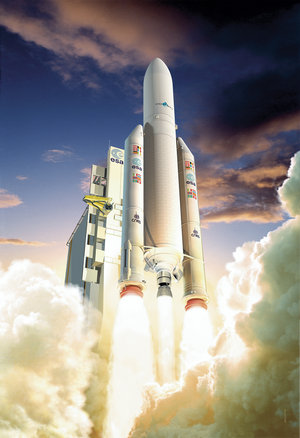
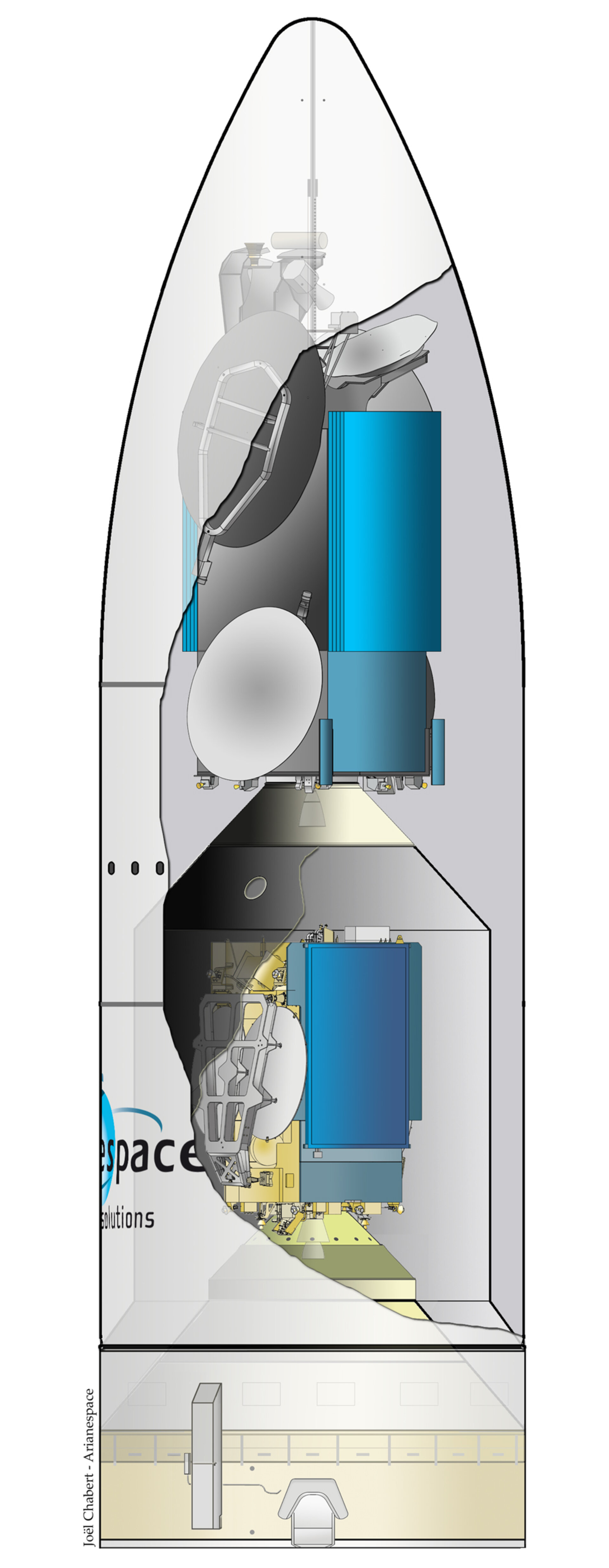
Hylas-1 launched on an Ariane 5, Europe's single most powerful launcher. It shared its ride to geostationary transfer orbit with a second telecommunication satellite, Intelsat 17.
| Main data | Ariane 5 ECA |
|---|---|
| Height | up to 53 m |
| Diameter | up to 5.4 m |
| Liftoff mass* | 780 t |
| Payload mass** | 10.0 t |
* Double launch
** Into geostationary transfer orbit (GTO)
The 54th Ariane 5 (V198) lifted off from Kourou, French Guiana, at 15:39 local time (1839 GMT, 1939 CET) and released its two payloads, Hylas-1 and Intelsat 17, into their planned transfer orbits.
The latest version of the Ariane 5 launcher, Ariane 5 ECA, is designed to place payloads weighing up to 9.6 tonnes into GTO. With its increased capacity, Ariane 5 ECA can handle dual launches of very large satellites.
This version of the Ariane 5 is helping to maintain Europe’s competitiveness in the commercial space transport sector by offering customers the opportunity to launch a wider range of heavier satellites while reducing launcher production costs.
Ariane 5 ECA

Ariane 5 ECA is an improved Ariane 5 Generic launcher. Although it has the same general architecture, a number of major changes were made to the basic structure of the Ariane 5 Generic version to increase thrust and enable it to carry heavier payloads into orbit.
Solid boosters (EAP)
The EAP boosters’ upper segment of the Ariane 5 ECA (also known as segment S1) carries 10% (2.5 tonnes) more propellant. This extra propellant gives the Ariane 5 ECA an additional 50 tonnes of thrust in the first 20 seconds following liftoff. This means that together the twin boosters deliver a thrust of 1300 tonnes at liftoff, nearly 10 times the level delivered by the new engine of the central stage.
The boosters are also equipped with a new nozzle that has fewer parts and is easier and cheaper to produce.
Main stage (EPC and Vulcain 2 engine)

An improved version of the Vulcain engine was developed for the Ariane 5 ECA version. The Vulcain cryogenic engine was modified to increase its thrust by 20%, up to 137 tonnes. This new Vulcain 2 operates under slightly higher pressure with a mixture ratio that has 20% more liquid oxygen than the Vulcain 1. Because of this change in the mixture, a new oxygen turbopump was developed.
In addition, the Vulcain 2 turbopump exhausts are reinjected into the main system, thus improving engine performance at high altitude. The Vulcain 2 engine is a key contributor to the additional lift capability of the new Ariane 5 ECA version into GTO.
To hold the extra liquid oxygen needed for the EPC core stage, the capacity of the liquid oxygen tank was increased by 16 tonnes. This was achieved by relocating the common tank bulkhead between the liquid oxygen tank and the liquid hydrogen tank of the Ariane 5 Generic EPC stage and reinforcing the structure elements.
The new fuel load capacity of the EPC is:
- Liquid oxygen: 150 tonnes
- Liquid hydrogen: 25 tonnes
The EPC stage operates for nearly 540 seconds. It also performs the roll control function during all its propulsion phase. At shutdown, at an altitude between 160 km and 210 km, depending on the mission’s trajectory, the EPC stage separates from the upper composite and reenters the atmosphere above the Atlantic Ocean.