


Iris: watch how satcoms help pilots
ESA is set to unveil a new interactive display in Amsterdam demonstrating communications via satellite for pilots as part of its pioneering Iris air traffic management project.
By 2020 Iris will allow cockpit crews to exchange digital messages with air traffic controllers wherever they are over the oceans and continents.
The display shows how controllers will compose and send data messages to aircraft, and then how the pilots respond. A typical message might include instructions from controllers on what heading to take. Different screens show the controller's view, what the pilot sees, and the air traffic covered by the satellite.
Built by the University of Salzburg, the display can be seen at the Air Traffic Control Global Exhibition and Conference in Amsterdam RAI during 6-8 March. Registration to visit the exhibition is free. Visit the conference website by clicking the link in the column to the right.

Iris allows more reliable exchanges and over wider geographical regions than is possible today, explains Nathalie Ricard, running ESA’s Iris project.
“When talking to our aviation partners about satellite communications, we realised there was some concern that satcoms would complicate the tasks of controllers and pilots because it is not integrated into aviation safety systems today.
“But they will be in the future. With Iris, pilots and controllers won’t even notice that their exchanges travel via satellite.
“We thought we should develop a mockup that shows these advantages, and simulate interactively how it works.”

“The University of Salzburg is a centre of expertise for aviation, and is respected in Europe when it comes to new air traffic management technology,” says Nathalie. “It has been involved with Iris from the start.”
Europe’s air traffic management system has more than 60 different sectors, all controlled individually. Pilots and controllers still communicate mostly by voice over VHF or HF radio, as they did in the 1950s.

Initial limited data links are already being introduced over Europe for essential communications using technology developed in the 1980s, but they will not be able to handle the growth in traffic by 2020.
Aircraft will need more capable links with the ground – and this is where Iris comes in. Iris provides the pipeline to the aircraft, while the aviation industry decides what to use that pipeline for. This could include letting the airline know how much fuel remains or continuously monitoring the aircraft’s whereabouts.
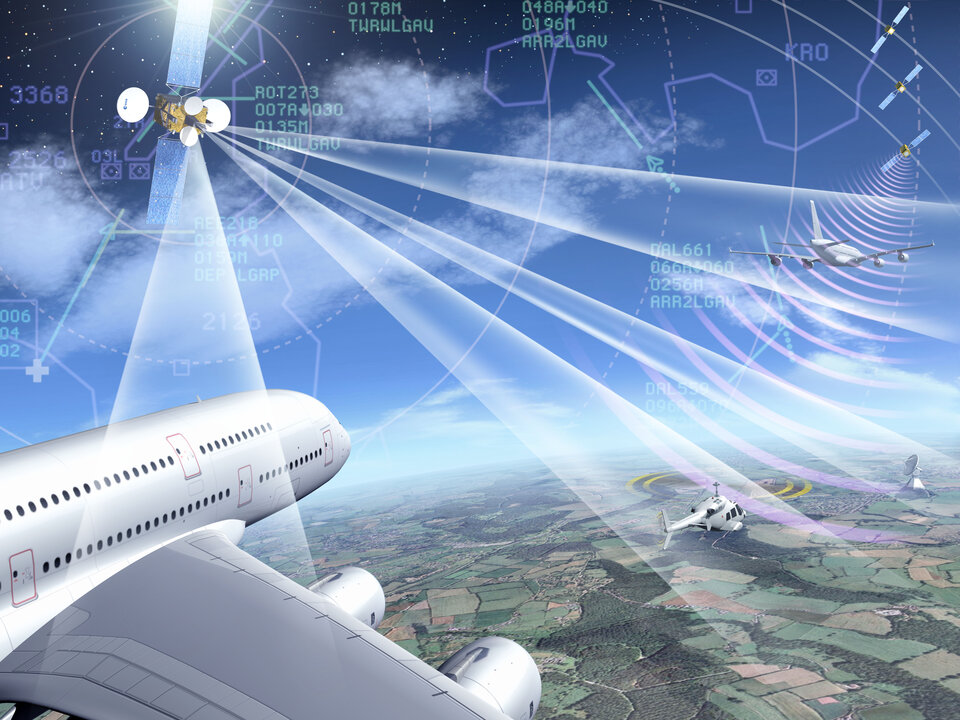
In recognising the need to modernise Europe’s air traffic management, the European Commission began the Single European Sky Policy. Part of that includes the Single European Sky ATM Research Programme: SESAR.
SESAR aims to develop a high-performance ATM system to enable the safe and environmentally friendly development of air transport.

As a result, a unique window of opportunity opened to develop a space-based solution to improve the safety of Europe’s skies.
ESA began Iris in 2007 to promote satcoms as part of SESAR. Thanks to this effort, the value of satcoms for aviation has been recognised and included in the ATM master plan.
Iris is a new type of initiative for ESA in which the space component is only one element of a much larger system.
It is being designed with the support of the European Commission, the SESAR Joint Undertaking, Eurocontrol, Europe’s space industry, air navigation service providers and aviation stakeholders.
For more information, see the links in the column to the right.


