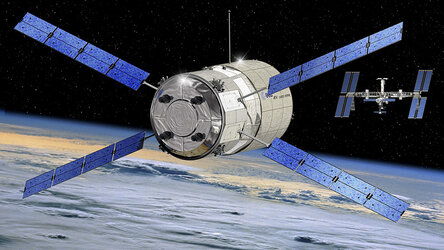
Automated Transfer Vehicle
The International Space Station depends on regular deliveries of equipment and spare parts as well as food, air and water for its crew. Since its first mission in 2008 Europe's Automated Transfer Vehicle (ATV) has been indispensable to the International Space Station.
Every 12 months or so, ATV hauls 7.7 tonnes of cargo from its launch site in Kourou, French Guiana to the Station 340 km above the Earth. High-precision navigation systems guide ATV on a rendezvous trajectory to the International Space Station where it automatically docks with the Station's Russian service module. ATV remains there as a pressurised and integral part of the Station for up to six months until its final mission: a fiery one-way trip into Earth's atmosphere to dispose of up to 6.4 tonnes of Station waste.
| Dimensions | |
|---|---|
| Length: | 9 794 mm |
| Diameter: | 4 480 mm |
| Solar arrays span: | 22 281 mm |
| Mass | |
| Vehicle dry mass: | 10 470 kg |
| Vehicle consumables: | 2 613 kg |
| Total vehicle mass: | 13 083 kg |
| Total cargo upload capacity: | 7 667 kg |
| Mass at launch: | 19 357 kg |
| Waste download capacity: | 6 400 kg |
| Launch configuration | |
|---|---|
| Cargo mass capabilities | Dry supplies: 5 500 kg |
| Drinking water: 840 kg | |
| Air (oxygen and nitrogen): 100 kg | |
| Refuelling propellant: 860 kg | |
| Reboost and attitude control propellant: 4 700 kg | |
| Total cargo upload capacity: 7 667 kg | |
| Launch vehicle | Ariane 5 ES (inclination 51.6°, initial orbital altitude 260 km) |
| ATV is launched with its solar panels folded | |
| Launch site | Kourou, French Guiana |
| First flight | 9 March 2008 |