COROT instruments
The payload of the COROT satellite consisted of a telescope, a wide-field two-part camera – one for each of the two mission objectives (exoplanet search and asteroseismology) – sensitive to visible light, and the on-board computer processors provided by ESA.
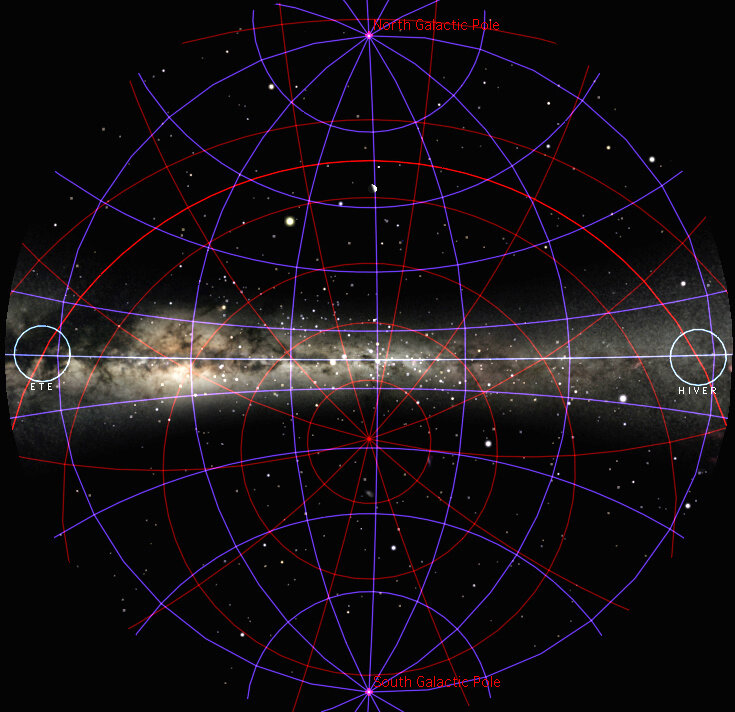
The telescope itself contained a primary mirror of 30 centimetres in diameter. It consists of two parabolic mirrors, and has a 1.1-metre focal length. The field of view is a square of 2.8 × 2.8 degrees, half for the seismology mission, the other half for the exoplanet mission. A prism, used by the telescope for certain aspects of the mission, will separate colours, enabling scientists to study stellar activity during a planetary transit.
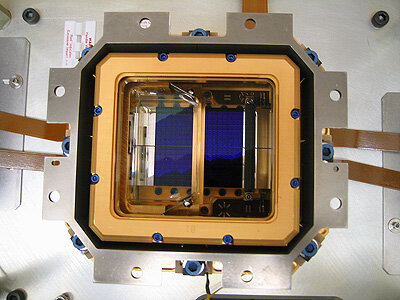
During the mission, the telescope collected the light from thousands of stars and fed it into a special two-part camera. One half of the camera was designed to look for planets; the other half was optimised to detect the subtle variation in a star's light, caused by sound waves rippling across the surface. These waves are the equivalent of seismic waves on the Earth.
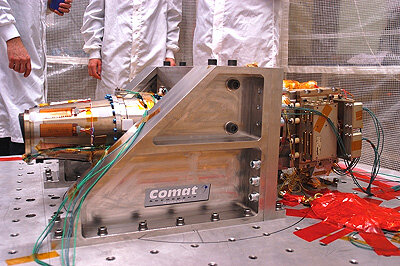
Both mission goals required the camera to be sensitive to changes in a star's light of just one part in one hundred thousand. To help reach this sensitivity, a design team at ESA came up with a highly successful 'baffle', external to the telescope, that prevented stray light from entering the telescope. In practice, the baffle was a device for shielding the camera from 'light pollution' coming from sources other than those objects at which the telescope is looking.
The analysis of the 3-colour light curves that COROT gathered thanks to a prism mounted in front of the exoplanet channel camera detectors (CCD's), made it possible to distinguish between the different families of detected events (transits, stellar activity, eclipsing binaries).
Planetary transits are achromatic events, which means that the colour of light we detect coming from the star doesn't change during these events. Stellar activity, on the other hand, are expected to be highly chromatic (meaning the light colour changes) due to temperature variations.
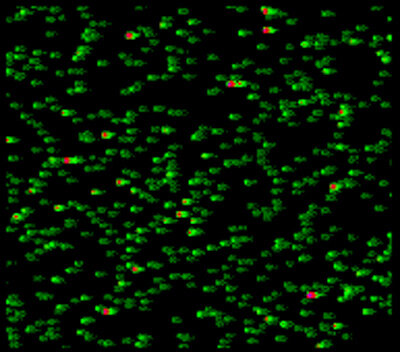
COROT surveyed more than 120 000 stars with 'magnitudes' between 12 and 15.5.