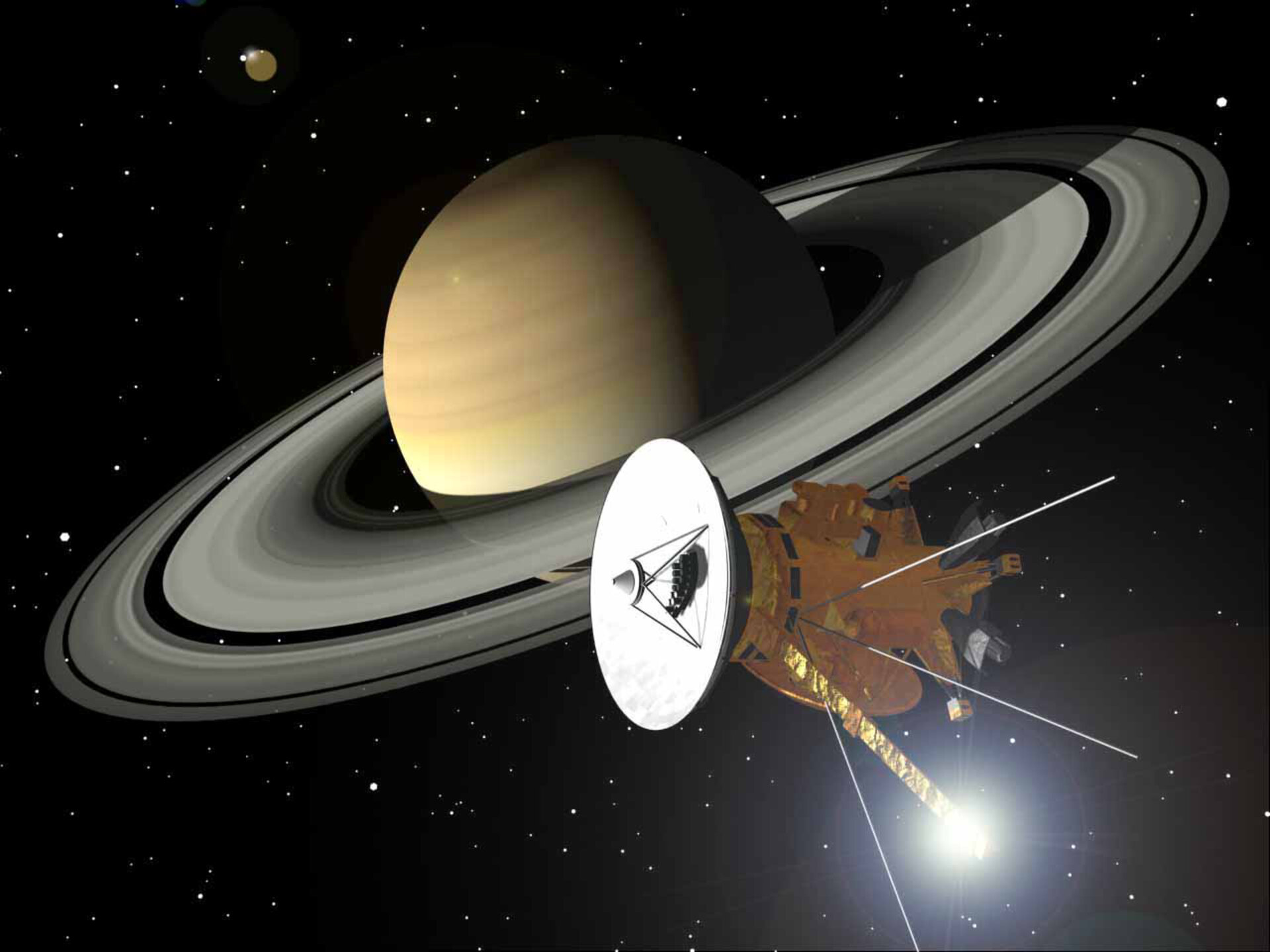
Cassini spacecraft
At the time of its launch, the Cassini-Huygens spacecraft was one of the largest, heaviest and most complex interplanetary spacecraft ever built. Of all interplanetary spacecraft, only the two Phobos spacecraft sent to Mars by the former Soviet Union were heavier.
Loaded with an array of powerful instruments and cameras, the spacecraft was capable of taking accurate measurements and detailed images in a variety of atmospheric conditions and light spectra.
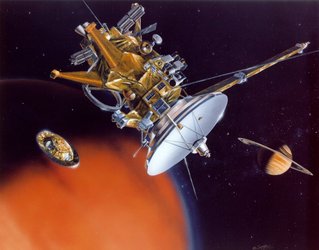
Two elements comprised the spacecraft: the Cassini orbiter and the Huygens probe.
Cassini-Huygens was equipped for 27 diverse science investigations. The Cassini orbiter had 12 instruments and the Huygens probe six. The instruments often had multiple functions, equipped to thoroughly investigate all the important elements of the Saturnian system.
Cassini was the first planetary spacecraft to use solid-state recorders without moving parts instead of the older tape recorder.

Communications
The Cassini-Huygens spacecraft communicated with Earth through its antenna subsystem, consisting of one high-gain antenna and two low-gain antennas.
The primary function of the high-gain antenna was to support communication with Earth, but it was also used for scientific experiments. During the early portion of the long journey to Saturn, the high-gain antenna was positioned toward the Sun, functioning like an umbrella to shield the spacecraft’s instruments from the harmful rays of the Sun.
The spacecraft would communicate through one of its low-gain antennas only in the event of a power failure or other such emergency situation.

Dimensions
The Cassini spacecraft stood more than 6.7 metres high and more than 4 metres wide. The magnetometer instrument was mounted on an 11-metre boom that extended outward from the spacecraft.
The orbiter alone weighed 2125 kilograms, and the total mass of the Huygens probe was 349 kilograms, including payload (49 kilograms) and probe support equipment on the orbiter (30 kilograms).
The launch mass of Cassini-Huygens was 5.82 tonnes, of which 3.1 tonnes were propellant.
Power
Three Radioisotope Thermoelectric Generators (RTGs) provided power for the spacecraft, including the instruments, computers, radio transmitters, attitude thrusters and reaction wheels.