Cassini-Huygens due to arrive at Saturn
The NASA/ESA/ASI Cassini-Huygens spacecraft is due to arrive at Saturn on 1 July 2004. This will mark the end of the spacecraft's journey through the Solar System and the beginning of its tour of Saturn.
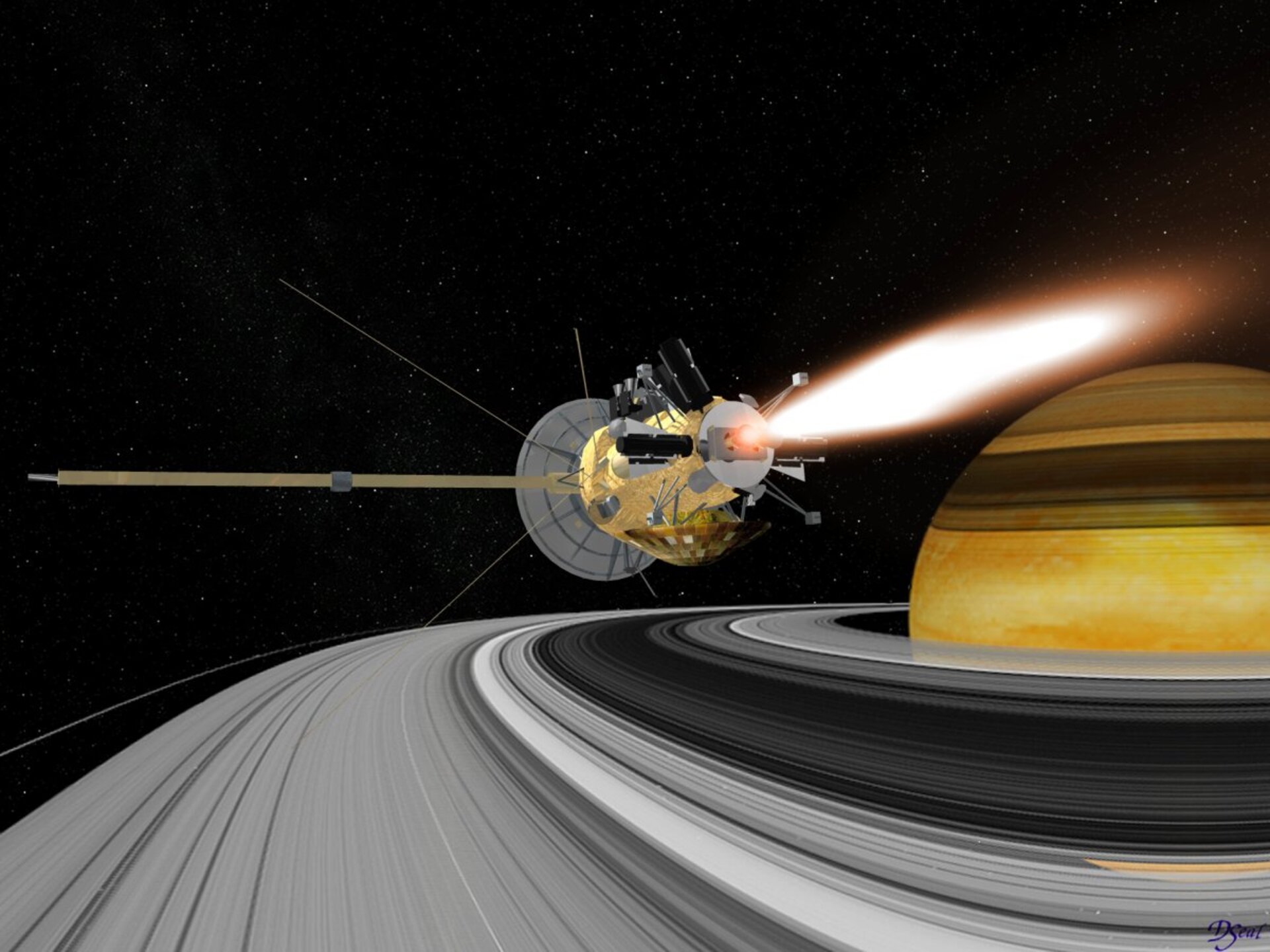
The spacecraft will approach Saturn from below the ring plane, and will cross through the large gap between the F Ring and G Ring. The spacecraft’s main engine will fire (or ‘burn’) shortly after passing through the rings to slow Cassini-Huygens enough to be captured by Saturn's gravity. This is called Saturn Orbit Insertion (SOI).
The main engine will be turned to face the direction of travel, and the resulting thrust from the engine will act as a braking device, which will slow down the spacecraft as it enters Saturn's orbit.
The engine burn will begin on 1 July 2004 at 04:36 Central European Summer Time (CEST) and will last 96 minutes, placing Cassini-Huygens in a highly elliptical orbit. Note that the burn starts at 4:36 CEST as perceived on Earth (Earth-Received Time), but the physical burning actually began 84 minutes before, i.e. at 3:12 CEST. This difference is due to the time taken for the signals from Cassini-Huygens to reach Earth.
Cassini's closest approach to Saturn during the entire four-year tour will occur during this burn. The spacecraft's distance from Saturn will be about 18 000 kilometres, or less than a sixth of Saturn's diameter. Cassini will continue to coast above the rings for approximately one hour and 44 minutes before its descent back through the ring plane.
The SOI burn is critical to the success of the mission at Saturn. The spacecraft's close proximity to the planet and its rings provides a unique opportunity for an in-depth study of the planet. Instruments on board the spacecraft will conduct studies on waves, particles and imaging data.
| Time (CEST) | Event |
|---|---|
| 1 July | |
| 03:11 | Loss of signal as spacecraft turns high-gain antenna away from Earth. |
| (Antenna is used a shield during passage through ring plane) | |
| 04:11 | Passing through ring plane, ascending. |
| 04:21 |
Spacecraft makes ‘turn to burn’ manoeuvre. Regains signal. |
| 04:36 | 96-minute SOI burn begins |
| 06:03 | Closest approach to Saturn in entire mission. |
| 06:12 | SOI burn ends. SOI achieved. |
| 06:57 | Spacecraft passes behind Saturn. Loss of signal again. |
| 07:58 | Passing through ring plane, descending. |
| 09:00 | Spacecraft regains signal, and sends SOI data back to Earth. |
| 14:39 | First images of Saturn downloaded from spacecraft. |
| 2 July | |
| 12:54 | First close approach to Titan. |