Cassini-Huygens science highlights
At the time of its launch, the Cassini-Huygens mission to Saturn was the most ambitious effort in planetary space exploration ever mounted.
A joint endeavour of ESA, NASA and the Italian space agency, Agenzia Spaziale Italiana (ASI), Cassini-Huygens was a sophisticated spacecraft sent to the ringed planet to study the Saturnian system in detail.
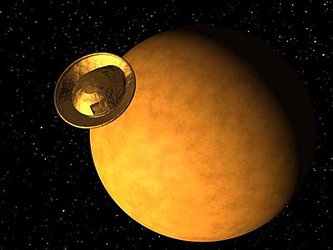
A scientific probe called Huygens was released from the main spacecraft to parachute through the atmosphere to the surface of Saturn’s largest and most interesting moon, Titan.
Mission objectives

Cassini-Huygens was designed to shed light on many of the unsolved mysteries arising from previous observations, such as:
- what is the source of heat inside Saturn that produces 87 per cent more energy than the planet absorbs from sunlight?
- what is the origin of Saturn’s rings?
- where do the subtle colours in the rings come from?
- are there any more moons?
- why has the moon Enceladus such an abnormally smooth surface? (Has recent melting erased craters?)
- what is the origin of the dark organic material covering one side of the moon Iapetus?
- which chemical reactions are occurring in Titan’s atmosphere?
- what is the source of methane, a compound associated to biological activity on Earth, which is so abundant in Titan’s atmosphere?
- are there any oceans on Titan?
- do more complex organic compounds and ‘pre-biotic’ molecules exist on Titan?
Key highlights and discoveries

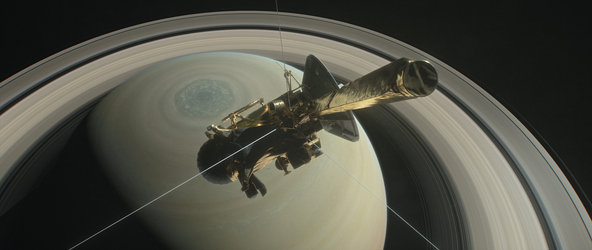
The Cassini spacecraft orbited around Saturn, sending back valuable data to Earth to help us understand the vast Saturnian region.
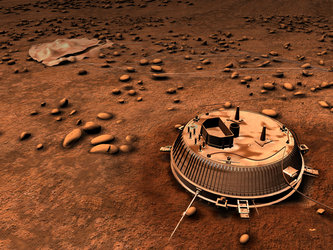
- Huygens touched down on Titan on 14 January 2005, becoming the first probe to land on a world in the outer Solar System. During its two-and-a-half-hour descent, Huygens profiled the moon’s atmosphere in terms of pressure, temperature and density, it measured super-rotating winds, and made in situ measurements of the chemical composition of haze particles – transmitting from the surface of Titan for another 72 minutes until Cassini disappeared over the horizon.
- Using the radar and Radio Science System, which includes the ASI-built high-gain antenna, Cassini revealed that more than 1.6 million sq km of Titan – almost 2% – are covered in liquid, including several large seas and numerous small lakes. One study found that one of the largest seas, Ligeia Mare, is filled with pure methane while others detected ephemeral lakes – large, shallow depressions that sometimes fill with liquid, similar to those seen on Earth.
- Radar was used to analyse the changing dunes of Titan, which cover about 13% of its surface, stretching over 10 million sq km. Titan’s dunes, made of solid hydrocarbons that precipitate out of the atmosphere, are gigantic by Earthly standards: they are on average 1–2 km wide, hundreds of kilometres long and around 100 m high.

- Indication of a hidden ocean beneath the surface of Titan, first hinted at by Huygens based on detection of electrical currents in the moon’s upper atmosphere.
- Observation of large negatively charged molecules in Titan’s upper atmosphere. An abundance of positively charged molecules was to be expected, but not negatively charged ones, which are highly reactive and should not last long in Titan’s atmosphere before combining with other materials.
- The first direct observations of changes in Titan’s atmospheric circulation, increasing our understanding of the effect of the changing seasons on the circulation pattern in Titan’s atmosphere, specifically with cooler air sinking down from warmer, high altitudes.
- Discovery that about seven tonnes per day of Titan’s atmosphere were found to be escaping on average, dominated by heavy ions – a significant loss over billions of years.
- Determination that Titan does not have its own intrinsic magnetic field. When Titan was directly exposed to the solar wind the magnetometer team found that Titan behaves much like other unmagnetised bodies, such as Venus or Mars, with the solar wind draped around the moon’s atmosphere. Studying this effect helps us to understand processes associated with atmospheric loss over time.
- Discovery that Enceladus is hiding a liquid water ocean below the frozen surface of its icy crust. This was the first time that an atmosphere had been detected around a moon of Saturn other than its largest moon, Titan.
- Discovery that most of the ions in the Saturn system come from water ejected by Saturn’s moon Enceladus.
Read more about the many Cassini-Huygens mission highlights in this article.