ESAESA ScienceCassini-Huygens
   
Unique insights into a ringed world
About Cassini-Huygens
About Saturn
About Titan
Meet the team
Multimedia
VideoTalkCassini-Huygens imagesCassini-Huygens videosTitan virtual tourHygens probe descent - multilingual CD-romDownload wallpapersDownload screensavers3D Flash 'model'SOI animationWaiting for Titan - the human side of Huygens
Watch the event
Services
Comments Bookmark and Share


Article Images
First processed images from Cassini-Huygens after Saturn arrival
 
2 July 2004

Download:
 HI-RES JPEG (Size: 282 kb)  HI-RES TIFF (Size: 553 kb)
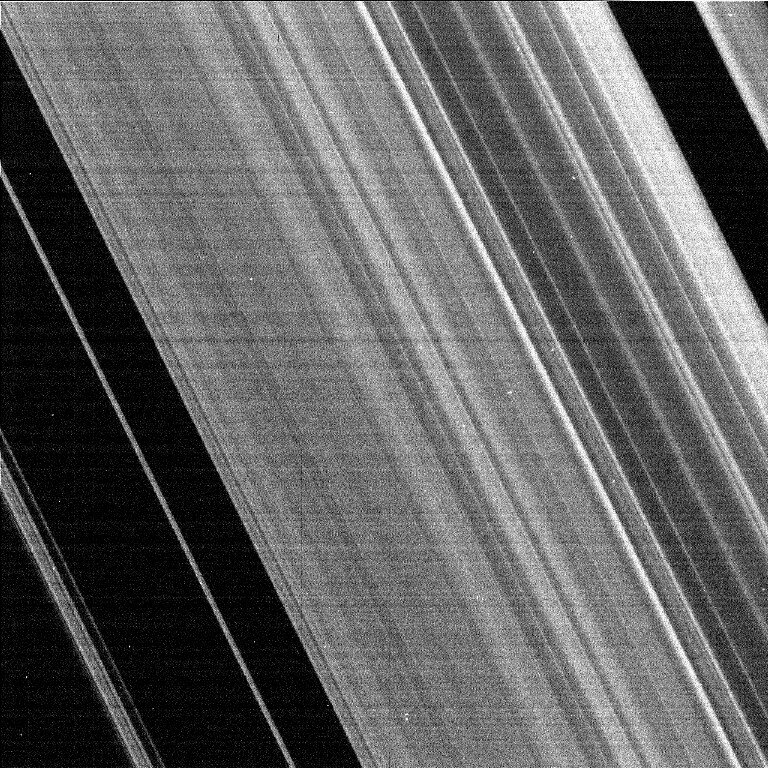
This is a narrow-angle camera image of Saturn's rings taken after the successful completion of the orbit insertion burn. At this time Cassini viewed the rings from the north side. The Sun illuminates the rings from the south side. The image shows the inner part of the Cassini Division, which contains both true gaps and regions containing ring material. The pixel scale of this image is about 370 metres per pixel.

Credits: NASA/JPL/Space Science Institute
 
 
Download:
 HI-RES JPEG (Size: 358 kb)  HI-RES TIFF (Size: 577 kb)
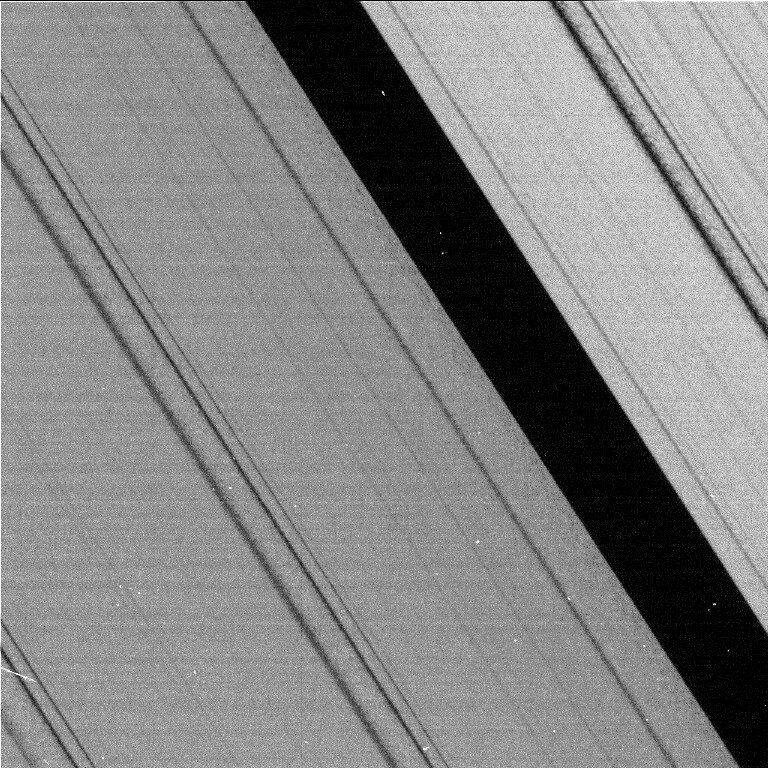
This is a narrow-angle camera image of Saturn's rings taken after the successful completion of the orbit insertion burn. At this time Cassini-Huygens viewed the rings from the north side. The Sun illuminates the rings from the south side.

This image was taken in the middle part of the A ring. The image shows the Prometheus 12:11 density wave in the lower left part of the image and the Mimas 5:3 bending wave in the middle of the image. The pixel scale of this image is about 290 metres per pixel.

Credits: NASA/JPL/Space Science Institute


Download:
 HI-RES JPEG (Size: 238 kb)  HI-RES TIFF (Size: 577 kb)
This is a narrow-angle camera image of Saturn's rings taken after the successful completion of the orbit insertion burn. At this time Cassini-Huygens viewed the rings from the north side. The Sun illuminates the rings from the south side. The image shows the outer part of the 325-kilometre wide Encke Gap in Saturn's A Ring, which is formed by the moon Pan. The ring material just outside the Encke Gap is disturbed by Pan. The pixel scale of this image is about 270 metres per pixel.

Credits: NASA/JPL/Space Science Institute
 
 
Download:
 HI-RES JPEG (Size: 306 kb)  HI-RES TIFF (Size: 577 kb)
This is a narrow-angle camera image of Saturn's rings taken after the successful completion of the orbit insertion burn. At this time Cassini-Huygens viewed the rings from the north side. The Sun illuminates the rings from the south side. The image shows the outer part of Saturn's A Ring and density waves in the rings due to Saturn's moons Janus, Pandora and Prometheus. The pixel scale of this image is about 270 metres per pixel.

Credits: NASA/JPL/Space Science Institute
 
 
Download:
 HI-RES JPEG (Size: 282 kb)  HI-RES TIFF (Size: 553 kb)
This is a narrow-angle camera image of Saturn's rings taken after the successful completion of the orbit insertion burn. At this time Cassini viewed the rings from the north side. The Sun illuminates the rings from the south side. The image shows the inner part of the Cassini Division, which contains both true gaps and regions containing ring material. The pixel scale of this image is about 370 metres per pixel.

Credits: NASA/JPL/Space Science Institute
 
 
Download:
 HI-RES JPEG (Size: 65 kb)  HI-RES TIFF (Size: 807 kb)
This narrow-angle camera image of Saturn's rings was taken after the successful completion of the orbit insertion burn when the spacecraft had crossed the ring plane and was looking upwards at the lit face of the rings.

The image shows details of the mysterious F ring that lies at a distance of approximately 140 200 kilometres from Saturn. The bright core of the F ring is clearly visible in the upper right-hand corner of the narrow-angle camera view, and is approximately 50 kilometres across. Wispy, ribbon-like features inside the main ring are clearly visible inside the orbit of the F ring. These are most likely due to the perturbing effect of the small moon Prometheus that orbits just inside the region.

Cassini-Huygens was approximately 157 000 kilometres above the ring plane when the images were obtained. Image scale in the narrow-angle camera image is approximately 940 metres per pixel.

Credits: NASA/JPL/Space Science Institute


Download:
 HI-RES JPG (Size: 40 kb)  HI-RES TIFF (Size: 1025 kb)
This wide-angle camera image of Saturn's rings was taken after the successful completion of the orbit insertion burn when the spacecraft had crossed the ring plane and was looking upwards at the sunlit face of the rings.

The image shows details of the mysterious F ring that lies at a distance of approximately 140 200 kilometres from Saturn.

Cassini-Huygens was approximately 157 000 kilometres above the ring plane when the images were obtained. Image scale in the wide-angle camera image is approximately 9 kilometres per pixel.

Credits: NASA/JPL/Space Science Institute


Download:
 HI-RES JPEG (Size: 222 kb)  HI-RES TIFF (Size: 551 kb)
This is a narrow-angle camera image of Saturn's rings taken after the successful completion of the orbit insertion burn. At this time Cassini-Huygens viewed the rings from the north side.

The Sun illuminates the rings from the south side. The image shows the 35-kilometre wide Keeler Gap in the outer part of Saturn's A Ring. Unlike the larger Encke Gap, which is formed by the moon Pan, no moon is presently known to orbit within the Keeler Gap. The pixel scale of this image is about 250 metres/pixel.

Credits: NASA/JPL/Space Science Institute


Download:
 HI-RES JPEG (Size: 38 kb)  HI-RES TIFF (Size: 947 kb)
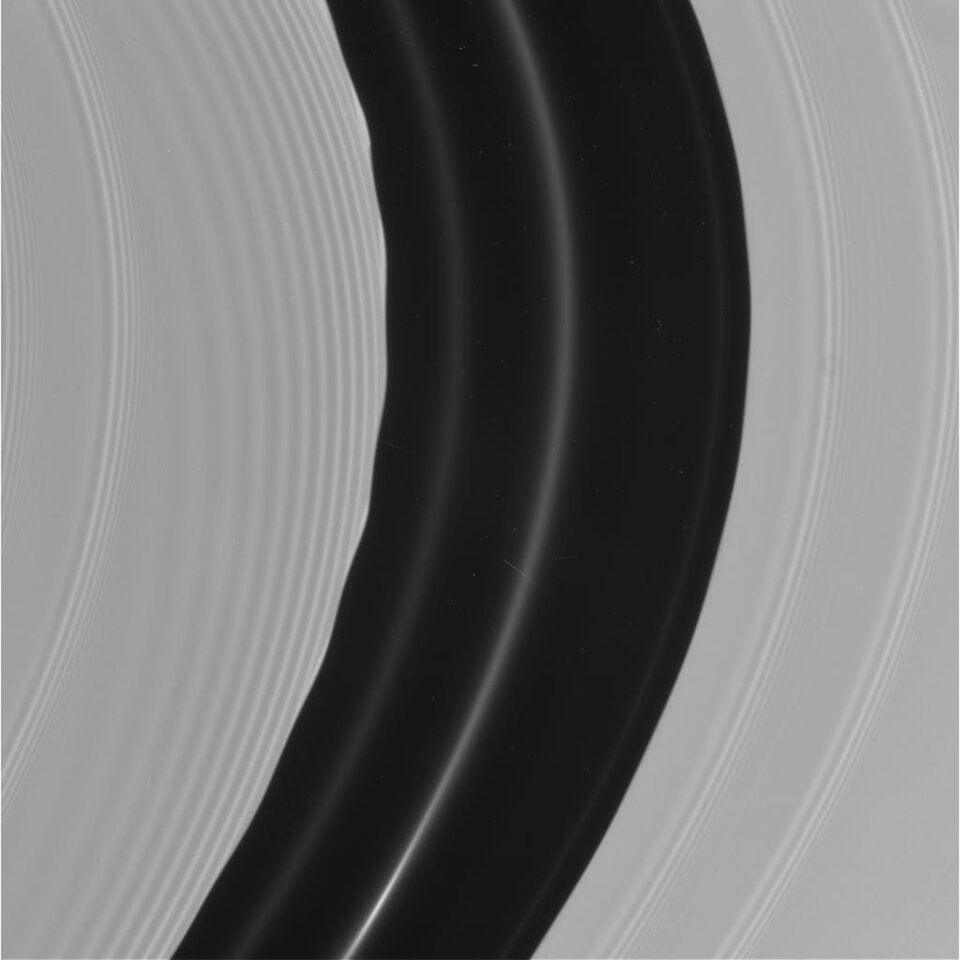
This is a narrow-angle camera image of Saturn's rings taken after the successful completion of the orbit insertion burn when the spacecraft had crossed the ring plane and was looking upwards at the sunlit face of the rings.

The image shows details in the Encke Gap (325 kilometres) in Saturn's A ring. The centre of the gap lies at a distance of 133 600 kilometres from Saturn. The image shows a ring in the centre of the gap.

The wavy inner edge of the gap and the wake-like structures emanating from its inner edge are caused by the tiny moon Pan that orbits in the middle of the gap. Two fainter ring features are also visible in the gap region.

Cassini-Huygens was approximately 195 000 kilometres above the ring plane when the image was obtained. Image scale is approximately 1 kilometre per pixel.

Credits: NASA/JPL/Space Science Institute


At Saturn and TitanViews on approach to Saturn
More about...
More on SaturnMore on TitanMore on getting thereMore on arrivalMore on Huygens descentMore on Cassini's tour
Related articles
Life on Titan?Christiaan Huygens: Discoverer of TitanJean-Dominique Cassini: Astrology to astronomy
Related links
NASA JPL Cassini-Huygens siteItalian Space Agency (ASI)


   Copyright 2000 - 2010 © European Space Agency. All rights reserved.