Facts about Saturn
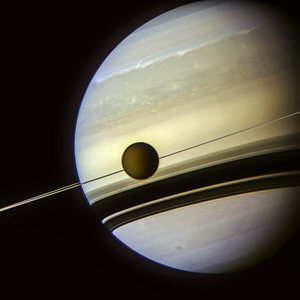
Saturn is the sixth planet from the Sun and is the second largest in our Solar System. Before the Cassini-Huygens mission, much of what was known about the planet was due to the US Voyager explorations in 1980-81.
| Orbit | 1 429 400 000 km (9.6 AU) mean distance from Sun |
| Diameter (equatorial) | 120 536 km |
| Diameter (polar) | 108 728 km |
| Orbital period (Saturnian year) | 29.46 Earth years |
| Saturnian day | 10 hours 39 mins |
| Core temperature | Approx. 12 000K (11 700°C) |
| Cloud-top temperature | 150K (-139 °C) |
| Average density | 0.7 g per cubic cm (0.7 times that of water |
| Atmospheric composition | 96% hydrogen and 4% helium with traces of water, methane and ammonia |
| Moons | 274 (as of March 2025) |
Saturn is visibly flattened at the poles, a result of the very fast rotation of the planet on its axis.
It is different from Earth in that there is no sharp distinction between atmosphere and the planet surface. Instead there is a slow gradual change from gaseous atmosphere to liquid. The pressure increases with depth, and the hydrogen and helium gases become liquid.
Thus, Saturn does not have a 'surface' in the same sense that the Earth does. It would be impossible to land a spacecraft, though one could be made to drop slowly with a parachute and transmit information until the intense pressure of Saturn's atmosphere crushed it.
In the end, this was the fate of the Cassini spacecraft.