Cassini instruments
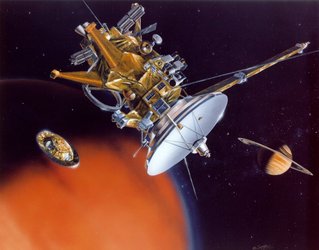
To gather as much science as possible during its historic mission to the Saturnian system, the Cassini-Huygens spacecraft was equipped with 18 instruments, 12 on the Cassini orbiter and six on the Huygens probe.
Many of these sophisticated instruments were capable of multiple functions, and the data that they gathered is studied by scientists worldwide.
Cassini Plasma Spectrometer (CAPS) explored plasma (highly ionised gas) within and near Saturn's magnetic field.
Cosmic Dust Analyser (CDA) studied ice and dust grains in and near the Saturn system.
Composite Infrared Spectrometer (CIRS) measured infrared energy from the surfaces, atmospheres and rings of Saturn and its moons to study their temperature and compositions.
Ion and Neutral Mass Spectrometer (INMS) examined neutral and charged particles near Titan, Saturn and moons to learn more about their extended atmospheres and ionospheres.
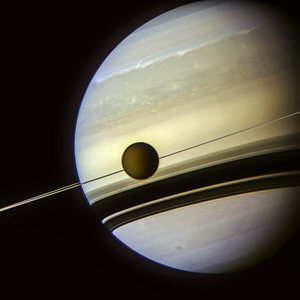
Imaging Science Subsystem (ISS) took pictures in visible, near-ultraviolet and near-infrared light.
Dual-Technique Magnetometer (MAG) studied Saturn's magnetic field and its interactions with the solar wind, the rings and the moons of Saturn.
Magnetospheric Imaging Instrument (MIMI) imaged Saturn's magnetosphere and measured interactions between the magnetosphere and the solar wind, a flow of ionised gases streaming out from the Sun.
Cassini Radar (RADAR) mapped surface of Titan using radar imager to pierce veil of haze. Also measured heights of surface features.
Radio and Plasma Wave Spectrometer (RPWS) investigated plasma waves (generated by ionised gases flowing out from the Sun or orbiting Saturn), natural emissions of radio energy, and dust.
Radio Science Subsystem (RSS) searched for gravitational waves in the Universe; studied the atmosphere, rings and gravity fields of Saturn and its moons by measuring telltale changes in radio waves sent from the spacecraft.
Ultraviolet Imaging Spectrograph (UVIS) measured ultraviolet energy from atmospheres and rings to study their structure, chemistry and composition.
Visible and Infrared Mapping Spectrometer (VIMS) identified the chemical compositions of the surfaces, atmospheres and rings of Saturn and its moons by measuring colours of visible light and infrared energy emitted or reflected.