


André Kuipers' diary – Part 5: Training in the Soyuz
8 - 14 januari 2004 I was still in the car, on my way to Star City from Moscow Airport, when my boss called. He told me that my American colleague, Bill McArthur, had been pulled out of the mission and replaced by Leroy Chiao. That was quite a shock. Like Bill, I knew that something was going on, but we had not expected this.
Fortunately, it is nothing serious. He is healthy, but for reasons of medical procedure he has to remain grounded for six months. I called him and asked how he was. He is taking it fairly well, partly because it simply means waiting for another flight.
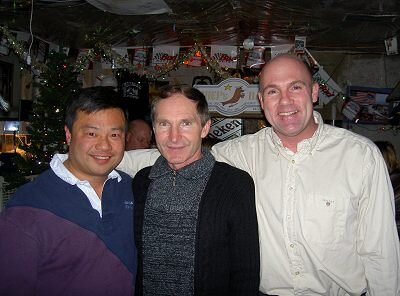
For the team, this change of crew is a drastic alteration. After all, the three of us had been working together for some time. Over that time, you create a bond, get to know each other and help each other. His replacement is Leroy Chiao, a very capable astronaut. Quite a bit younger than Bill, but very experienced nevertheless. Like me, Chiao will be flying in a Russian Soyuz for the first time. That will mean training intensively in the weeks and months ahead.

In last week's simulation, everything went wrong again of course. The trainers made it as difficult as possible in order to knock us into shape for all the emergency procedures. In the Space Station there was loss of pressure and then, on top of that, fire broke out. We had to put on oxygen masks and we tried to put out the imaginary fire, but it was so bad that we had to evacuate the Station. Still wearing our masks, we then squeezed into our spacesuits and crawled into the cramped Soyuz simulator for a pretended flight back to Earth. Training of this type is very hard work because you have to make such an effort while wearing your mask; because of the smoke, you cannot switch on the ventilation for your spacesuit. As a result, you sweat by the bucketful. It was a literal 'baptism of fire' for my new colleague Chiao.

On Sunday, my trainer Igor Ivanovic gave me some extra training. I had specially requested this. When working with the crew, you sometimes learn things only in broad terms; I was keen to go through all the small details again from the start and review the initial activities. In other words, I wanted to link theory and practice: why do we take certain actions, and what are the alternatives? Igor is a past master in the trade, a walking encyclopaedia, so he was able to explain everything in fine detail.

The next day was devoted to normal training, dominated by video filming. Video filming is important. You have to record things for the media and for experiments. There are a number of different cameras on board and I have to learn how to use all of them. Actually, it is a crash course in the art of being a cameraman; we learn about light sources, the surroundings and even editing. Of course, I will not have time for editing during the mission, but I enjoyed learning how to do it.

On the mission, eighty percent of my time will be spent on Dutch and European experiments. On Tuesday, some ESTEC colleagues who have prepared these experiments came to Star City. Over the next few days, they will work with the Russians in Star City on the procedures that I will use in space. One of the scientists also arrived, and we carried out measurements for his experiment. This is about the interaction between the eyes and the balance mechanism. Later, these results will be compared with the measurements taken under weightless conditions.
Finally, on Wednesday evening, I visited the American astronauts who are staying here at Star City. We watched CNN together as President Bush announced his plans for NASA. It sounds pretty good. He wants the construction of the Space Station completed by 2010. That means that we still have a good chance of getting a European astronaut up there for an extended period in 2006. The plans would then take NASA to the Moon and after that to Mars, in cooperation with other countries. For me it will probably be just too late, but I would have loved to go to the Moon. The desire for discovery is in the nature of humankind, and I am no exception.

