ESAEducationESA KidsTeachers' Corner
   
About ESA Education
Education programmeInternational collaborationSupported activities
Hands-on Projects
Resources
Classical materialsOnline materialsIdeas for projectsESA expertise
Space Careers
Careers at ESACareers in Earth ObservationTransfer of knowledge
Opportunities
ConferencesContestsGaining experienceAffiliation programme
Services
CalendarSubscribe


printer friendly page
André Kuipers
André Kuipers during one of ESA's Parabolic Flight Campaigns
Microgravity and parabolic flights
 
Everything on Earth is subject to gravity (g). Most of the physical phenomena occurring on our planet are influenced by this force, as it pulls objects towards the centre of the Earth. Even our bodies have adapted to cope with gravity: the composition and shape of our skeleton, the position of our organs, etc.
 
Weightlessness is the state in which the effect of gravity is completely cancelled out when an object experiences “free fall”. The term “microgravity” refers to a state where weightlessness is not perfectly attained, due to small residual forces. Microgravity is expressed as a fraction of g (from 10^-2g to 10^-6g), where g is the gravitational acceleration at the surface of the Earth, on average 9.81 m/s^2.

Practically speaking, the best way of achieving such a state would be to place an object in orbit, such as the International Space Station. This allows the time of the free fall to be extended almost infinitely.  
 
Since sending payloads to the ISS requires a large investment, scientists often prefer to use other means of achieving microgravity. These include sounding rockets, parabolic flights and drop towers. These solutions offer a limited duration of microgravity but higher flexibility and much lower cost.

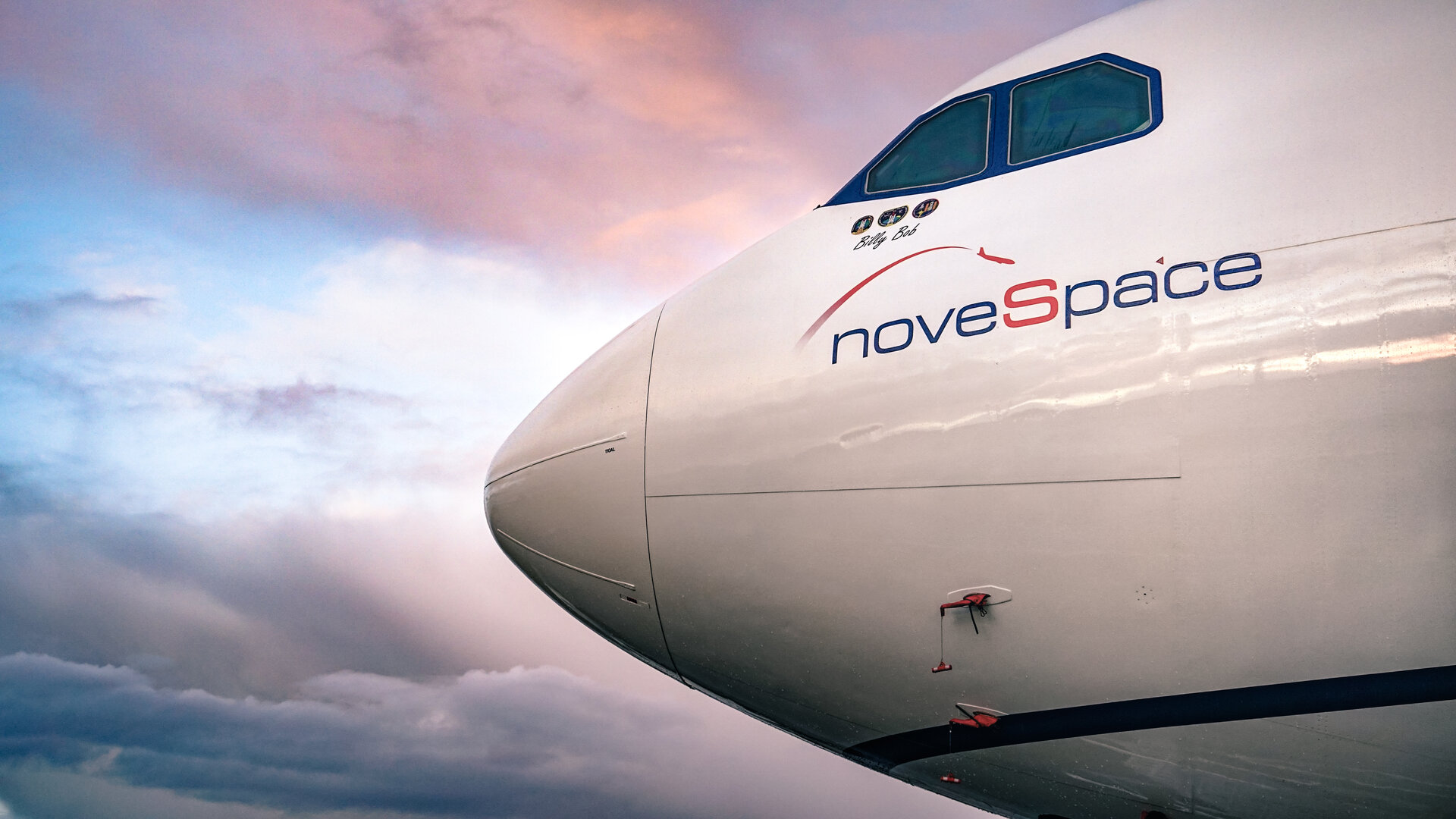
Parabolic flights involve a specially equipped aircraft that repeatedly climbs with a high angle, before dramatically reducing its thrust. As a result, the plane falls freely along a parabolic trajectory, before returning to the horizontal. Each parabola includes phases with different gravity levels: 1g – 2g (while climbing), 0g (about 20 seconds per parabola), 2g (while going back to a horizontal trajectory); 1g (on a horizontal flight).
 
 
More information about parabolic flights can be found at the ESA Human Spaceflight website and the prime contractor's (Novespace) website.
 
 
Last update: 2 September 2009


More information
Fly Your Thesis! - an astronaut experienceWhat experiments can be undertaken?Eligibility criteriaSchedule 2009 campaignSchedule 2010 campaignList of documentsHow to applyQuestions and contact detailsFly your thesis trailer
Documents
Terms and conditionsMedical requirementsRules and guidelinesTemplate of letter of intentExperiment safety data package2010 campaign poster
Related news
12 teams selected for next stage of ESA’s ‘Fly your Thesis!’ 2010 programmeFly your Thesis! 2010 call for proposalsFour student teams selected to fly their theses!16 teams selected for next stage of ESA’s ‘Fly your Thesis!’ programmeFly your Thesis! - An Astronaut Experience
Related links
A300 Zero-G ESA Human Spaceflight users websiteNovespaceErasmus Experiment ArchiveELGRA
Register for ESA Education projects


   Copyright 2000 - 2009 © European Space Agency. All rights reserved.