

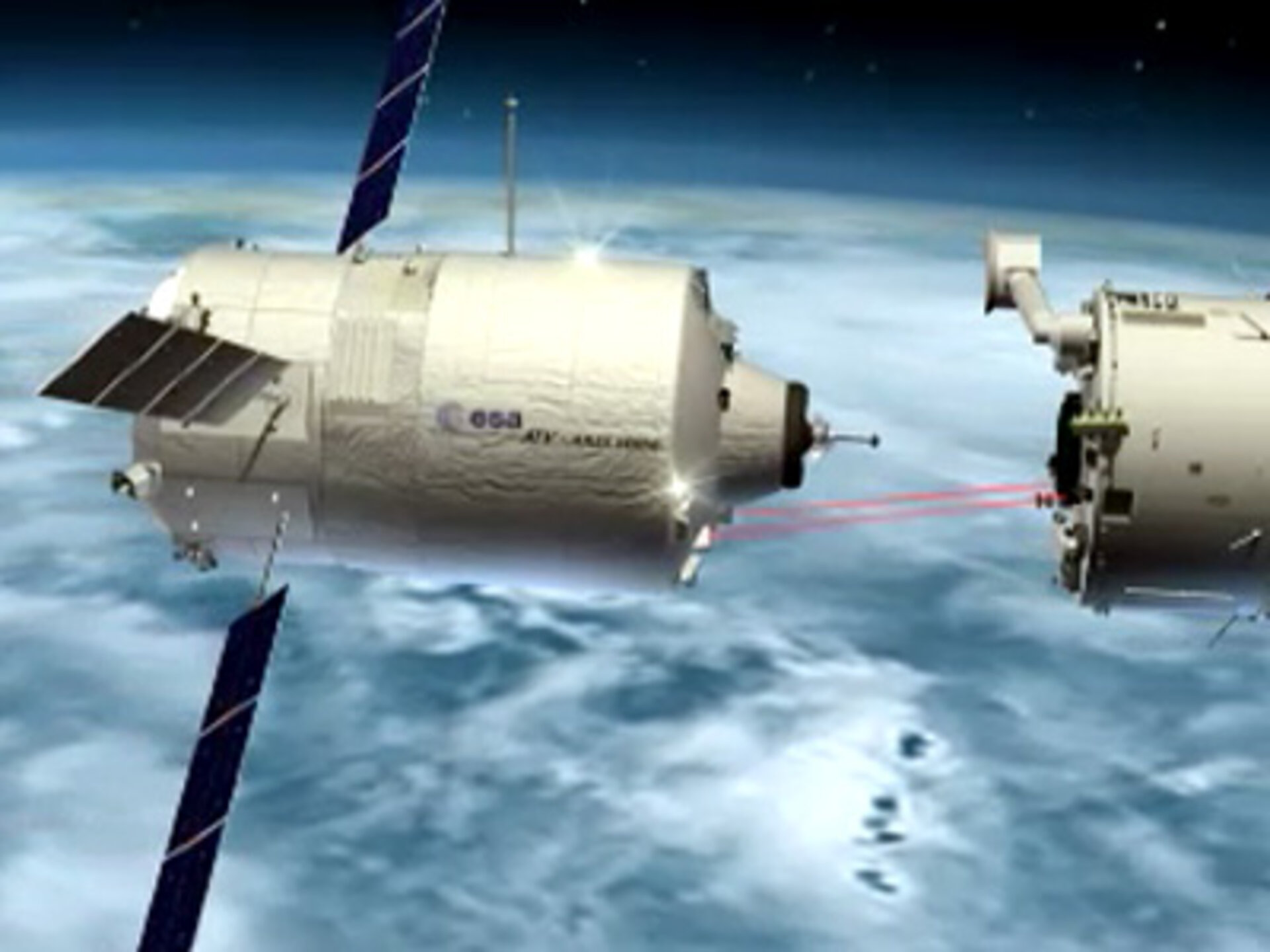
Cool animation of ATV mission scenario
A cool animation illustrating all phases of the mission scenario for Europe's Automated Transfer Vehicle (ATV), Jules Verne. ATV is scheduled to launch from Europe's Spaceport in Kourou, French Guiana, on Sunday, 9 March.
After launch, the 20.7-tonne ATV is well protected at the top of Ariane 5 during a three-minute, high-pressure aerodynamic ascent; 100 minutes after lift-off, ATV becomes a fully automatic spacecraft navigating toward the International Space Station (ISS).
The ATV uses its laser-guided rendezvous sensors to dock precisely and safely with the ISS, becoming a working extension of the Station.
The 45 m³ pressurised module can deliver up to 7.2 tonnes of equipment, fuel, food, water and air for the crew, and it will also be used to raise the ISS altitude, which naturally decreases over time due to residual atmospheric drag.
After 6 months, ATV, loaded with 6.5 tonnes of waste, separates from the ISS and burns up during a guided and controlled re-entry high over the Pacific Ocean.