Setting stars reveal planetary secrets
Watching the stars set from the surface of the Earth may be a romantic pastime but when a spacecraft does it from orbit, it can reveal hidden details about a planet’s atmosphere.
The technique is known as stellar occultation. Jean-Loup Bertaux, Service d'Aeronomie du CNRS, France was the first to suggest its use on an ESA mission. It works by watching stars from space, while they drop behind the atmosphere of a planet under investigation, before disappearing from view below the planet’s horizon.
When the stars are shining above the atmosphere, they give off radiation across a wide spread of wavelengths. As the orbit of the spacecraft carries it around the planet, the star appears to sink down, behind the atmosphere of the planet. The atmosphere acts as a filter, blocking out certain wavelengths of the star’s radiation. The key to this technique is that the blocked wavelengths are representative of the molecules and atoms in the planet’s atmosphere.

ESA currently has three spacecraft around three different planets that are using the technique to investigate those atmospheres. Each one is returning unique insights.
Around Earth, ESA’s Envisat mission carries an instrument called GOMOS (Global Ozone Monitoring by Occultation of Stars). As its name suggests, it is designed to study whether the quantity of ozone is increasing now that the use of harmful chemicals has been banned. Since 2002, it has been watching about 400 stars set behind the Earth every day in order to build up a map of the ozone in the Earth’s atmosphere for all latitudes and longitudes.
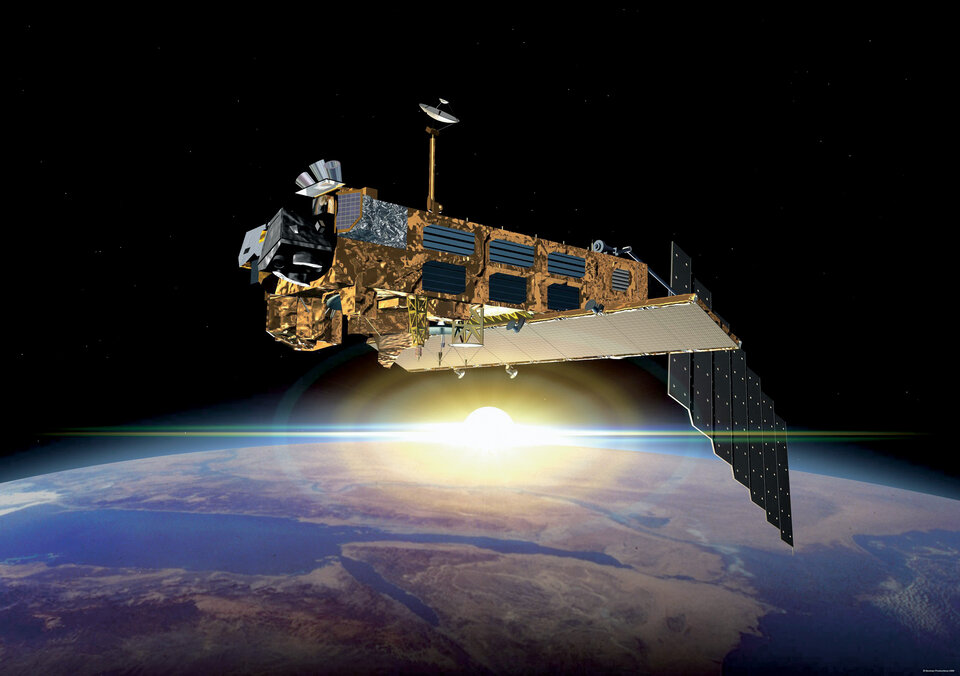
“It’s still too early to say whether the ozone is recovering or not,” says Bertaux. Nevertheless, as data accumulates, so the instrument is discovering other phenomena that contribute to the amount of ozone in the atmosphere. In January and February of 2004, GOMOS saw a large build up of nitrogen dioxide at an altitude of 65 km.
Nitrogen dioxide is an important gas to trace in the atmosphere because it can destroy ozone. Over the next two months, GOMOS watched as the layer sank to 45 km, clearly destroying ozone as it descended, providing scientists with another piece in the ozone puzzle.
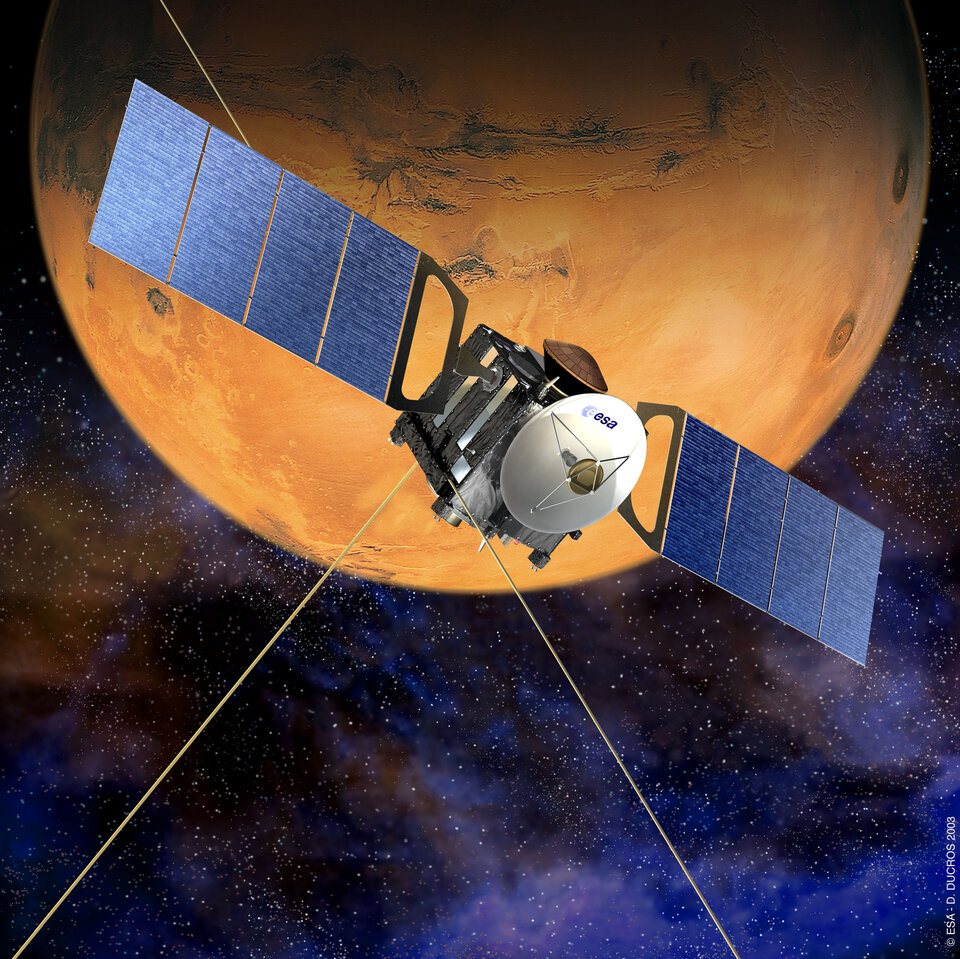
A simplified stellar occultation instrument is onboard ESA’s Mars Express. Since the spacecraft arrived at the Red Planet in 2003, SPICAM (Spectroscopy for Investigation of Characteristics of the Atmosphere of Mars) has observed more than 1000 stellar occultations. This work provides the most detailed description yet of Mars’s upper atmosphere, and reveals persistent haze layers.
Apart from delivering pure science, the data provides practical benefits for future exploration missions. “Atmospheric profiles of Mars are important for designing parachutes for landing craft,” says Bertaux.

The latest addition to this family of instruments is SPICAV (Spectroscopy for Investigation of Characteristics of the Atmosphere of Venus) on Venus Express. Venus has a different atmosphere again from Earth or Mars. It is much denser and SPICAV is revealing the temperature and density profiles of the atmosphere to waiting scientists on Earth, who expect to publish their results soon.
“I think the stellar occultation technique is now ‘combat proven’ and should be useful for further long-term studies,” says Bertaux.
Note:
An expanded version of this article appears in the ESA Science pages.