Why 'Rosetta'?
The European Space Agency's unprecedented mission of cometary exploration was named after the famous 'Rosetta Stone'. This slab of volcanic basalt - now in the British Museum in London – was the key to unravelling the civilisation of ancient Egypt.
French soldiers discovered the unique Stone in 1799, as they prepared to demolish a wall near the village of Rashid (Rosetta) in Egypt's Nile delta. The carved inscriptions on the Stone included hieroglyphics – the written language of ancient Egypt – and Greek, which was readily understood. After the French surrender in 1801, the 762-kilogram stone was handed over to the British.
By comparing the inscriptions on the stone, historians were able to begin deciphering the mysterious carved figures. Most of the pioneering work was carried out by the English physician and physicist Thomas Young, and the French scholar Jean François Champollion. As a result of their breakthroughs, scholars were at last able to piece together the history of a long-lost culture.
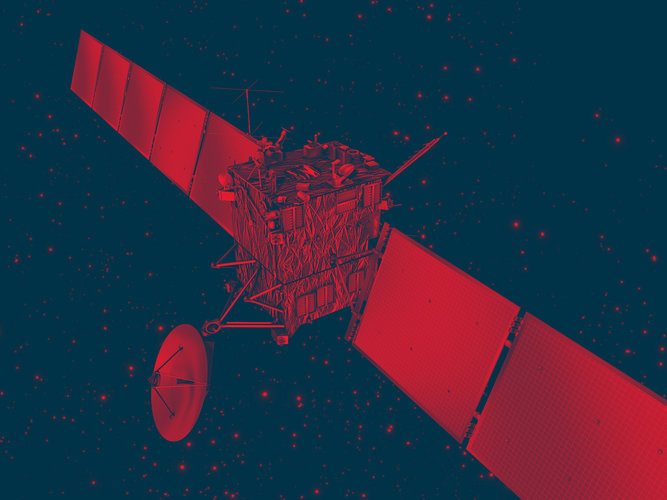
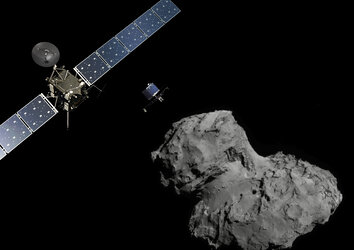
Just as the Rosetta Stone provided the key to an ancient civilisation, so ESA's Rosetta spacecraft is unlocking the mysteries of the oldest building blocks of our Solar System – the comets. As the worthy successor of Champollion and Young, Rosetta is allowing scientists to look back 4600 million years to an epoch when no planets existed and only a vast swarm of asteroids and comets surrounded the Sun.