The Rosetta orbiter
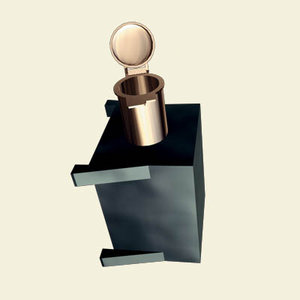
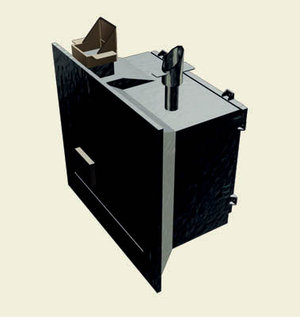
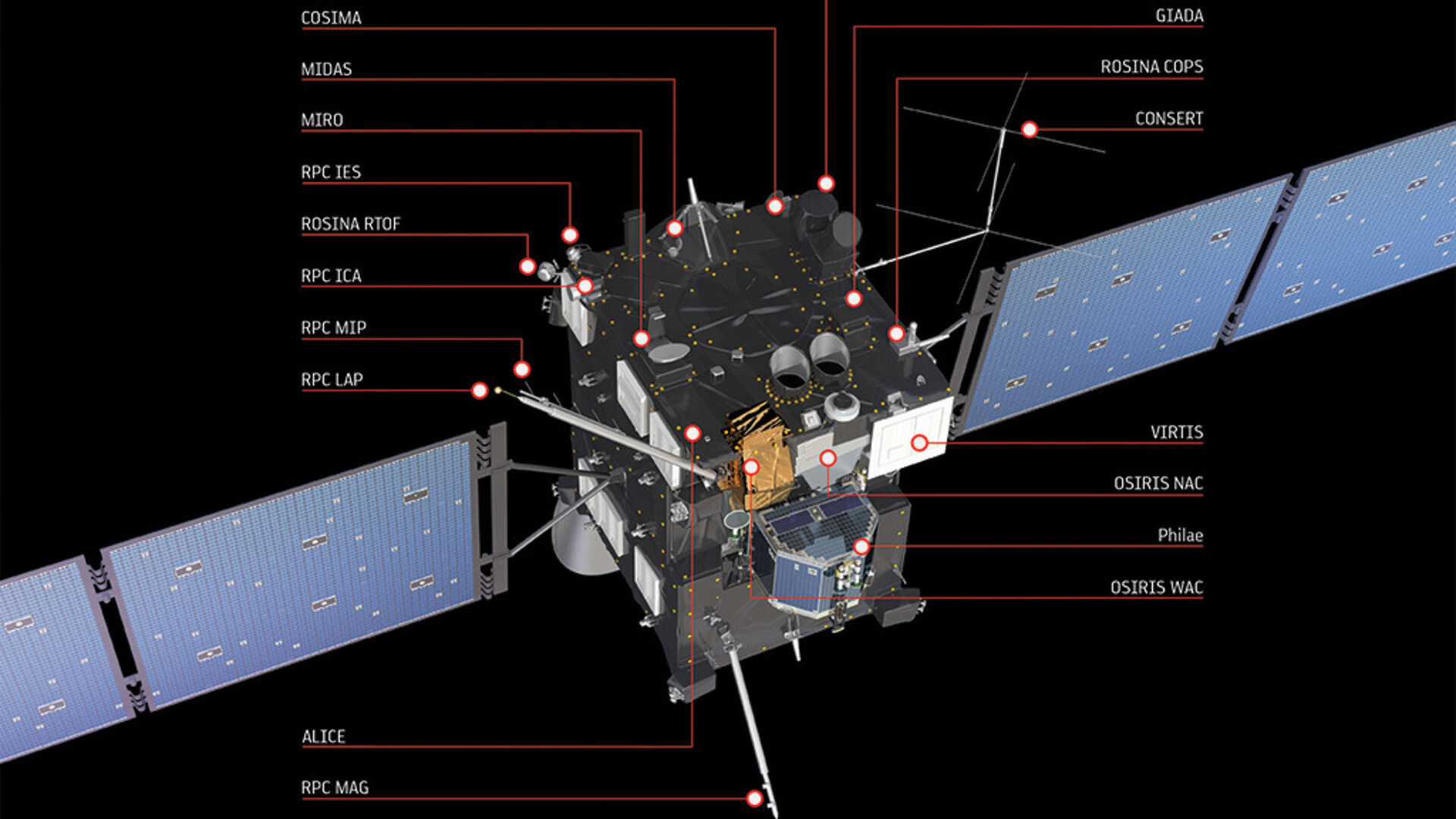
Rosetta was a large aluminium box with dimensions 2.8 x 2.1 x 2.0 metres. The scientific instruments were mounted on the 'top' of the box (Payload Support Module) while the subsystems were on the 'base' (Bus Support Module).
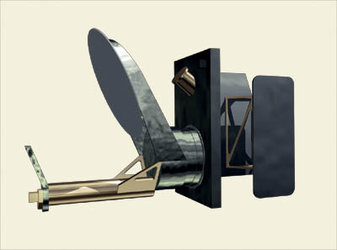
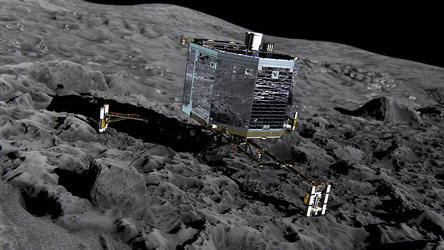
On one side of the orbiter was a 2.2-metre diameter communications dish – the steerable high-gain antenna. The lander was attached to the opposite face.
Two enormous solar panel 'wings' extended from the other sides. These wings, each 32 square metres in area, had a total span of about 32 metres tip to tip. Each of them comprised five panels, and both could be rotated through +/-180 degrees to catch the maximum amount of sunlight.
In the vicinity of Comet 67P/Churyumov-Gerasimenko, the scientific instruments almost always pointed towards the comet, while the antennae and solar arrays pointed towards the Sun and Earth (at large distances, they are more or less in the same direction).
In contrast, the orbiter’s side and back panels were in shade for most of the mission. Since these panels received little sunlight, they were an ideal location for the spacecraft’s radiators and louvres. They also faced away from the comet, so damage from comet dust could be minimised.
Propulsion
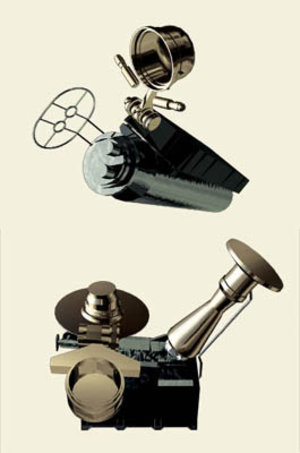
At the heart of the orbiter was the main propulsion system. Mounted around a vertical thrust tube were two large propellant tanks, the upper one containing fuel, and the lower one containing the oxidiser.
The orbiter also had 24 thrusters for trajectory and attitude control. Each of these thrusters pushed the spacecraft with a force of 10 Newtons, about the same as experienced by someone holding a large bag of apples. Over half the launch weight of the entire spacecraft was taken up by propellant.
| Spacecraft vital statistics | |
|---|---|
| Size | |
| Main structure | 2.8 x 2.1 x 2.0 metres |
| Diameter of solar arrays | 32 metres |
| Launch mass | |
| Total | 3,000 kg (approx.) |
| Propellant | 1,670 kg (approx.) |
| Science payload | 165 kg |
| Lander | 100 kg |
| Solar array output | 850 W at 3.4 AU, 395 W at 5.25 AU |
| Propulsion subsystem | 24 bipropellant 10N thrusters |
| Operational mission | 12 years |
An international enterprise
Rosetta’s industrial team involved more than 50 contractors from 14 European countries and the United States. The prime spacecraft contractor was Astrium Germany. Major subcontractors were Astrium UK (spacecraft platform), Astrium France (spacecraft avionics) and Alenia Spazio (assembly, integration and verification).