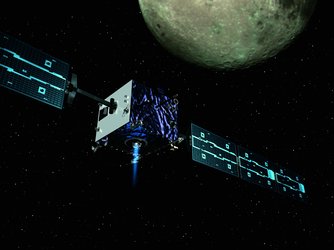
The SMART way to travel
The type of ion engine chosen for SMART-1 made clever use of an effect discovered by the American physicist E.H. Hall in 1879, whereby a current flowing across a magnetic field creates an electric field directed sideways to the current. This is used to accelerate ions (charged atoms) of xenon. A gassy element with atoms about 131 times heavier than hydrogen atoms, xenon is chemically inert.
Drawing electric power of 1350 watts from SMART-1's solar panels, the ion engine generated a thrust of 0.07 newton. That is equivalent to the weight of a postcard.
By accelerating SMART-1 at 0.2 millimetre per second per second, the incredibly gentle thrust could in theory have flung the spacecraft right out of the Solar System, if sustained for long enough. In practice, SMART-1 used its ion engine intermittently over 16 months, fighting against the Earth's attraction, to put itself into orbit around the Moon.
For the first two or three months, the leisurely journey could have brought problems due to SMART-1's exposure to possible harm from energetic atomic particles in the radiation belts that surround the Earth. The electronics and instruments were hardened to resist such damage.