SpaceWire
Developed under ESA auspices in the late 90’s, SpaceWire formal standardisation via ECSS was envisaged in an early stage in order to provide space users with a directly usable specification. SpaceWire was standardised in 2003: ECSS-E-ST-50-12C.
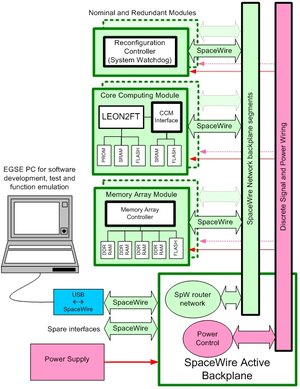
Within a SpaceWire network the processing nodes are connected through low-error rate, low-footprint, low-cost, low-latency, full-duplex, point-to-point serial links and wormhole switches.
SpaceWire has been supplemented by a set of standards for higher-protocols supporting onboard SpaceWire Data-Handling networks:
- SpaceWire Protocol Identification: ECSS-E-ST-50-51C
- Remote Memory Access Protocol: ECSS-E-ST-50-52C
- Consultative Committee for Space Data Systems (CCSDS) Packet Transfer Protocol: ECSS-E-ST-50-53C
Applications and benefits
The SpaceWire standard offers many advantages over other comparable communications technologies and it extends the concept of serial links to Modular Systems based on On-board Networks. Its main advantages are:
- it facilitates the construction of high-performance onboard data-handling systems
- it helps reduce system integration costs
- it facilitates compatibility between data-handling sub-systems
- it encourages re-use of data handling equipment across several different missions
Designed for use in space applications, it served first as an interface between the instruments and the mass memory for on-board storage of spacecraft Telemetry. It gained popularity for space applications because of its simple circuitry, low power consumption and low-error rate. It is now widely use by the platform sub-systems to send Telecommands (e.g. OBC, SSMM and the RIU) as on the Bepi Colombo platform.