En route for ‘Mars’
Tuesday 3 July 2001
First day of my journey to Devon Island in the Northwest Territories of Canada. A long day spent travelling from Amsterdam to London to Edmonton in Canada. I arrive at two in the morning of the next day European time, although it is 19:00 local time.
My next flight will be on Wednesday from Edmonton to Yellowknife to Resolute Bay. If you look on a map this is the last northern dot on the map. Departure time will be 21:05 to arrive at 22:50 in Yellowknife and then leaving at 00:15 to arrive at 03:36 at Resolute Bay. Can you imagine normally taking off and landing at times like these? Well, it seems that under polar skies this is normal routine.
Wednesday 4 July 2001
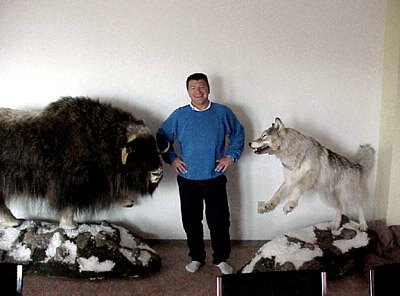
Well, here I am in the Great North. We have just landed in Yellowknife, capital of the province of the Northwest Territories. I am sitting in the small airport, in front of a big white polar bear, the artwork of a taxidermist.
The approach to Yellowknife by plane was really strange and beautiful. Lots of open spaces, lots of water, a huge massive bay, lots of small and large rock islands, and the mainland full of small pines and rocks. The time is 23:00 and the temperature is about 15°C. The airport signs are all in two languages, English and Inuit. Inuit sounds and reads strange and exotic but nice. The writing is somehow similar to the old Runic one.
The plane for Resolute Bay is planned for 15 minutes past midnight but we were told before leaving Edmonton that due to bad weather in Resolute - fog apparently – that although the flight is still scheduled to go ahead if it is unable to land it will return to Yellowknife.
This afternoon I went to visit the West Edmonton Mall. Many superlatives are needed to describe it: the biggest mall in the world with the biggest car park in the world. It has a scale 1 replica of the famous ship of Christopher Columbus, the Santa Maria, in a huge pool next to a dolphinarium; an ice rink; a swimming pool with wave machines and toboggans; a huge fair with a roller-coaster; three cinema complexes; and countless restaurants, bars and shops.
Thursday 5 July 2001

At last we arrive in Resolute Bay. We flew in last night and the scenery below was quite fantastic: frozen seas and lakes, dry ground and rocks, no trees or grass, little ponds like scars on the soil, all lying in the same direction.
Resolute is home to 230 inhabitants and is the second most northern community. On the map it is a relatively large dot but when you see it from inside, well, it is different. We landed on a strip of rocks and pebbles, no real concrete or bitumen tarmac and the airport is basically one big room, where everybody meets and hugs.
I have already met up with several people: Colleen Lenahan from NASA who gives logistic support to the NASA-HMP project, running in parallel with that of the Mars Society; Aziz Kheraj, a very nice man from Tanzania who has lived here for the last 20 or 25 years. Aziz, who is father of many and grandfather of even more, runs a hotel and several other businesses in town, and is the man to talk to if you have any problems.
Later I met the other people waiting in the hotel. There are some five or six people from the Discovery TV channel part still waiting to be flown to Devon Island and some military people waiting to go to the weather station. I also met Kathy Quinn, a young geologist from MIT University, who will be in the same rotation as me in the Mars habitat. We discussed the seismic experiment that we will be carrying out and she agreed to give me a hand.
Robert Zubrin, President of the Mars Society called this afternoon to say that the equipment was still stuck in customs in Ottawa as a signature was still missing. I called Dr P. Lognonne, co-investigator of the experiment, who had agreed to lend the equipment from the French ‘Laboratoire de Physique du Globe de Paris’ to ask him to send his signature to whoever needs it. Hopefully the equipment should be here on Saturday.
Later on in the afternoon, Colleen announced that we will not fly to Devon Island before Saturday or even Sunday due to the bad weather and to the fact that only one plane is operating as the other broke down some days ago. To fly to Devon Island you need sufficiently nice weather both here and there. Although we are still scheduled to enter the Mars habitat on Sunday, we will have to adapt to a new schedule when we finally manage to arrive.
Luckily, Aziz’s place is large and comfortable and has everything needed for people in transit who are blocked by the bad arctic weather.
Friday 6 July 2001
Another strange day in the arctic. The 24 hour light outside is disturbing, I woke up at 07:00 this morning and was up the entire day waiting for the evening but of course the evening never comes in the arctic summer. So although it is close to midnight I don’t feel like going to sleep as it is as light outside as in the middle of the afternoon. I do as the locals do, a little nap in the afternoon and in the evening and up and about for the rest of the day and night.
The weather today was still not good enough to take off for Devon Island. Last night the pilot managed to land with some supplies for those who are already there but as the weather was still bad he decided not to fly back as originally scheduled.
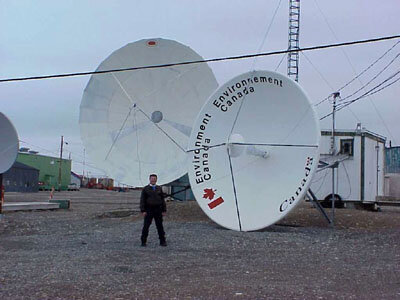
While waiting I read up on the area. Resolute is located just below the latitude of 75° north. If you are lost on the planet’s surface and you do not know at which latitude you are, you can always rely on the old methods of looking at the stars, or where the sun sets, or your compass. Modern life now allows you to find it another way, by looking at the parabolic antennas. As most of them are pointing towards geostationary satellites in the Earth’s equatorial plane, they will be pointing nearly horizontally.
Resolute is on the Cornwallis Island in the Nunavut territory. The name of the settlement in the Inuit language is Qausuittuq, which translated means “the place with no dawn”. The English name of Resolute was given to the place in the 19th century after HMS Resolute was sent by the English to search for the lost British expedition looking for the northwest passage to Asia, led by Sir John Franklin.
Nunavut, meaning “our land” in Inuktitut, is a new territory created in 1999 to recognise the importance of what are called here the First Nations, that is mainly Indians and Inuits. Never say to an Inuit that he is an Eskimo as this term is perceived as being offensive as it comes from the Algonkian language of south Canada and means “eaters of raw meat”.
Saturday 7 July 2001
Well, finally things are moving up and today it looks like we may be going. After hanging around for a while in this beautiful place we received word that the plane is up and running and that our turn will come sooner than we think.
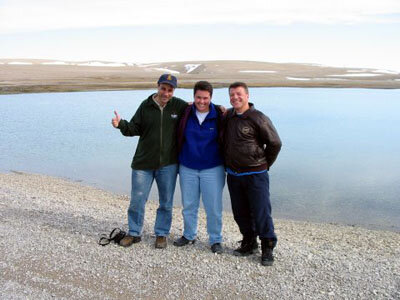
The weather is absolutely gorgeous, the sun is shining and although the temperature is still around zero, facing the sun you would think that it is actually hotter than July. I went for a stroll along the beach to admire the sea ice and I even walked on water, which is easy when it is frozen.
Robert Zubrin, President of The Mars Society and our future Sim Team Leader, arrived in the middle of the afternoon full of energy as usual, accompanied by Bill Clancy, a computer scientist involved in cognitive science research, who will also be on our shift.
We had out first meeting to talk about the coming simulation. As the weather has been so bad the first team only entered the habitat yesterday and they are asking for two more days out of our shift to complete the minimum amount of their science programme. This means that we will be entering the habitat on Tuesday 10 July at 21:00 instead of the morning of Sunday 8 July.

After dinner we went to visit the offices of the First Air company to check for the geophysical equipment that was supposed to arrive from Paris via Ottawa and that will be needed to perform our experiment later this week.
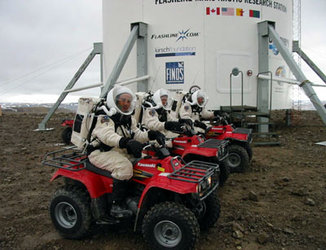
Aziz told us that his 16 year-old son, who was on Devon Island as a guide, was returning on the next flight as he had had an accident. Nothing too serious, just an ankle slightly damaged by an ATV, one of these All Terrain Vehicles that are so popular here (nothing to do with the other ATV, the Automated Transfer Vehicle that will deliver cargo and supplies to the International Space Station). So he was shuttled back by plane accompanied by Dr Rainer Efenhauser of German origin, who is a Flight Surgeon at NASA-JSC and a member of the first simulation crew.
We were told that we might be flying at midnight or on the next flight rotation at 04:00. These time indications loose their meaning as the sun is up 24 hours a day. It is a mere reference to your wristwatch and not to a particular moment in your day. You sleep when you feel the need to sleep not because you are constrained by night hours. As I was walking around at 04:00 children were playing happily outside under a bright sun.
However, I slept for two hours until Colleen, Robert and Joe woke me up by thumping on the door to say that we were to leave in 30 minutes at 01.30. Just time to pack the bags and throw them in the van. Isn’t it ironic? You spend three days lazing around with so much spare time that you do not know what to do with it and at the last second you are told to rush off. But I don’t mind as we are finally going to Devon Island, the location of our Martian environment on Earth.