SOHO's private view of a sunbathing comet
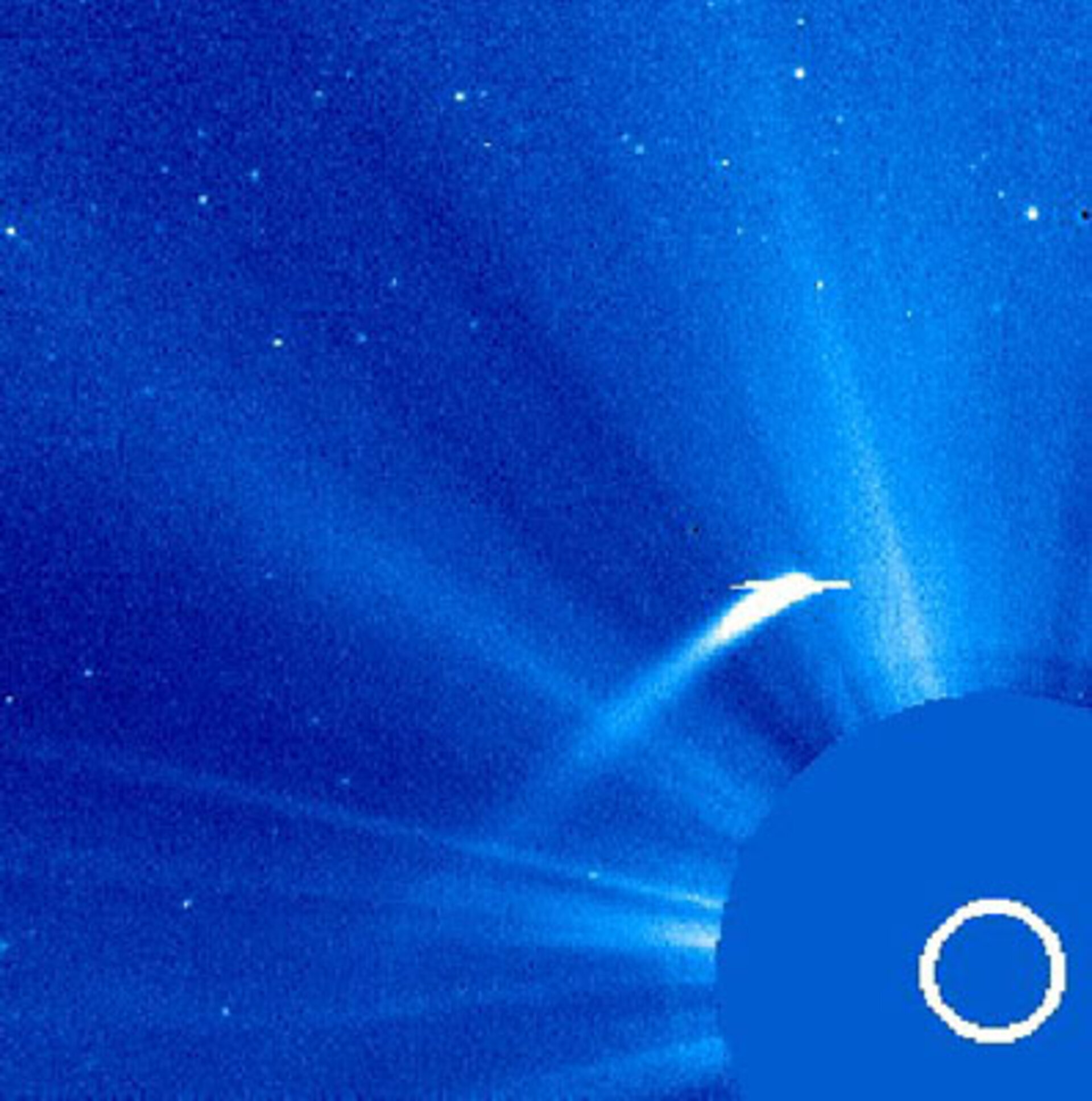
You could see it easily with your unaided eye (but don't try!) if only Comet Machholz 1 were not so very close to the Sun. This unusual comet, reputed to flare up a lot, is today sweltering only 18 million kilometres from the Sun.
This is its closest approach on an orbit that brings it back to the solar vicinity every 63 months. The best and perhaps the only view of it at this time comes from the ESA-NASA sunwatching spacecraft SOHO.
"It's great to see Comet Machholz 1 doing well in these SOHO images,' says Don Machholz, who discovered it in 1986, as an amateur observing in California. "I'm pleased to join you for these next few days as the comet crosses the field."
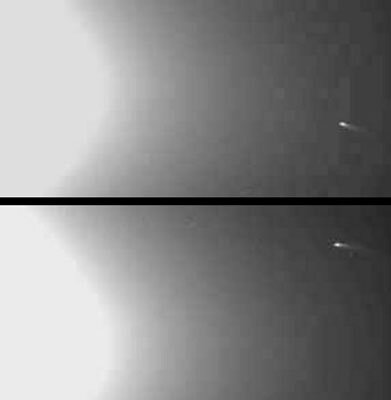
The LASCO coronagraph on SOHO, designed for seeing outbursts from the Sun, uses a mask to block the bright rays from the visible surface. It monitors a large volume of surrounding space, and as a result it became the most prolific discoverer of comets in the history of astronomy. Most of them are small sungrazer comets that burn up completely in the Sun's hot atmosphere.
Seen today with an impressive tail, Machholz 1 is a more robust, but puzzling comet. No one is sure of the reason for its frequent outbursts. Whether its icy nucleus is 1 kilometre or 10 kilometres wide is also uncertain.
"Experts will look closely at the LASCO images, and at other images from our ultraviolet coronagraph UVCS as well," says Paal Brekke, ESA's deputy project scientist for SOHO. "We already know it's unusually bright in the ultraviolet. Maybe we'll find out why Machholz 1 is idiosyncratic."
SOHO is a project of international cooperation between ESA and NASA. The spacecraft was built in Europe for ESA and equipped with instruments by teams of scientists in Europe and the USA. NASA launched SOHO in December 1995, and in 1998 ESA and NASA decided to extend its highly successful operations until 2003.