A global discussion: directions for space science research
Understanding osteoporosis, perfecting vaccines and developing new alloys all share one thing: they are just some of the many scientific fields that have advanced significantly through research performed in space.
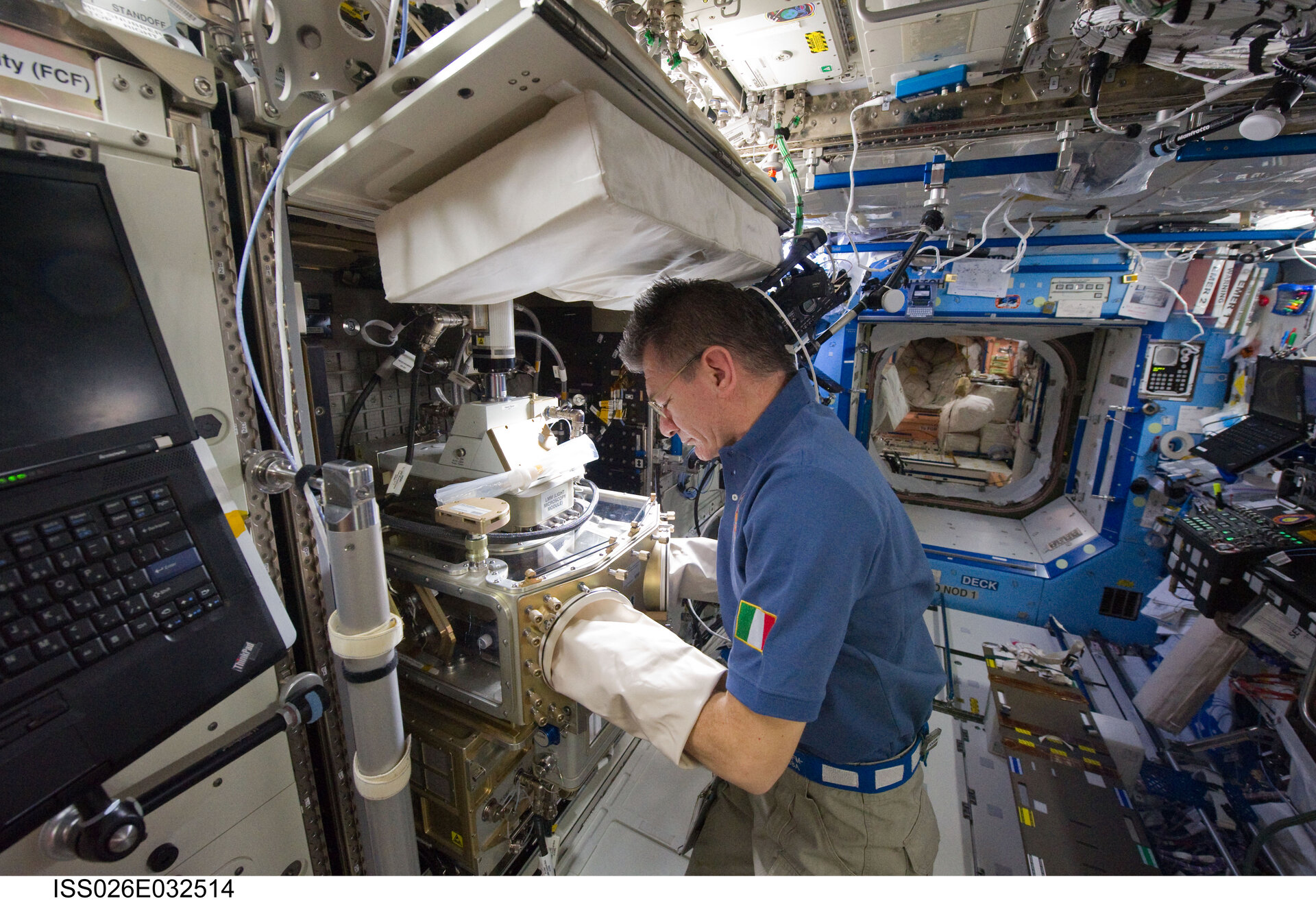
For more than a decade, scientific research performed on the International Space Station and other microgravity platforms has pushed the boundaries of science beyond earthly limits and provided new knowledge that is improving our future.
From medicine including cardiology, neuroscience, osteology and immunology to geophysics, space sciences, biotechnology, astrobiology and education, scientists worldwide are using space to obtain results not possible on Earth.
Thomas Reiter, ESA's Director for Human Spaceflight and Operations, describes some of the benefits of orbital science and plans for a 2012 global symposium on space research.
Q: Now that the Station is complete, will orbital research finally start?

TR: It will continue, not start — even during the Station construction phase, astronauts have been very active conducting a large number of scientific experiments and demonstrating future technologies.
By mid-2011, 215 sets of results from specific payloads had already been published, supported by dozens of reviews, additional publications and issued patents related to Station science and future exploration technologies.
Q: Is there a good example of orbital science helping researchers on the ground?
TR: Osteoporosis is a major public health threat affecting a large fraction of the elderly. The root cause is not fully understood and current treatments deal only with the symptoms.
Q: Is there a good example of orbital science helping researchers on the ground?

Research under microgravity conditions is absolutely vital to help develop an understanding of the causes and new therapies.
This is only one of many areas of human physiology benefiting from experiments conducted in orbit. Others include vaccine development, new uses for ultrasound in diagnostics, delivery of cancer-fighting drugs and increased understanding of muscular dystrophy.
And the benefits extend to many other scientific fields as well.
Q: Where do we go from here?
TR: With assembly of the Station now complete and all laboratories in operation, the international space community has laid solid foundations for research in space for at least the next decade.

It's time to reflect on the future path for research in space. What should future research priorities and goals include? And for Europe, how can we remain competitive and cooperative in a global world?
In May 2012, ESA will convene an international space research symposium in Berlin to review and discuss accomplishments made to date, and debate future directions.
In cooperation with our international partners and other space-faring nations, we want to discuss how space science should develop after 2020 and even after the Space Station.
We hope to see participation from everyone involved in this vital endeavour. The possibilities for research in orbit are wide open. We've really only just begun.
For further information, please contact
Directorate of Human Spaceflight & Operations
Promotion Office
Tel: +31 71 565 5069 or +31 71 565 5413
Sylvie.Ijsselstein@esa.int