Planck first light yields promising results
Preliminary results from ESA’s Planck mission to study the early Universe indicate that the data quality is excellent. This bodes well for the full sky survey that has just begun.
Planck started surveying the sky regularly from its vantage point at the second Lagrange point of the Sun-Earth system, L2, on 13 August. The instruments were fine-tuned for optimum performance in the period preceding this date.
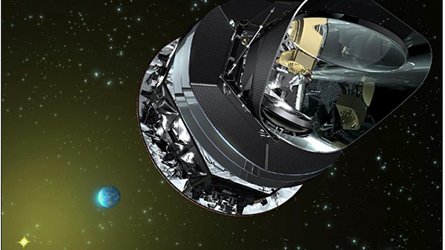
ESA's Planck microwave observatory is the first European mission designed to study the Cosmic Microwave Background – the relic radiation from the Big Bang.
Following launch on 14 May, checkouts of the satellite's subsystems were started in parallel with the cool-down of its instruments' detectors. The detectors are looking for variations in the temperature of the Cosmic Microwave Background that are about a million times smaller than one degree – this is comparable to measuring from Earth the body heat of a rabbit sitting on the Moon. To achieve this, Planck's detectors must be cooled to extremely low temperatures, some of them being very close to absolute zero (–273.15°C, or zero Kelvin, 0K).
With check-outs of the subsystems finished, instrument commissioning, optimisation, and initial calibration was completed by the second week of August.
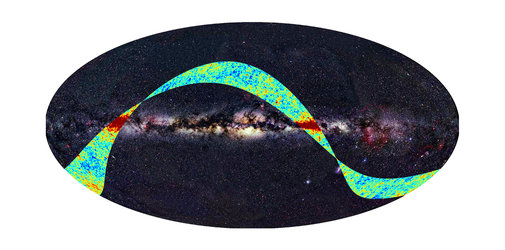
The 'first light' survey, which began on 13 August, was a two-week period during which Planck surveyed the sky continuously. It was carried out to verify the stability of the instruments and the ability to calibrate them over long periods to the exquisite accuracy needed.
This survey was completed on 27 August, yielding maps of a strip of the sky, one for each of Planck's nine frequencies. Each map is a ring, about 15° wide, stretching across the full sky. Preliminary analysis indicates that the quality of the data is excellent.
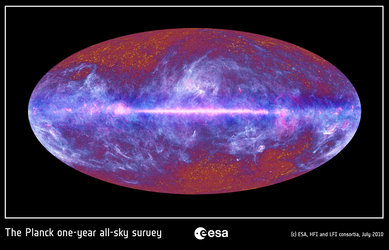
Routine operations started as soon as the first light survey was completed, and surveying will now continue for at least 15 months without a break. In approximately 6 months, the first all-sky map will be assembled.
Within its allotted operational life of 15 months, Planck will gather data for two complete sky maps. To fully exploit the high sensitivity of Planck, the data will require delicate adjustments and careful analysis. It promises to return a treasure trove that will keep both cosmologists and astrophysicists busy for decades to come.
Credits are available in this pdf document on the International Participation in Herschel and Planck.
See the in-depth version for more images and information on Planck's observations, via the links to the right.