

Holiday weather on Mars
ESA's Mars Express is due to arrive at Mars in December 2003, and its Beagle 2 lander will be making a touchdown in the middle of the Martian winter. Will it see a 'white Christmas' on the Red Planet? Also, if humans one day go to Mars, would they need to take a sunscreen?
Over its four-year lifetime, Mars Express will be returning data to refine the latest computer models of the Martian climate. It will be closely watching the clouds, fog, dust devils, and storms, looking for clues to explain the climate changes on Mars, now and in the past, and to better prepare us for future missions.
ESA scientists are already working to make sure that future missions to Mars arrive safely, and that future human explorers know what kind of weather to expect. They have developed a global atmospheric circulation model for Mars, which uses the same principles as those used to predict weather on Earth. Weather data sent back from Mars Express will help us to perfect these Martian weather forecasts.
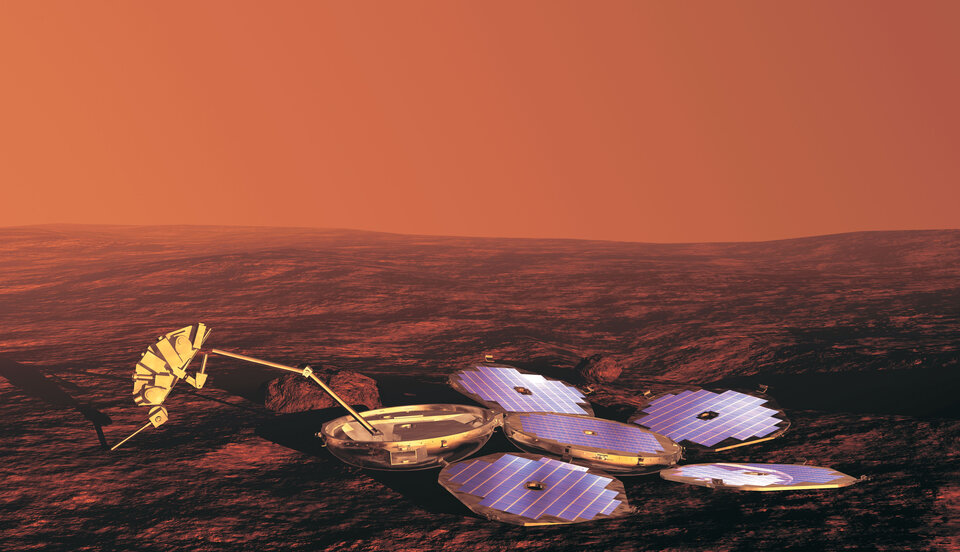
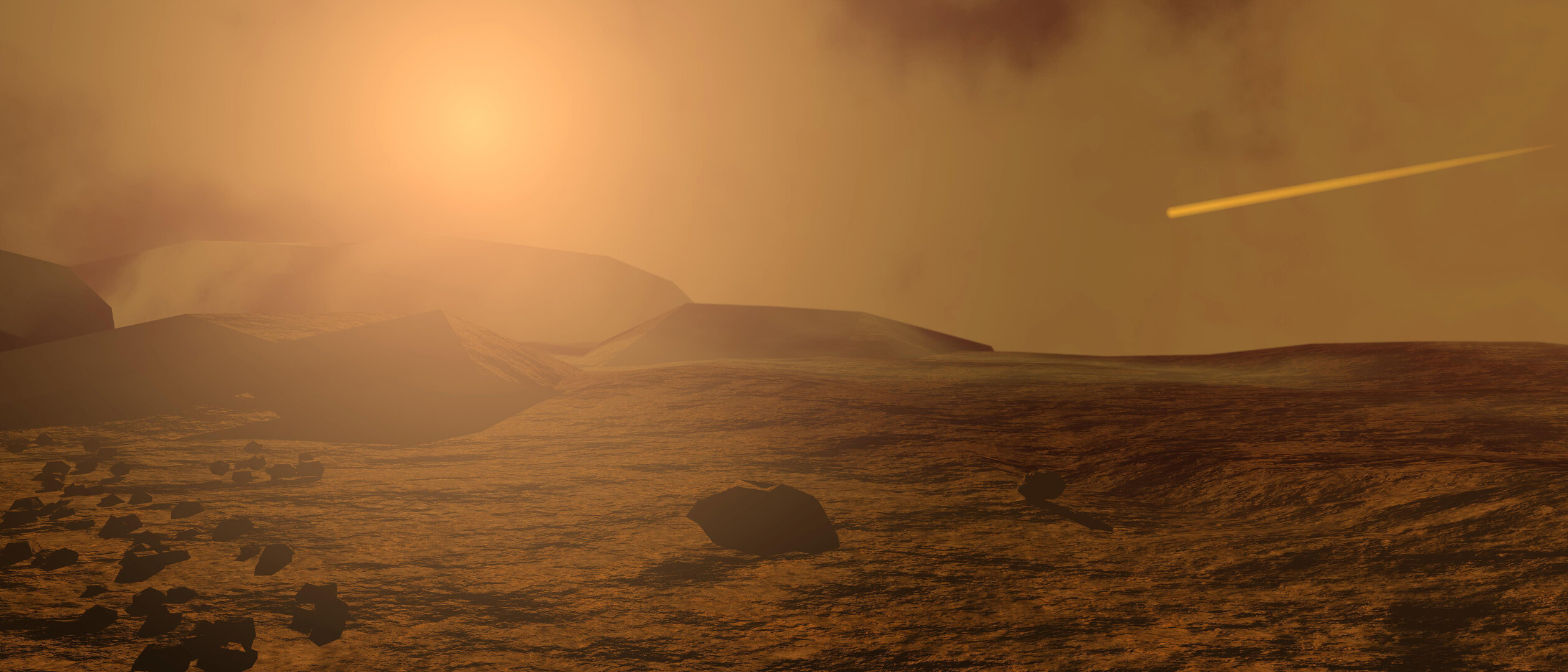
This winter, the weather will be similar to that of the Earth, but colder. Mars Express will experience cold, cloudy mornings and cool, hazy afternoons. Some of the clouds could be made of water-ice crystals, but most clouds are made of crystals of carbon dioxide, or 'dry ice'. Temperatures will fall below –125°C but, because there is not enough moisture in the atmosphere to produce a significant amount of snow, Beagle 2 itself will not see a 'white Christmas'.
One of the main investigations carried out by Mars Express will be the global study of the atmospheric circulation and composition. Its instruments will also search for water, from just below the surface to the upper reaches of the atmosphere. ESA scientists hope that the instruments on board Mars Express will detect the presence of water below the surface, and may answer the question of whether there has ever been life on Mars.

Like Earth, Mars has a summer season too, but this is very different from the heatwaves that many of us are now experiencing in Europe. If you are on vacation, spare a thought for a future holidaymaker on Mars. With maximum temperatures reaching only 0°C, and plunging to –80°C at night, this is as cold as Antarctica in winter.
However, the summer temperatures do melt the carbon dioxide ice that make up the polar ice caps, and the atmosphere gets thicker. This raises the typical air density to about that of Earth's atmosphere at 25 000 metres where only the highest-flying research aircraft have ventured.
However, even this atmosphere is still too thin to protect us from the incoming radiation from space, such as ultraviolet light, X-rays and gamma rays, or charged particles such as protons and electrons. On this dry, cold world, human holidaymakers will have a different set of weather concerns, not least exposure to these harshest elements of space weather.
Unlike Earth, which sits inside a protective magnetic shield called the magnetosphere, Mars does not have a global magnetic field to protect it from solar flares and cosmic rays. Solar protons pose the biggest threat to us because they ionise molecules along their tracks. These can be very damaging when passing through humans and they pose a long-term health risk.
Scientists do not yet know why Mars's magnetic field disappeared about 4000 million years ago. Since then, the solar wind has gradually eroded the Martian atmosphere so that today it is less than 1% as thick as that of the Earth.
With radiation hazards, tissue damage and sunburn, Mars sounds like a dangerous place to go on holiday. You can leave your umbrella on Earth, but remember to take your Geiger counter!

