Envisat concludes a busy second year in orbit
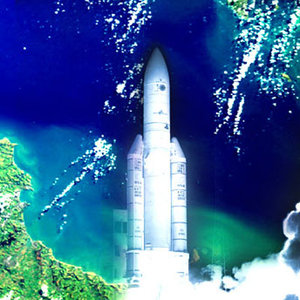
On the last night of February 2002 ESA's Envisat - the largest and most sophisticated Earth Observation spacecraft ever built - swapped the tropical atmosphere of French Guiana for orbital vacuum, as it was shot 800 km into the sky by Ariane 5 launcher.
Two years on this lorry-sized spacecraft operates nominally in the extreme environment of space; it circles the world every hundred minutes at a speed of seven kilometres per second while its ten onboard instruments gather a mass of data about the terrestrial environment.
More than 70 different types of information products derived from Envisat data are now available. Fresh products will add to this number during the coming year, while existing products undergo a process of continuous improvement. The products represent valuable tools for researchers and service providers requiring knowledge about the current state of our planet.
Seeing more of the world

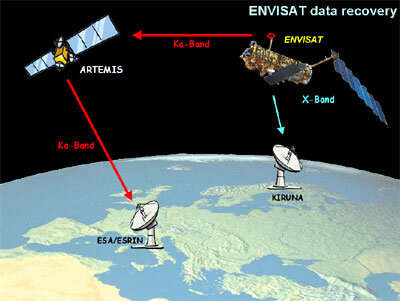
One major development since Envisat's first year occurred last spring when ESA's Artemis telecommunication satellite finally reached its assigned station, in geostationary orbit 36,000 km above the Congo Basin. During its launch in July 2001 Artemis was placed in the wrong orbit, and mission controllers had to spend the next 18 months nursing the spacecraft up to its intended position.
Envisat had always been designed to work in conjunction with Artemis. Without it the amount of data Envisat could return to Earth was constrained by onboard storage limits as well as bottlenecking at the overworked Kiruna ground station in Sweden - even after a back-up downlink capability was added to a neighbouring ground station at Svalbard in the Norwegian Arctic.
By last summer Envisat could relay data via Artemis to ESRIN in Frascati, from which it is processed and distributed to users. The result is that Envisat now returns sufficient data to image the entire surface of the world during each and every orbit.
"We have seen the data returned by the Medium Resolution Imaging Spectrometer (MERIS) in its full resolution mode increase threefold since the summer," says Envisat Mission Manager Henri Laur. "And the data yield from the Advanced Synthetic Aperture Radar (ASAR) instrument has doubled.
"Envisat's ASAR returns four times more data than its equivalent instrument on ERS-2, and in up to 37 different sub-modes. One of the most used modes is called 'ERS-like' because of its ability to extend the ERS SAR archive, and in this mode alone ASAR produces more data than its predecessor instrument."
Overall a total of 140 gigabytes of information products are derived from Envisat data daily, equivalent to 50 terabytes a year – sufficient in paper form to fill the largest library on Earth, the United States Library of Congress, more than two times over. Depending on their size, processed products are disseminated to users either via internet, DVD or CD-Roms, or relayed via communication satellite.
Data use doubled

During the last 12 months the number of projects worldwide making use of this data has more than doubled to 450.
"This number encompasses many different activities and requirements," explains Laur. "Projects range from small scientific teams making use of limited scientific data up to the heavy data demands and dedicated dissemination of systems like those making up the Global Environment for Environment and Security (GMES) Services Element."
The GMES Services Element is the first programme of a joint ESA-European Union initiative intended to enhance global monitoring capabilities to support European policy goals.
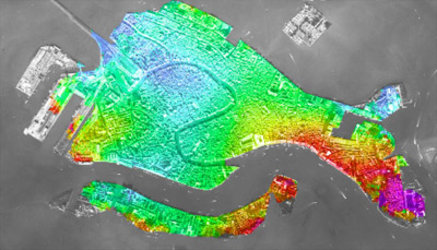
In the longer term the initiative will have its own dedicated missions, but for now the multiple-sensor capability of Envisat plays an important role in supplying GMES services coming on stream with the data they require: from the advance of ice floes in the Canadian Arctic to the damage done by forest fires and subsidence events in city streets.
Mapping the atmosphere in near-real time

In addition, during each and every orbit Envisat instruments provide continuously updated measurements of many of the fastest-changing components of the Earth system. Delivered rapidly to end users, these measurements serve as the basis for a variety of near-real time services.
The swiftest changes of all occur in the atmosphere, but data from Envisat enables regularly updated mapping of the concentration of otherwise invisible trace chemicals in the air. These maps are available to users worldwide over the internet.
As part of the Netherlands-hosted Tropospheric Emission Monitoring Internet Service (TEMIS) Envisat's German-backed SCIAMACHY (SCanning Imaging Absorption Spectrometer for Atmospheric Cartography) sensor routinely supplies data for a daily map of global ozone thickness. Because stratospheric ozone blocks harmful ultraviolet radiation, a four-day ultraviolet radiation forecast can in turn be derived from these results.
The website of the Florence-based Institute for Applied Physics (IFAC) enables researchers to browse atmospheric maps derived from near-real time MIPAS Michelson Interferometer for Passive Atmospheric Sounding (MIPAS) results. Users can specify the time, chemical species and atmospheric altitude they wish to see.
"The site enables us to visualise our analysis of MIPAS data in different ways as needed," explains Bruno Carli of IFAC. "It started as an internal tool for our monitoring work as part of the quality working group for MIPAS level 2 data, but it is now accessible to everyone."
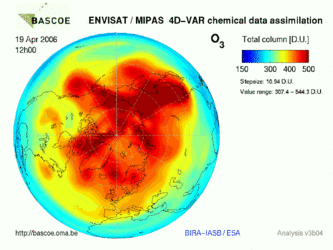
Another near real website service called Belgian Assimilation System of Chemical Observations from Envisat (BASCOE) assimilates MIPAS data as well, forecasting the chemical concentration of ozone as well as 56 other chemical species.
Watching ocean waters

Envisat instruments also monitor the ever-changing features of the ocean surface. These observations that help to make other near real time services possible, including a French system called Mercator Ocean that provides analysis and forecasts of ocean circulation around Europe for up to a fortnight ahead.
The service has a variety of users, from oceanographers to competitive yachtsmen, and is the French contribution to the international Global Ocean Data Assimilation Experiment (GODAE) initiative, intended to create a real time four-dimensional planetary ocean current model.
Mercator makes use of near real time results from Envisat's Radar Altimetry-2 (RA-2), which bounces thousands of radar pulses each second off the sea surface in order to detect ocean eddies and currents.
"Our model for forecasting has a maximum five km mesh size, which is demanding in terms of computing power, but which we need to resolve surface features like major currents and see their meanders," says Pierre Bahurel, Director of Mercator Ocean. "It is also demanding in terms of observations, to keep the model corresponding to actual conditions.
"That is why space-based altimeters are so important, because they give us a continuous supply of data to assimilate. The different satellites we rely on compliment each other, so, while the French-American Jason-1 has a more frequent revisit time, Envisat has a higher spatial resolution.
"We are also working to assimilate further Envisat products into our model, such as near-real time sea surface temperature measurements taken by the Advanced Along Track Scanning Radiometer (AATSR)."
RA-2 ocean wave height data – plus Envisat ozone measurements - gets assimilated operationally into the ten-day forecast model of the European Centre for Medium-Range Weather Forecasts (ECMWF), with plans to make additional use of ASAR wave mode in future.
ASAR homes in on earthquake zones

The improved amount of data returned by Envisat has improved the global reach of the spacecraft's imaging instruments. Near real time ASAR products are currently put to numerous uses including iceberg monitoring and ship tracking.
And the archive of ASAR imagery has grown greatly, which can be 'mined' for many other applications. For example, part of Envisat's 'background mission' has involved prioritising acquiring images of the 15% or so of the planet's land surface classed as seismically active.
The policy paid off in the aftermath of the tragic Bam earthquake that took place in Iran in December 2003. Before and after images of the quake zone were successfully merged using a technique called radar interferometry to identify very tiny ground movements occurring between acquisitions, allowing geologists to work out the location and extent of the subsurface fault responsible.
MERIS tracks algae blooms

Meanwhile regularly updated MERIS images of the Southern Ocean off the coast of Chile are being used together with AATSR sea surface temperature products to identify and forecast the distribution of potentially hazardous algae blooms.
MERIS is an ocean colour sensor optimised to detect chlorophyll pigments in the water – an indication of the presence of microscopic organisms called phytoplankton. In certain conditions the growth of these organisms 'blooms' out of control.
Interest in bloom tracking goes beyond the purely scientific, because some species of algae contain toxins that can poison marine life as well as any humans that eat them. Alternatively algae blooms can exhaust water of oxygen, suffocating larger fish.
Fish farms are particularly vulnerable to algae blooms because the fish cannot flee affected areas. In the past algae blooms have caused millions of Euros worth of annual losses to the 360 fish farms found in the southern region of Chile.
The country's national fish farming association, Salmon Chile, has co-founded a pilot scheme with oceanography firm Mariscope Chilena to investigate the feasibility of an operational satellite early warning service for algae blooms.

"Since the end of last year, high concentrations of phytoplankton have been measured from in situ water samples and online detectors, as well as with remote sensing," says Dr Cristina Rodríguez-Benito of Mariscope Chilena. "MERIS images demonstrated the presence of blooms from the middle of December.
"Some show intense patches in several areas, indicating the blooms do not only originate locally but may be influenced by meso-scale phenomena. The blooms are already affecting some of the main aquaculture companies and losses of fish have started."
Salmon were found starved of oxygen within their cages off the big island of Chiloé. In addition, more than four hundred people were reported poisoned by contaminated shellfish.
"Beyond our current scientific study, the next step would be to secure delivery of near real time products within 24 or 48 hours after satellite acquisition for integration into an operational and commercial service."
Images of the year
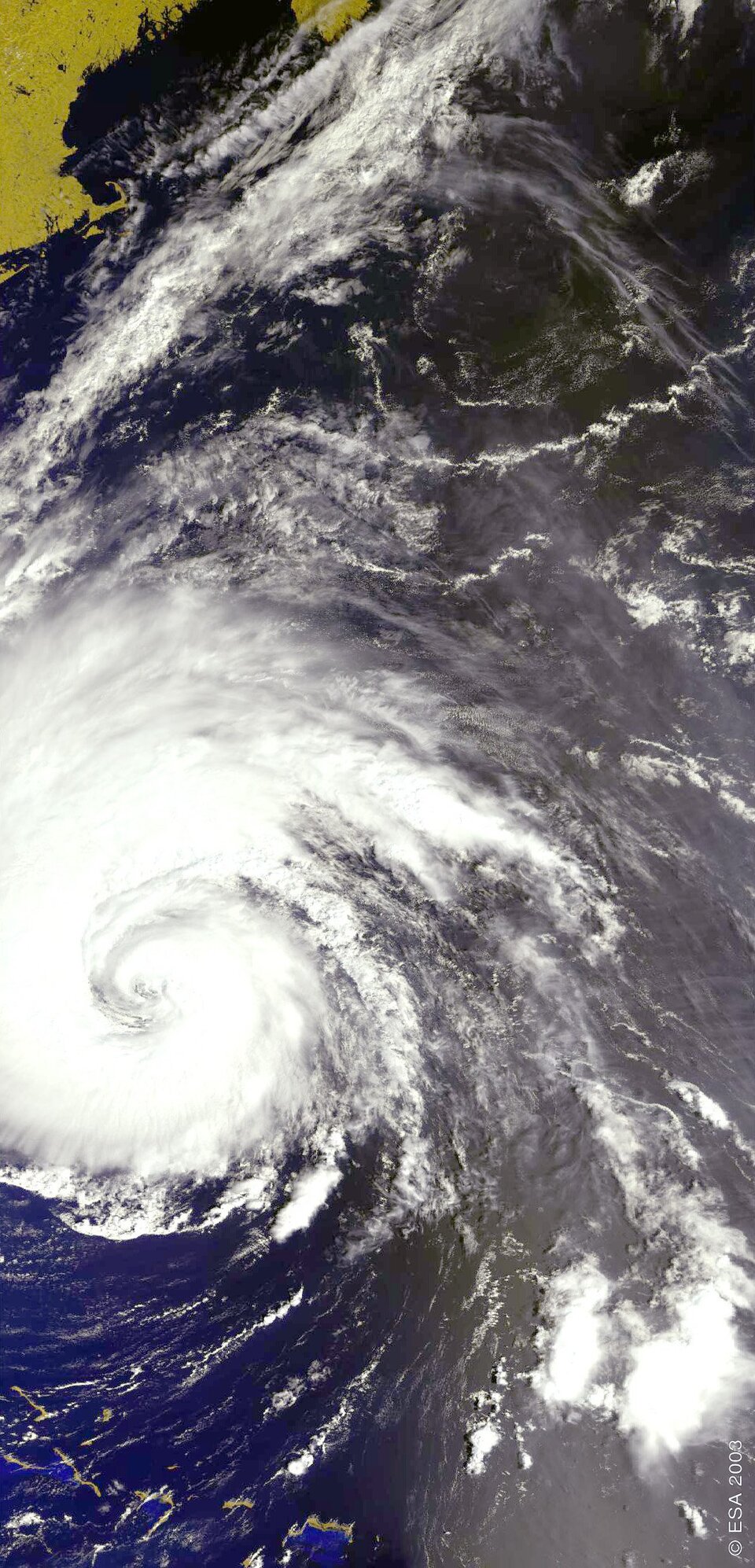
Throughout the last year Envisat has been returning a steady stream of striking images and scientific data showing the ever-changing face of our planet. Some of the most memorable results of the year include:
The splitting of the gigantic B-15 iceberg off the Antarctic coast, captured by a sequence of ASAR images as it was ripped in two by winter storms.
In September MERIS acquired Hurricane Isabel looming up on the United States coast, while sister satellite ERS-2 mapped the wind fields powering the storm.
During Europe's long hot summer of 2003 Envisat's Advanced Along Track Scanning Radiometer (AATSR) showed the Mediterranean 'hot flush' that occurred as a result.
In the aftermath of the worst Portuguese forest fires for two decades, MERIS images mapped burn scar areas, quickly quantifying the overall scale of damage done.
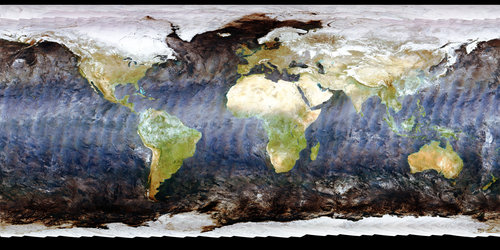
- MERIS imagery showed the current state of the fast-shrinking Aral Sea in Central Asia, as well as producing a spectacular composite image of the entire planet Earth.