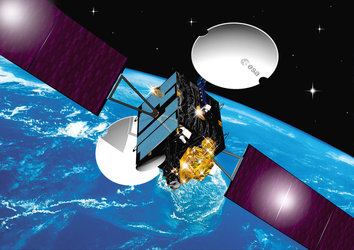
ESA's Artemis satellite reaches geostationary orbit - from total loss to full recovery
ESA INFO 04-2003. In the late afternoon of Friday 31 January, a final trim manoeuvre nudged Artemis into its assigned position in geostationary orbit, completing a most remarkable satellite recovery operation which has lasted 18 months.
The unusual route taken by Artemis to get to geostationary orbit was long and hard, and beset with unfamiliar problems. But the mission was saved by the skills of a dedicated team of engineers and other specialists from the European Space Agency, Alenia Spazio, the prime contractor, Telespazio, responsible for satellite operations at the Fucino control centre, and Astrium, which designed the ion propulsion system, and by the use made of this experimental system, which had not been designed for such a task. The ion propulsion system – originally on board Artemis to control small motion around its nominal position – was the key to climbing the final 5000 km to reach geostationary height.
Due to a malfunction in its upper stage, Ariane 5 left ESA's telecommunications satellite Artemis in a lower than intended elliptical orbit. The apogee (maximum distance from Earth) was only 17 487 km, far short of the targeted geostationary transfer orbit with an apogee at 35 853 km. A team of ESA and industry specialists responded vigorously with a series of innovative control procedures to rescue the spacecraft. Daring manoeuvres were executed and these proved not only very successful but also highly efficient. Using almost all of the available chemical propellant, Artemis managed to escape the orbit in which it had to contend with the deadly Van Allen belts and safely reach a circular orbit at an altitude of 31 000 km only a few days after launch.
A long haul to geostationary orbit
Since then, the rescue efforts have continued unabated using the four ion engines mounted on the satellite redundantly in pairs. These novel engines, instead of conventional chemical combustion engines, use ionised Xenon gas. They were originally designed only to control the satellite's inclination by generating thrust perpendicular to the orbital plane. The rescue operation however required thrust to be generated in the orbital plane to push the satellite to final geostationary orbit. This could be realised by rotating the satellite in the orbital plane by 90 degrees with respect to its nominal orientation.
Taking optimum advantage of the spacecraft flight configuration, new strategies were developed not just to raise altitude but also to counter the natural increase in orbital inclination. To implement those new strategies, new onboard control modes, a new station network and new flight control procedures had to be put in place.
The new concept for steering the ion propulsion engines included entirely new control modes never before used on a telecommunication spacecraft, as well as new telecommand and telemetry and other data-handling interface functions. In all, about 20% of the original spacecraft control software had to be modified. Thanks to the reprogrammable onboard control concept, these modifications could be loaded by uplinking to the satellite software "patches" amounting in total to 15 000 words, the largest reprogramming of flight software ever done on a telecommunications satellite.
By the end of December 2001 work on the new software had been completed, and it was subsequently validated using the spacecraft simulator as testbed. With the characterisation of the four engines all preparatory activities were completed and on 19 February 2002 the orbit-raising manoeuvre was started using only the ion propulsion system.
From the start of orbit-raising operations spacecraft controllers had to respond to many kinds of unforeseen situations, since the new strategy could only be tested realistically on the spacecraft itself. Unlike traditional pre-flight acceptance testing, no testbed is available to replicate exactly the current scenario.
Thanks to the extreme flexibility and the redundancy inherent in the system design, steady progress in the orbit-raising process was maintained, albeit at a lower rate than would theoretically be possible. Artemis - through dogged operation of its ion engines with their very modest thrust of only 15 milli-Newton - climbed on average at a rate of 15 km per day: like a small boat with one propeller pushing a big cargo ship!
Payload tests and performances
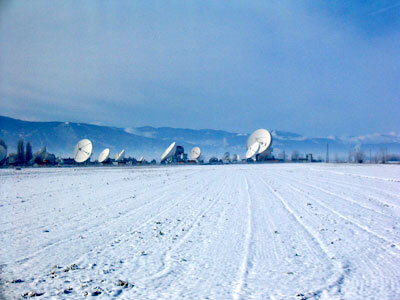
Several months passed between arrival in the parking orbit and commencement of orbit-raising manoeuvres. That time was used to carry out commissioning and payload performance verification. In November/December 2001 payload tests were performed. These tests could only be done every fifth day, when the Artemis feeder link antenna beam "illuminated" ESA's test station in Redu (Belgium). Further constraints arose from the fact that some payload frequencies can be used only when Artemis is at, or close to, its nominal orbit position.
Nevertheless, enough opportunities were found to demonstrate that all payloads (S-band and Ka-band and optical data relay, navigation and L-band mobile payload) were available and that their performance was in line with pre-launch results. In other words, that they fully complied with specifications.
Correct operation of the closed-loop tracking system for the Ka-band inter-orbit antenna was also demonstrated. The antenna acquired a signal transmitted from Redu and maintained the link automatically while Artemis drifted slowly across the sky.
World premiere even before Artemis reached its working position

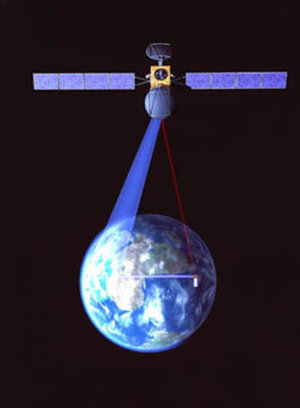
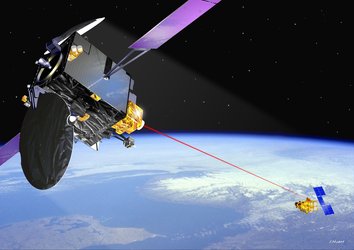
The most spectacular event was the demonstration of SILEX operations. Following successful initial commissioning using ESA's optical ground station on Tenerife, the optical link was established between Artemis and SPOT 4. On 30 November 2001, for the first time ever, image data collected by a low-flying spacecraft were transmitted by laser to a (quasi-) geostationary satellite and from there to the data processing centre in Toulouse.
In total, 26 attempts were made to establish the optical link and all 26 were successful. The link was never lost before the preprogrammed point in time. Link quality was almost perfect: a bit error rate better than 1 in 109 was measured. This means that 1 bit at most is received erroneously per 1 000 000 000 bits transmitted.
Ion propulsion to the rescue
After the hectic and exciting orbital recovery operations in the days after launch, it was not easy to come to terms with the incremental progress provided by the ion propulsion, and for those not involved in the satellite operations it must have seemed a monotonous and uneventful activity. Nothing could be further from the truth for the operators and engineers responsible for maintaining a steady rate of climb.
Since the new attitude control mode was commissioned in February, and the ion engines started to expand the orbit with an almost imperceptible thrust, the workload has been gruelling and almost every week has brought new problems to be solved. Although generally minor, these anomalies needed investigation and sometimes resulted in an interruption in effective thrusting, slowing progress.
In addition to careful monitoring and optimisation of the ion engine's performance, the operators explored several different attitude control techniques to orientate the spacecraft for the most efficient use of the impulse from the ion engines. The planning and sequencing of satellite mode changes, including regular updating of critical parameters, and the management of ground station contacts involved steady but considerable background tasks.
In October the satellite left the third and final eclipse season since its launch. During eclipse the Earth's shadow hides the sun for some two hours each orbit and for reasons of power and attitude control the satellite has to be commanded from thrust mode to earth-pointing mode and the ion thrust turned off. These manoeuvres cost time and effort.
Final operations

With these difficulties behind them, the operators turned their attention to planning for the process of station acquisition in the geostationary orbit and initial operations on station.
At altitudes only a few hundred kilometres below the geostationary ring, it takes several weeks for the satellite to drift once around the Earth. It is therefore important to avoid overshoot by tuning the drift rate to arrive at the designated station longitude (21.5 degrees East) just as the geostationary altitude is reached.
These orbital adjustments were made using small chemical propellant thrusters, activated for the first time since launch. The first thrust was performed successfully in December and two more in January, slowing the drift rate to a few degrees/day as the satellite made its last pass over Europe to arrive at its working position in geostationary orbit.
When the last manoeuvre was performed on 31 January it was an emotional moment. From the attitude control mode which had sustained the ion thrusting for so long, the satellite was turned to point to earth for normal operations and the ion thrusters themselves were the toast of the day. Ground controllers were able to stand down the network of ground stations around the world that had helped in commanding the satellite.
Now on station, Artemis will function as originally planned and there is sufficient chemical propellant for 10 years’ operation.
Artemis arrives on station just when a significant community of users is waiting for it. During its first few weeks in nominal orbit, an exhaustive check-out of the Artemis payloads has taken place using the In-Orbit Test facilities at Redu, Belgium. All payloads are performing well and the first optical link with SPOT-4 has also been established.
The satellite can now be made available to serve its first users: SPOT4, Envisat, EGNOS and Eutelsat/Telespazio. A preparatory test will also be made with NASDA’s Earth observation mission ADEOS-II. Other users planning to use Artemis in future include ESA's Automated Transfer Vehicle and Columbus elements of the International Space Station.
Not only has Artemis clocked up a number of unique first-time applications during its recovery action - first optical inter-orbit satellite link; first major reprogramming of a telecommunications satellite; first orbital transfer to geostationary orbit using ion propulsion; longest ever operational drift orbit - but it will provide the promotional opportunity and stimulus for future European data relay services. A promising future for this incredible mission!
For further information, please contact:
Gotthard Oppenhäuser
Artemis Project Manager
ESA/ESTEC
Phone: 00 31 71 565 3168
Fax: 00 31 71 565 4093
e-mail:gotthard.oppenhauser@esa.int
ESA Media Relations Service
Tel: +33(0)1.53.69.7155
Fax: +33(0)1.53.69.7690