Notes for editors
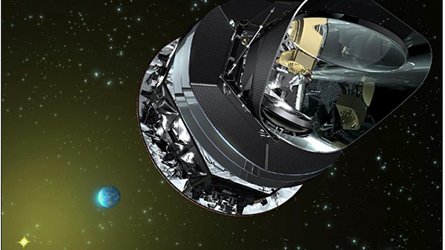
Planck is a mission of the European Space Agency (ESA), which has managed the project since its inception in 1993 and funded the development of the satellite, its launch, and its operations.
ESA's prime industrial contractor for Planck was Thales Alenia Space (Cannes, France). Industry from all over Europe has contributed to the development of Planck. Especially notable contributions to the development are due to Thales Alenia Spazio (Torino, Italy) for the Service Module, Astrium (Friedrichshafen, Germany) for the Planck reflectors, and Oerlikon Space (Zürich, Switzerland) for the payload structures.
Much of the most challenging cryogenic and optical testing has been carried out at the Centre Spatial de Liège in Belgium and on the premises of Thales Alenia Space in Cannes.
Two large international Consortia, comprising a total of around 50 scientific institutes within Europe and North America, and funded by agencies from the participating countries, have each brought outstanding know-how to the development of the Low Frequency Instrument (LFI) and the High Frequency Instrument (HFI). Details can be found on the following web sites: LFI and HFI.
Important industrial contributions to the instrument development are due to Thales Alenia Space (Milano, Italy) for LFI, and Air Liquide - DTA (Grenoble, France) for HFI.
The Consortia are also responsible for scientific operations of their respective instruments and processing the acquired data. The Consortia are led by the Principal Investigators: J.-L. Puget of the Institut d’Astrophysique Spatiale in Orsay (France) leads HFI (funded principally by CNES and CNRS [INSU, IN2P3]), and N. Mandolesi of the Instituto di Astrofisica Spaziale e Fisica Cosmica in Bologna (Italy) leads LFI (funded principally by ASI and INAF).
NASA has funded the US Planck Project, based at JPL and involving scientists at many US institutions, which has contributed significantly to the efforts of these two Consortia.
A Consortium of Danish institutes, funded by the Danish National Research Council, has participated with ESA in a joint development of the two reflectors for the Planck telescope.
Planck is being operated by a Flight Control Team at the Mission Operations Centre (MOC) at ESA's European Space Operations Centre (ESOC), Darmstadt, Germany.
The Planck Science Office, located at ESA's European Space Astronomy Centre (ESAC), Spain, manages the survey and coordinates scientific operations of the two instruments.
For more information:
ESA Media Relations Office
Tel: +33 1 53 69 72 99
Fax: +33 1 53 69 76 90
Email: media@esa.int
Markus Bauer
ESA Science and Robotic Exploration Communication Officer
Email: markus.bauer@esa.int
Tel: +31 71 565 6799
Mob: +31 61 594 3 954
Jan Tauber
ESA Planck Project Scientist
Email: Jan.Tauber@esa.int
Tel: +31 71 565-5342
Jean-Loup Puget
Institut d'Astrophysique Spatiale
CNRS-Université Paris Sud, France
Email: jean-loup.puget@ias.u-psud.fr
Tel: +33 1 69 85 86 65
Nabila Aghanim
Institut d'Astrophysique Spatiale
CNRS-Universite Paris Sud, France
Email: nabila.aghanim@ias.u-psud.fr
Tel: +33 1 69 85 86 46
Clive Dickinson
Jodrell Bank Centre for Astrophysics
University of Manchester, U.K.
Email: Clive.Dickinson@manchester.ac.uk
Tel: +44-(0)161-275-4232