ESA highlights online games as key future technology
Video gaming has become one of the globe’s most popular pastimes. Fans say games are often educational, their detractors answer they are anything but. Might ESA have something to learn from gaming? A new Agency study says the answer is yes.
It comes from ESA’s Technology Observatory, which is tasked with scanning non-space sectors to look for developments with potential for spin-in or joint research. The study, Online Game Technology for Space Education and System Analysis, looks at potential applications of different online game-playing technologies from the simplest content-oriented games through to Massively Multiplayer Online (MMO) virtual worlds.
The study highlights a number of ways in which these technologies could benefit ESA aims: immersive environments based on these technologies could enhance collaborative working of project scientists and engineers. It was also recognised that exciting online games could prove an excellent tool for promoting space and supporting the teaching of science, technology, engineering and maths.
As part of the study, a video of a potential future game environment was produced, showing future human exploration of Jupiter’s ice moon Europa.
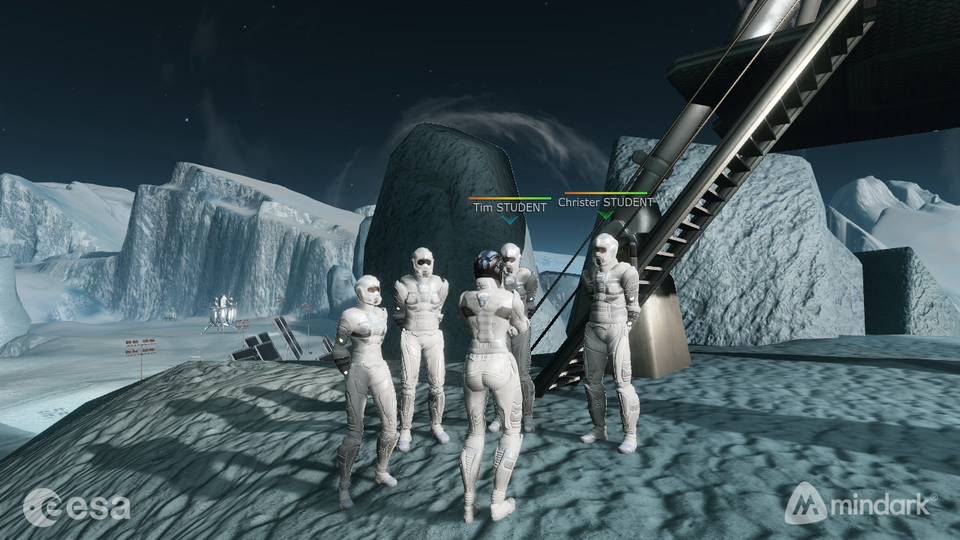
Secondary school and university students are considered as the natural target audience of such ‘exploratory learning environments’, being already familiar with the interaction principles involved. But other important groups are also recognised: educators, members of the public without any previous interest in space, space professionals, parents of student and, of course, current games players.
The study shows that games could be valuable to educators who want to learn more about the space industry, and be in a better position to support students. Simulation games designed as information tools and meeting places could be used to inform and attract potential future space professionals.

ESA would need to establish partnerships with other stakeholders before the use of online games technology becomes practical reality. The study recommends looking into public-private partnerships which would be self-financing, enabling online games operators to invest in development, support and game content, building upon technical and scientific expertise provided by ESA. Widespread consultation concerning the design and promotion of any potential product would be required for such an initiative to become a successful educational tool. ESA experts and representatives would need to involve parents and educators, national space agencies and industrial contractors.
Study background
The study has been undertaken by MindArk PE AB of Sweden, a company providing technology platforms for the development and operation of MMO games. Funding was provided through ESA’s General Studies Programme (GSP) and the study initiated by the Software Systems division of ESA’s Technical and Quality Management Directorate.
The GSP interfaces in various ways with all ESA programmes, but its main role is to act as a ‘think-tank’ to lay the groundwork for future Agency activities. By proposing this study within GSP, Software Systems sought to investigate the potential use of advanced software technology and platforms in order to prepare for the next generation of engineers entering the space business.