Rosetta's scientific 'first' - observation of Comet Linear
ESA PR 29-2004. ESA's comet-chaser Rosetta, whose 10-year journey to its final target Comet 67P/Churyumov-Gerasimenko started on 2 March, is well on its way. The first phase of commissioning is close to completion and Rosetta has successfully performed its first scientific activity - observation of Comet Linear.
The commissioning activities, which started a couple of days after launch, included the individual activation of all instruments on board the Rosetta orbiter and the Philae lander. This first check-out worked flawlessly and showed that the spacecraft and all instruments are functioning well and in excellent shape.
The commissioning tests also paved the way for Rosetta's first scientific activity: observation of Comet C/2002 T7 (LINEAR), which is currently travelling for the first and only time through the inner Solar System and offered Rosetta an excellent opportunity to make its first scientific observation.
On 30 April, the OSIRIS camera system, which was scheduled for commissioning on that date, took images of this unique cometary visitor. Later that day, three more instruments on board Rosetta (ALICE, MIRO and VIRTIS) were activated in parallel to take measurements of the comet. Although the parallel activation of the instruments was not planned until later in the year, the Rosetta team felt confident that this could be done without any risk because of the satisfactory progress of the overall testing.
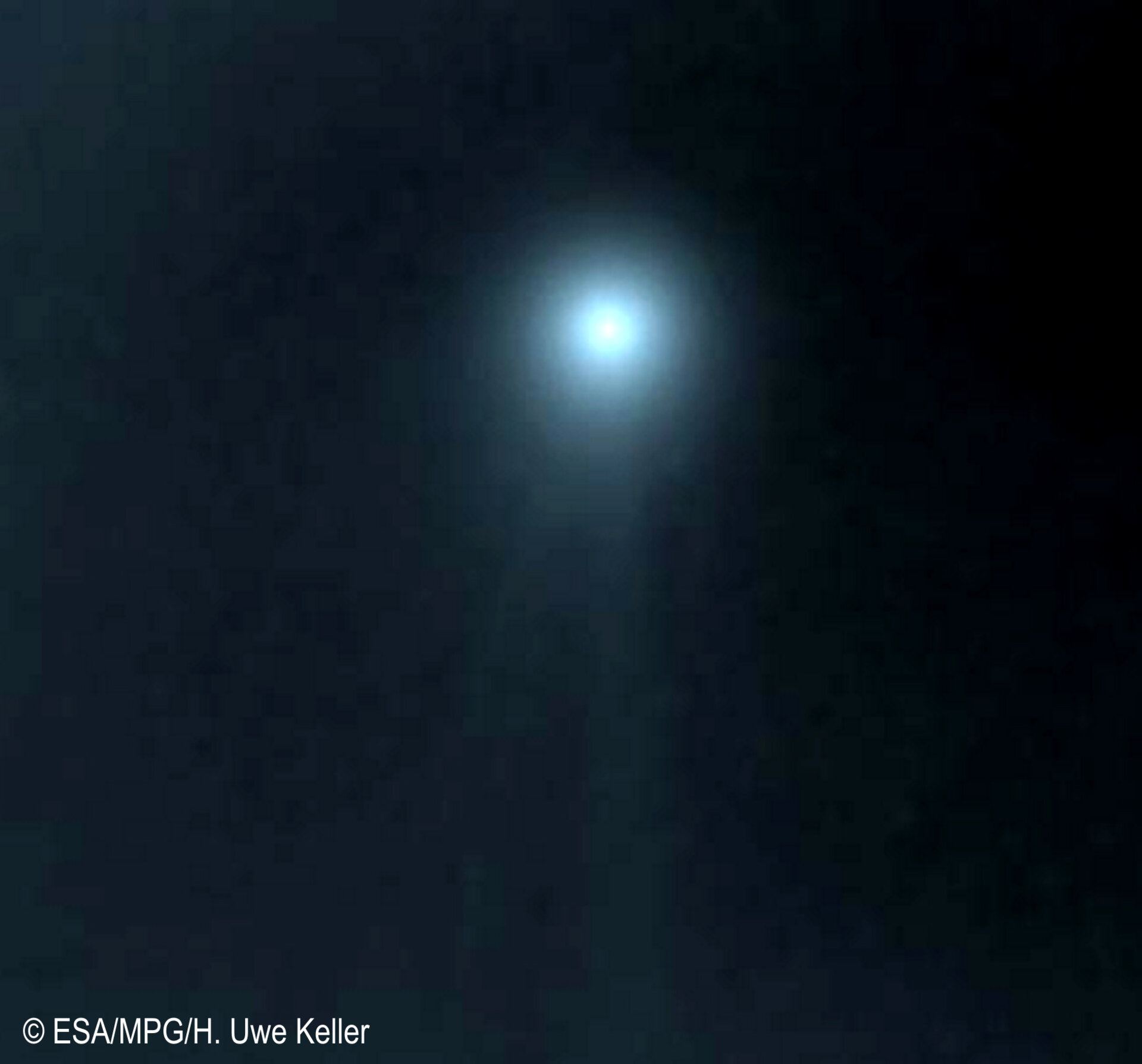
The first data from the remote-sensing observations confirm the excellent performance of the instruments. The four instruments took images and spectra of Comet C/2002 T7 (LINEAR) to study its coma and tail in different wavelengths, from ultraviolet to microwave. Rosetta successfully measured the presence of water molecules in the tenuous atmosphere around the comet. Detailed analysis of the data will require the complete calibration of the instruments, which will take place in the coming months. The OSIRIS camera produced high-resolution images of Comet C/2002 T7 (LINEAR) from a distance of about 95 million kilometres. The image (above) showing a pronounced nucleus and a section of the tenuous tail extending over about 2 million kilometres was obtained by OSIRIS in blue light.

The successful observation of Comet Linear was a first positive test for Rosetta's ultimate goal, Comet 67P/Churyumov-Gerasimenko, which will be reached in 2014. Rosetta will be the first mission to undertake a long-term exploration of a comet at close quarters whilst accompanying it on its way towards the Sun.
The unprecedented in-depth study conducted by the Rosetta orbiter and its Philae lander will help scientists decipher the formation of our Solar System around 4600 million years ago and provide them with clues of how comets may have contributed to the beginning of life on Earth. In particular, the Philae lander, developed by a European consortium under the leadership of the German Aerospace Research Institute (DLR), will analyse the composition and structure of the comet's surface.
After Rosetta's first deep-space manoeuvres were carried out on 10 and 15 May with the highest accuracy, the first phase of commissioning is set to be completed in the first week of June. Rosetta will then go into a quiet ‘cruise mode’ until September, when the second phase of commissioning is scheduled to start. These activities, including the interference and pointing campaign, will last until December.
So the Rosetta spacecraft is well under way on its epic 10-year voyage, to do what has never before been attempted – orbiting and landing on a comet.
Note to editors:
Rosetta was built under the prime contractorship of Astrium Germany, leading an industrial team of more than 50 contractors from 14 European countries and the United States.
For further information please contact:
ESA Media Relations Division
Tel: +33(0)1.53.69.7155
Fax: +33(0)1.53.69.7690