Space Shuttle Columbia - Information Note No. 1
ESA INFO 2-2003. At about 14:00 GMT (15:00 Central European Time), Saturday 1 February 2003, the Space Shuttle Columbia was lost and seven NASA astronauts perished. They were Rick Husband, Mission Commander; William McCool, Pilot; Michael Anderson, Payload Commander; Kalpana Chawla, Mission Specialist; Laurel Clark, Mission Specialist; David Brown, Mission Specialist and the Israeli astronaut Ilan Ramon, Payload Specialist.
The Director General, Antonio Rodotà, and the Director of Human Spaceflight Joerg Feustel-Buechl, have expressed ESA’s condolences to the NASA Administrator and other senior NASA officials and, through them, to the families of the astronauts.
Basic mission facts
Space Shuttle Columbia was launched on 16 January 2003 carrying a Spacehab module for a 16-day scientific mission (STS 107). The mission was conducted at an altitude of 274 km and an inclination of 39o. This was not a mission to the International Space Station Mission, it was an autonomous Space Shuttle mission with no docking to the ISS and no crew exchange.
In a nominal Shuttle re-entry scenario, the re-entry phase starts about one hour before touch down and at some 8000 km from the landing site at the Kennedy Space Center (KSC) in Florida. At that point the Orbiter is at an altitude of about 170 km and is travelling at about 28000 km/h. The Orbiter is put into its correct orientation and reaction control system jets are fired to start the descent.
About 5 minutes later, at an altitude of about 120 km, entry into the upper atmospheric begins with an automatic sequence monitored by an on-board control system. During this phase, between altitudes of 81 and 49 km, a communications blackout occurs, when radio signals cannot penetrate the layer of ionised gas particles surrounding the spacecraft. This phase lasts about 16 minutes.
The whole re-entry phase can either be flown automatically or under crew control.
The re-entry of Columbia on 1 February 2003 was not nominal. At about 14:00 GMT, communications with the Space Shuttle were lost. At this time, the Orbiter was flying over Texas, about 15 minutes from landing and at about 18 times the speed of sound. It was at an altitude of 63 km, about 1400 km from the landing site at KSC.
Video films show the spacecraft following a constant track and apparently slowly disintegrating. Debris is being found over a large area of East Texas and Louisiana, and is being collected.
The NASA Administrator, Mr Sean O’Keefe, has established an Interagency Mishap Investigation Board, which will provide an independent review of the events and activities that led up to the tragic loss of the seven astronauts on Space Shuttle Columbia. A statement has also been made by the Shuttle Programme Manager, Mr Ron Dittemore, addressing the possibility of damage being caused to the wing of Columbia during launch, but is not yet known if this has any bearing on the situation. All data is being safeguarded and, together with the retrieved debris, will be analysed to determine the cause of the accident.
Meanwhile the Shuttle fleet is grounded and, amongst other things, the flight of ESA astronaut Christer Fugelsang, planned for July 2003 on-board Space Shuttle Atlantis, is under review.
International Space Station (ISS)
There are currently three crew on-board the ISS (Commander Kenneth Bowersox, NASA, and flight engineers Nikolai Budarin, RSA, and Donald Pettit, NASA). They were launched on 24 November 2002 on STS 113 (Endeavour) and were scheduled to return in mid-March 2003 on Shuttle Atlantis.
A Russian Progress vehicle (9P) de-docked from the ISS as planned on 1 February, and a Soyuz flight with an unmanned Progress vehicle (10P) has been successfully launched on 2 February at 12:59 GMT, as planned, for a nominal refuel and logistics flight.
There are sufficient supplies (food, water, fuel, etc..) on-board for several months of nominal activities. Soyuz 5S is on orbit as the station lifeboat and is planned to remain there until at least May 2003.
Rosaviakosmos and NASA are currently assessing all necessary ISS and crew re-supply requirements for the coming months and will re-evaluate the manifest of the next flights of Progress (11P, planned for June 2003) and Soyuz (6S, planned for April 2003).
The next crew exchange was planned to be on the March flight of Space Shuttle Atlantis. The next Soyuz flight, planned for 26 April 2003, is planned to be a taxi flight including ESA astronaut Pedro Duque. This flight is now under active review, but in the meantime Pedro Duque, as well as André Kuipers, who is scheduled to fly on Soyuz 7S in October 2003, are maintaining their training programme as planned.
The next several Shuttle missions to the ISS were planned to be a series of five truss/solar array assembly flights following an MPLM logistics flight, leading to the launch of Node 2 in February 2004. The effect of the Columbia tragedy on this sequence and schedule will be evaluated over the next weeks.
ESA payloads on board the mission
The Space Shuttle Columbia carried the Spacehab Research Double Module with seven ESA payloads with a mass of 600 kg and representing approximately 25% of the payload in the Shuttle middeck and in Spacehab.
All payloads performed well during the 16-day mission. However, for the following group of four biology and protein crystallisation research instruments, no scientific results will be available as no samples or electronic data can be provided to the Investigators for analysis:
- Advanced Protein Crystallisation Facility (APCF): included 38 experiment containers. Data were recorded on a digital tape and the scientific results consisted of the processed experiment samples.
- Biobox was related to four experiments. The results of Biobox consisted of processed experiment samples. Only facility telemetry data are actually available which indicate a perfect performance of Biobox.
- Biopack was related to eight experiments. Scientific results of Biopack consisted of processed experiments samples.
- European Research in Space and Terrestrial Osteoporosis (ERISTO) was related to two experiments with 12 experiment samples consisting of human bone cells. ERISTO made use of the OSTEO on loan from the Canadian Space Agency (CSA). Again, the science results were represented by the samples themselves.
For the following group of three research instruments all data are available for further scientific analysis:
- Com2Plex was related to three technological experiments exploring new Loop Heat Pipe designs proposed by Industry. Telemetry data of all experiments indicated already significant improvements of heat transfer capabilities. More detailed analyses of the data will be performed in the future.
- Facility for Adsorption and Surface Tension (FAST) concluded all three experiments during the flight. All information (telemetry and video data) is available for further analysis by three investigator groups.
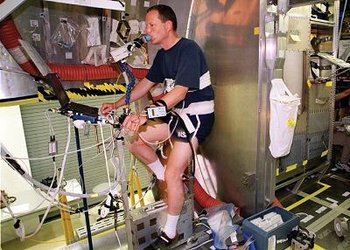
- Advanced Respiratory Monitoring System (ARMS) was related to 7 flight experiments and 1 ground experiment in pulmonary and cardio-vascular research in microgravity. All pre-flight Baseline Data Collection (BDC) information and all flight data are available in electronic form for further analysis by the Investigators.
For further information:
ESA Media Relations Service
Phone: + 33 1 53 69 77 13
Fax: + 33 1 53 69 7690