Second space Christmas for ESA: Huygens to begin its final journey to Titan
Media activities
ESA PR 63-2004. One year after Mars Express’ arrival at Mars, the mighty rules of celestial mechanics have again set Christmas as the date for a major ESA event in deep space.
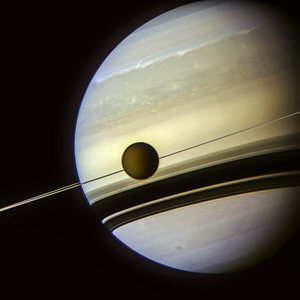
At 1.25 billion km from Earth, after a 7-year journey through the Solar system, ESA’s Huygens probe is about to separate from the Cassini orbiter to enter a ballistic trajectory toward Titan, the largest and most mysterious moon of Saturn, in order to dive into its atmosphere on 14 January. This will be the first man-made object to explore in-situ this unique environment, whose chemistry is assumed to be very similar to that of the early Earth just before life began, 3.8 billion years ago.

The Cassini-Huygens pair, a joint mission conducted by NASA, ESA and the Italian space agency (ASI), was launched into space on 15 October 1997. With the help of several gravity assist manoeuvres during flybys of Venus, Earth and Jupiter, it took almost 7 years for the spacecraft to reach Saturn.
The Cassini orbiter, carrying Huygens on its flank, entered an orbit around Saturn on 1 July 2004, and began to investigate the ringed planet and its moons for a mission that will last at least four years.
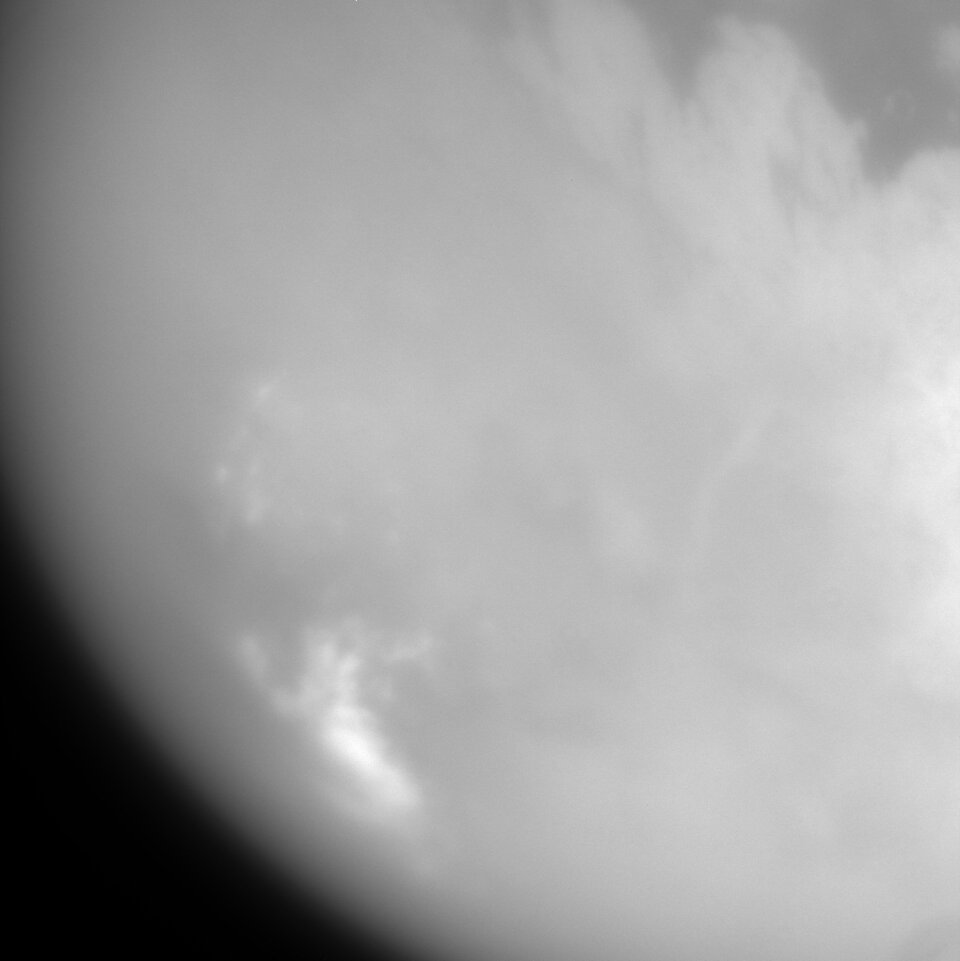
The first distant flyby of Titan took place on 2-3 July 2004. It provided data on Titan's atmosphere which were confirmed by the data obtained during the first close flyby on 26 October 2004 at an altitude of 1174 km. These data were used to validate the entry conditions of the Huygens probe. A second close flyby of Titan by Cassini-Huygens at an altitude of 1200 km is scheduled on 13 December and will provide additional data to further validate the entry conditions of the Huygens probe.
On 17 December the orbiter will be placed on a controlled collision course with Titan in order to release Huygens on the proper trajectory, and on 21 December (some dates and times are subject to minor adjustment for operational reasons, except the entry time on 14 January which is know to within an accuracy of under 2 minutes) all systems will be set up for separation and the Huygens timers will be set to wake the probe a few hours before its arrival at Titan.
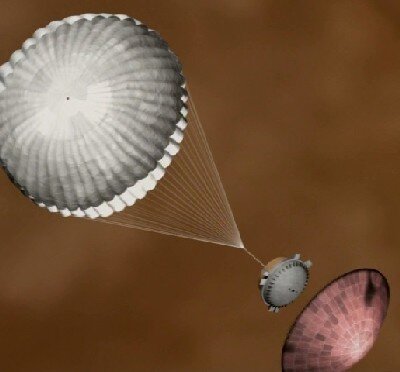
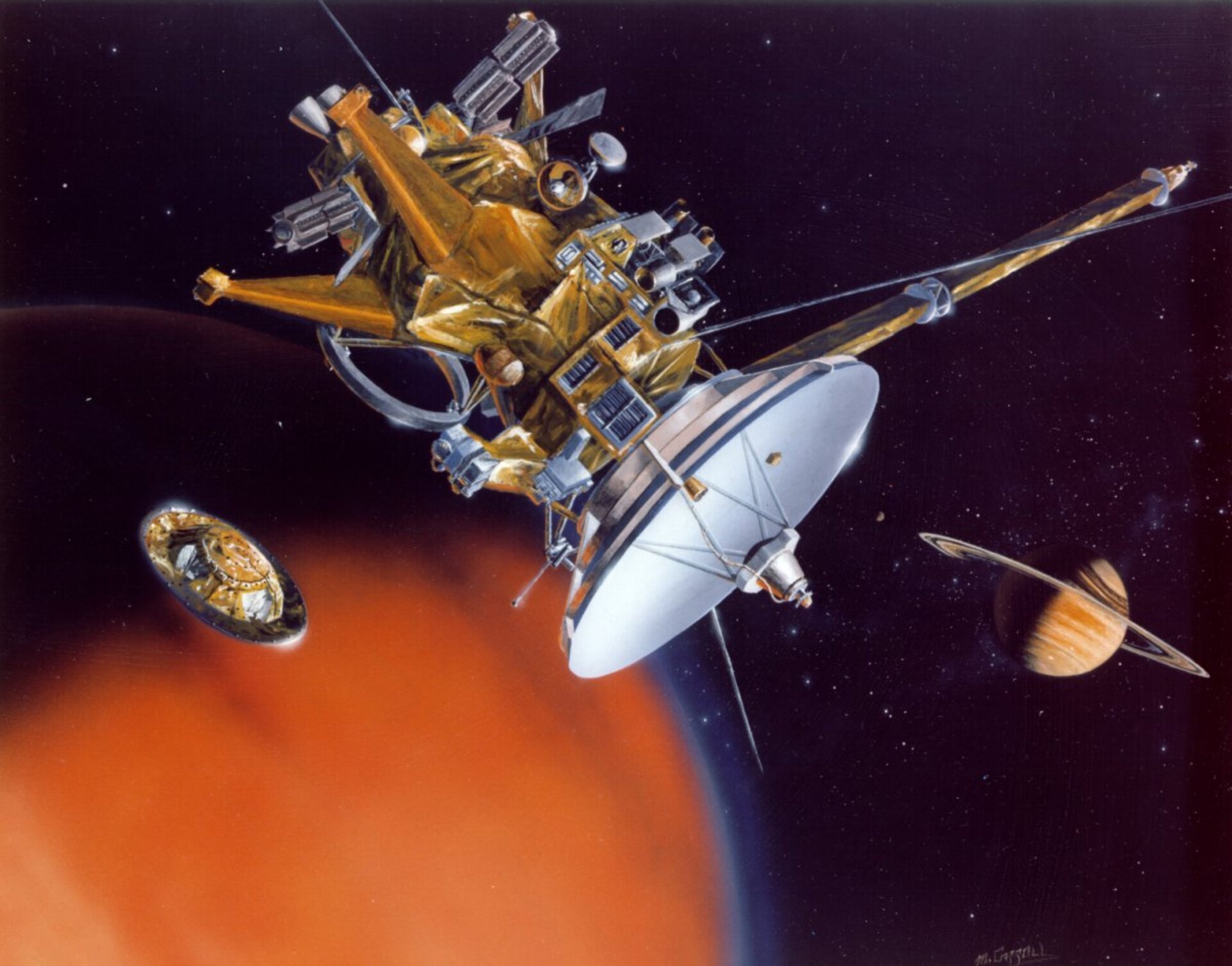
The Huygens probe is due to separate on the morning of 25 December at about 05:08 CET. Since the Cassini orbiter will have to achieve precise pointing for the release, there will be no real-time telemetry available until it turns back its main antenna toward Earth and beams the recorded data of the release. It will take over an hour (67 min) for the signals to reach us on Earth. The final data confirming the separation will be available later on Christmas Day.
After release, Huygens will move away from Cassini at a speed of about 35 cm per second and, to keep on track, will spin on its axis, making about 7 revolutions a minute. Huygens will not communicate with Cassini for the whole period until after deployment of the main parachute following entry into Titan’s atmosphere. On 28 December Cassini will then manoeuvre off collision course to resume its mission and prepare itself to receive Huygens data, which it will record for later playback to Earth.
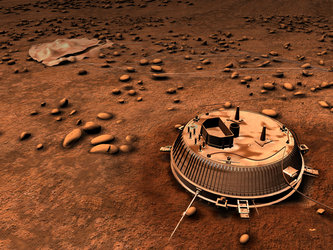
Huygens will remain dormant until a few hours before its arrival at Titan on 14 January. The entry into the atmosphere is set for 11:15 CET. Huygens is planned to complete its descent in about two hours and 15 minutes, beaming back its science data to the Cassini orbiter for replay to Earth later in the afternoon. If Huygens, which is designed as an atmospheric probe rather than a lander, survives touchdown on the surface, it could deliver up to 2 hours of bonus data before the link with Cassini is lost.
Direct radio signals from Huygens will reach Earth after 67 minutes of interplanetary travel at the speed of light. An experiment has been set up by radio scientists that will use an array of radio telescopes around the Pacific to attempt to detect a faint tone from Huygens. If successful, early detection is not expected before around 11:30 CET.
The European Space Agency owns and manages the Huygens probe and is in charge of operations of the probe from its control centre in Darmstadt, Germany. NASA's Jet Propulsion Laboratory in Pasadena, California, designed, developed and assembled the Cassini orbiter. NASA's Deep Space Network, also managed by JPL, will be providing communications support via the Cassini orbiter and relaying it to ESA’s control centre in Darmstadt for processing. The Italian Space Agency provided the high-gain antenna on the Cassini orbiter, much of the radio system and elements of several of Cassini's science instruments. The Huygens payload has been provided by teams including from CNES, DLR, ASI and PPARC, and outside Europe, from NASA.
Practical arrangements for the Media wishing to cover the event
These dramatic events marking the first attempt ever to unveil the mysteries of Titan in-situ, a distant world bigger than Mercury and Pluto which may hold clues to the early days of our own planet, will be marked by several media activities not to be missed. Pencil them into your diary.
Saturday 25 December
Spacecraft operations will be run at NASA’s Jet Propulsion Laboratory (JPL) in Pasadena, California.
The ESA Media Relations Office in Paris will be operational from 04:00 hrs to 12:00 CET. ESA specialists can be reached for interviews and comments via the ESA News Desk on +33(0)1.53.69.71.55.
Contacts: Franco Bonacina, Anne-Marie Rémondin, Roberto Lo Verde.
Interviews from JPL can also be arranged by calling the JPL media relations office at + 1. 818-354-5011.
ESA specialists at JPL: Jean-Pierre Lebreton, Claudio Sollazzo.
05:08 CET - Expected separation of the Huygens probe from the Cassini orbiter
~07:00 CET - Status report upon successful separation from NASA/JPL
10:00 CET at the latest : ESA press release assessing the separation of the Huygens probe
~10:00 CET - ESA TV Video News Release produced at JPL during separation (contact for TVs: Claus Habfast: + 31(0)6.51.18.14.96, claus.habfast@esa.int)
Transmission details will be on http://television.esa.int
12:00 CET - Replay of ESA TV Video News Release on separation
Thursday 13 January
ESA’s ESOC establishment in Darmstadt, Germany, will act as the main European press centre. The Huygens Principal Investigators, the ESA Huygens Mission Manager and Project Scientist will be at ESA/ESOC and available for interviews. If you wish to attend the media activities at ESOC, please return the accreditation form (link on the right).
Press Contacts:
Jocelyne Landeau-Constantin
jocelyne.landeau-constantin@esa.int (+49(0)6151.90.2696)
Bernhard von Weyhe
(+49(0)6151.90.2516).
17:00-17:30 CET - Press briefing at ESA/ESOC Control Centre. Televised on ESA TV - This event can also be followed remotely by phone : +49(0)69.4035.9681.
Friday 14 January
Media briefings originated at ESA/ESOC will also be retransmitted to several ESA establishments and across Europe: Cité des Sciences/ La Villette in Paris (F), (event hosted in coordination with ESA and CNES)
ESA/ESTEC in Noordwijk (NL)
ESA/ESRIN Frascati (I)
ESA/ESAC in Villafranca (E)
Central London (event hosted by PPARC).
ESA specialists will be on hand at the various locations for interviews.
If you wish to attend the briefings at one of these venues, please contact the local Communication services directly.
ESA for Cité des Sciences, Paris (F):
Anne-Marie Rémondin (Anne-Marie.Remondin@esa.int) + 33(0)1.5369.7155
Brigitte Kolmsee (Brigitte.Kolmsee@esa.int), + 33(0)1.5369.7299
ESA/ESTEC,Noorwijk Space Expo (NL): + 31(0)71.565.3006- Wil Spangenberg (Wil.Spangenberg@esa.int)
ESA/ESRIN, Frascati (I): + 39 06 9418 0951- Franca Morgia (Franca.Morgia@esa.int)
ESA/ESAC, Villafranca (E): + 34 91 813 11 00 - Monica Oerke (Monica.Oerke@esa.int)
PPARC, London (UK) : Peter Barratt + 44 (0)1793 44 20 25 (Peter.Barratt@pparc.ac.uk)
ESA TV Broadcast schedule for 14 January 2005
09:00-09:30 CET - ESA TV broadcast - Cassini turns to Huygens - Feeds from ESA/ESOC main Control Room
11:00-12:15 CET - ESA TV Broadcast - Probe activation to parachute deployment and status of tracking by radio-telescope
13:30-14:00 CET - Press briefing at ESA/ESOC: Huygens descent update (possible results from ground radio telescope observations – televised on ESA TV
14:30-15:00 CET - ESA TV broadcast: mission update
16:00-16:30 CET - ESA TV broadcast: mission update
As of 17:15 CET - Press briefing: arrival of first data – televised on ESA TV
23:00-24:00 CET - Press briefing: presentation of first image if available) - Televised on ESA TV
All events can also be followed (audio only) by calling + 49(0)69.4035.9681 and highlights of ESA TV can be watched on the Web at http://saturn.esa.int
Saturday 15 January
11:00-12:00 CET - Press conference at ESA/ESOC: presentation of the first image, sounds, etc. - not broadcast live on ESA TV. This event can also be followed (audio only) by calling + 49(0)69.4035.9681.
A video news release with the highlights will be available on ESA TV for broadcasters immediately at the end of the press conference.
Satellite details for ESA TV broadcast reception:
The ESA TV Service provides live broadcasts of ESA’s most important events on the Astra 2-C satellite, using a digital transponder that enables everyone in the satellite’s footprint, with a digital receiver and a parabolic pointing at 19.2 degrees East, to follow these events.
For more information and updates, please check the ESA TV Website: http://television.esa.int .
On the Web
You can follow all main Cassini/Huygens mission events on the ESA web at: http://saturn.esa.int Bookmark now! If you have not already done so, subscribe to the ESA portal news service at http://www.esa.int/esaCP/subscribers.html
to get the latest news on this fascinating mission directly into your mail box.
Here you will find information on Cassini-Huygens and its status, a rich selection of multimedia material, news on the separation of Huygens from the Cassini orbiter and the latest updates on January 13. There will be continuous coverage during the last exciting hours of the descent on 14 January, with the first image expected late on 14 January or on 15 January.
Messages from earthlings and pop music heading to Titan
Before the mission was launched, ESA offered Europeans a unique opportunity to send a message to the unknown. Over 80 000 people wanted to share the excitement of this mission and wrote or drew a message that was engraved on a CD-ROM put on board the Huygens probe. The same CD ROM carries four pop songs, composed by French musicians Julien Civange and Louis Haéri. More about this project at http://www.music2titan.com
Specific information for media representatives going to ESA/ESOC
Getting there:
The nearest airport is Frankfurt-am-Main and it takes about 20 minutes by taxi to get to ESA/ESOC. A shuttle bus is also available from the airport approximately every 30 minutes. There are also frequent trains (approx. every 40 minutes) from the airport to Darmstadt (one change).
http://www.heag.de/verkehr/02_02.html http://www.bahn.de/pv/view/index.shtml
Accommodation:
Darmstadt has many hotels, ranging in price from € 68 to € 230 (the closest to ESA/ESOC is a 4-star Maritim Konferenz Hotel, in walking distance from the Control Centre). For further information about Darmstadt hotels go to http://www.proregio-darmstadt.de/uebernachten/hotel.asp. If you need help with accommodation, do not hesitate to contact the ESA/ESOC travel office on +49(0)6151.902.885.
Laptops/ Internet/ Cell Phones:
Power supply rating: 220-240 volts (adaptor plug available in most hardware stores or at most international airport shops). Most North American cell phones will not work in Europe unless they are tri-band phones.
Internet via LAN: Standard network connector RJ45 required in laptop.
Internet via analogue modem: Standard RJ11 connector in laptop, special German Telekom TAE connection to the socket.
Internet via ISDN: PCMCIA Card inside Laptop, RJ45 in the wall.
The ESA/ESOC Press Rooms are equipped with ISDN and standard network with RJ45 cable. No wireless LAN is available for the media. Analog lines can be provided if needed.
For further information, please contact:
ESA/ESOC Media Relations:
Jocelyne Landeau-Constantin:
Tel : +49(0)6151.90.2696:
jocelyne.landeau-constantin@esa.int
ESA/HO Media Relations:
Franco Bonacina
Tel : + 33(0)1.5369.7155
Franco.Bonacina1@esa.int
JPL Media Relations:
Carolina Martinez
Tel: + 1 818-354-9382 or + 1 818-354-5011
Carolina.Martinez@jpl.nasa.gov