Planck nos acerca al primer acto de la formación del Universo
ESA PR-3 2011 Los primeros resultados científicos de la misión Planck de la ESA fueron presentados ayer por la mañana en una rueda de prensa en París. Sus descubrimientos nos acercan a los objetos más fríos del Universo, desde el interior de nuestra propia Galaxia hasta los distantes confines del cosmos.
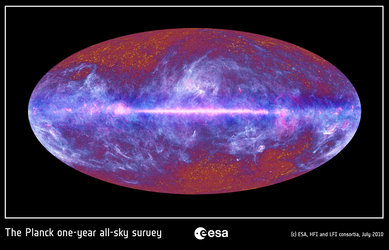
Si William Shakespeare fuese un astrónomo hoy en día, bien podría haber escrito que “El Universo es un escenario, y todas las galaxias meros actores”. Planck nos muestra nuevas imágenes tanto del escenario como de los actores, desvelando el gran drama de la evolución del Universo. En Julio del año pasado vio la luz la primera imagen del cielo completo obtenida por Planck; hoy se han presentado los primeros resultados científicos de la misión, basados en estas observaciones. Estos resultados, condensados en 25 artículos enviados a la revista ‘Astronomy & Astrophysics’ (A&A), han sido presentados por la Colaboración Planck en una importante conferencia científica que se está celebrando esta semana en París.

La mayor parte de los resultados están basados en el catálogo ERCSC - acrónimo inglés de ‘Early Release Compact Source Catalogue’ - de la misión Planck, que en esta analogía jugaría el papel de la lista del elenco.
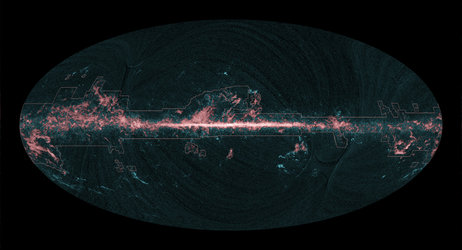
Este catálogo condensa los resultados de la medición continua del todo el cielo realizada por Planck en las longitudes de onda milimétrica y submilimétrica, y contiene información sobre miles de fuentes puntuales de radiación a muy baja temperatura, que la comunidad científica podrá ahora estudiar con más detalle.
“Este es un gran momento para Planck. Hasta la fecha, sólo había recogido datos que demostraban su gran potencial. A partir de ahora, por fin podemos empezar a descubrir los orígenes del Universo”, comenta emocionado Jan Tauber, Científico del Proyecto Planck para la ESA.
Podemos imaginarnos el Universo como si fuese un escenario en el que se representa un gran drama cósmico dividido en tres actos.
Los telescopios de luz visible apenas alcanzan a ver el acto final: el telón de galaxias que nos rodea. Al hacer mediciones en las longitudes de onda comprendidas entre el infrarrojo y radio, Planck es capaz de retroceder en el tiempo y mostrarnos los dos actos anteriores. Los resultados presentados hoy desvelan información inédita sobre el segundo acto, en el que las galaxias comenzaban a tomar forma.
Planck ha encontrado rastros de una población de galaxias que hace miles de millones de años se encontraban envueltas en una gran nube de polvo, en las que se empezaron a formar estrellas a un ritmo de 10 a 1000 veces superior al que vemos en nuestra Galaxia hoy en día. Esta población de galaxias nunca había sido estudiada en estas longitudes de onda. “Este es tan sólo un primer paso, estamos aprendiendo cómo trabajar con estos datos para extraer el máximo de información”, explica Jean-Loup Puget, del CNRS-Université Paris Sud en Orsay, Francia.
Con el tiempo, Planck nos desvelará qué sucedió en el primer acto del Universo: cómo se formaron las primeras grandes estructuras del cosmos, a partir de las que más tarde tomarán forma las galaxias. Se pueden trazar las huellas dejadas por estas estructuras en la radiación del fondo cósmico de microondas, emitida 380 000 años después del Big Bang, cuando el Universo comenzaba a enfriarse.
Sin embargo, para poder observar la radiación del fondo cósmico de microondas como es debido, hay que eliminar primero las interferencias causadas por un gran número de fuentes de radiación que se encuentran en primer plano. Entre estas fuentes se incluyen los objetos puntuales catalogados en el ERCSC, así como varias fuentes de radiación difusa.
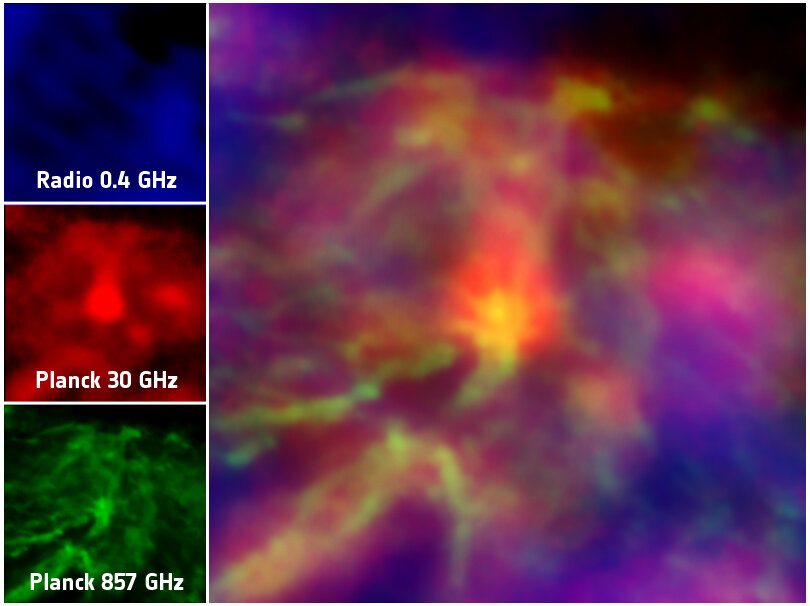
Ayer también se anunció un importante paso hacia la supresión de estas interferencias. La ‘emisión anómala de microondas’ es una emisión difusa comúnmente asociada a los densos cúmulos de polvo interestelar de nuestra Galaxia, pero su origen ha sido un misterio durante décadas. No obstante, los datos recogidos a lo largo del ancho espectro que es capaz de observar Planck confirman la teoría de que esta radiación es emitida por partículas de polvo interestelar girando miles de millones de veces por segundo, como resultado de colisiones con átomos que viajan a alta velocidad o con fotones de luz ultravioleta. Este hallazgo permite eliminar con precisión esta ‘neblina’ de radiación local de los datos obtenidos por Planck, desvelando la radiación del fondo cósmico de microondas en todo su esplendor. “Este fantástico descubrimiento ha sido posible gracias a la excepcional calidad de los datos obtenidos por Planck”, comenta Clive Dickinson, de la Universidad de Manchester en el Reino Unido.
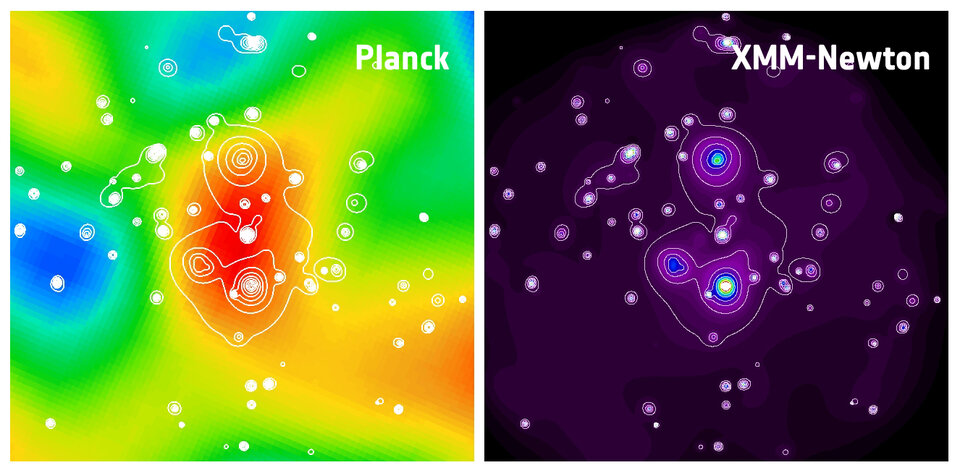
Entre los otros muchos resultados presentados ayer, Planck muestra nuevos detalles de otros actores de la escena cósmica: los lejanos cúmulos de galaxias. Estas formaciones se pueden distinguir en los datos de Planck como unas siluetas compactas, perfiladas sobre la radiación del fondo cósmico de microondas.
La Colaboración Planck ya ha identificado 189 cúmulos, entre los que se incluyen 20 de los que no se tenía constancia previa y que están siendo confirmados por el telescopio de rayos-X de la ESA, XMM-Newton.
En su escrutinio de todo el cielo, Planck puede observar los mejores ejemplos de estos cúmulos. Son muy poco comunes y su número es un buen indicador del tipo de Universo en que nos encontramos hoy en día, a qué velocidad se está expandiendo y cuánta materia contiene.
“Estas observaciones sentarán las bases para construir un nuevo modelo del Universo”, afirma Nabila Aghanim, del CNRS-Université Paris Sud en Orsay, Francia.
“Los resultados presentados hoy no son más que la punta de este iceberg científico. Planck está excediendo cualquier expectativa gracias a la increíble dedicación de todas las personas involucradas en el proyecto”, comenta David Southwood, Director de Ciencia y Exploración Robótica de la ESA.
“Sin embargo, esto no es todo: este catálogo contiene los datos brutos de las observaciones de Planck, que permitirán realizar muchos nuevos descubrimientos. Debemos recordar que aún no hemos llegado al tesoro que estamos buscando: la radiación del fondo cósmico de microondas”.
Planck continúa escrutando el Universo. La próxima publicación de datos se realizará en Enero de 2013, y desvelará la radiación del fondo cósmico de microondas con un nivel de detalle sin precedentes; el primer acto de este drama cósmico, cuando todo comenzó.